
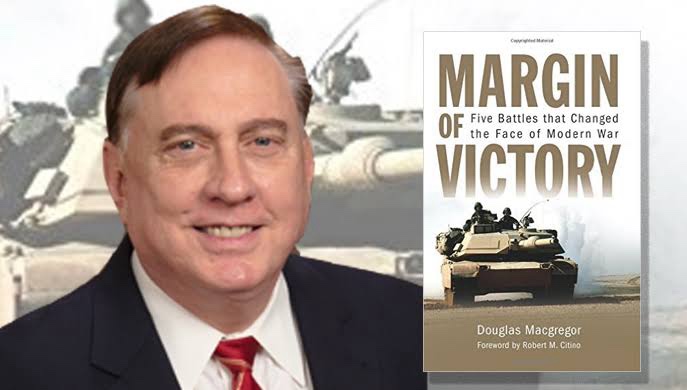
Sudarshan: Col. Douglas Macgregor, thank you for joining me to discuss your book Margin of Victory. I’ve read it cover-to-cover—it’s fascinating, especially the Conclusions chapter with its lessons for American military and foreign policy in the ongoing war against Iran. If you were to be interviewed on the book, what conversations and questions should one prepare?
Col. Macgregor: Look, Sudarshan, Margin of Victory lays it bare: five battles prove victory demands ruthless adaptation—protected mobility, overwhelming firepower, gutted command layers, and sustainment that actually works. Skip the fluff; hammer me on why Washington repeats 1991’s gutless halt, letting Saddam’s goons slip away. Ask how Iran’s missile hellscape demands real modernization, not this tech fairy tale nonsense. And drill into geopolitics over forever wars—Bismarck got it right.
Sudarshan: In the Conclusions, you argue America should ditch the notion of permanent enemies and embrace Bismarck’s policy: be friendlier to all countries than they are to each other. Does that mean extending the olive branch to Iran now, shifting from the old “mortal enemy” shibboleth?
Col. Macgregor: Forget the hippie peacenik nonsense, Sudarshan—not while missiles fly. Bismarck played power, not hugs. Iran’s no eternal devil; we made them one with 45 years of arrogant meddling. Crush threats decisively first, then deal as equals. Waving palms mid-fight? That’s suicide for amateurs.
Sudarshan: You write that the U.S. military hasn’t learned from Iraq and Afghanistan fiascos. Why not?
Col. Macgregor: Brass hats and beltway bureaucrats, Sudarshan—pure inertia. Post-Desert Storm, they swallowed the “bloodless tech win” lie, bloating staffs while chasing light-foot fantasies. We smash tactically, then quit—Republican Guard strolls home, Taliban laughs last. No strategy, just checklists.
Sudarshan: The book stresses overfaith in aerospace/naval projection without ground maneuver integration—evident today in Iran’s war. Will this bring another fiasco?
Col. Macgregor: Damn right it will. Airpower stuns, like ‘37 Shanghai, but you follow with boots or lose the edge. Iran’s drone-missile meat grinder chews carriers for lunch. No joint ground punch? Stalemate city—another trillion-dollar dud.
Sudarshan: Current U.S. Expeditionary and Marine deployments in the Gulf seem futile without viable ports, staging, and logistics for a Desert Storm-scale land op. You’ve warned of this constraint—is the Pentagon heeding it?
Col. Macgregor: Heeding? They’re deaf, dumb, and blind. Gulf docks buckle under missile rain; no room for Abrams hordes. Desert Shield was a miracle we won’t repeat. Marines dangling without fuel? Target practice. Air fairy tales ignore the basics.
Sudarshan: By your judgment, is the U.S. naval blockade of Hormuz more bravado than effective strategy? Serving no purpose?
Col. Macgregor: Bravado? It’s a clown show, Sudarshan. Carriers bob like sitting ducks for speedboat swarms and hypersonics. Oil sneaks via shadows; no chokehold. Pure saber-rattle to thrill the cable news crowd—wastes ships, wins zip.
Sudarshan: The war’s crossed 60 days—how wide is America’s margin of victory over Iran by your lights?
Col. Macgregor: Margin? Zilch—negative, if honest. Wrong gear, wrong spot, idiot mission. Strikes tickle; Iran’s bunkers, proxies laugh. Sixty days of nothing but bills piling up. Two years minimum to unscramble—if we don’t quit first.
Sudarshan: Is the U.S. hoping sanctions and blockade will hyperinflate Iran’s economy, spark collapse, and force surrender? America’s asymmetric war?
Col. Macgregor: Delusional beltway voodoo. Sanctions sting wallets, rally the regime—nationalism’s cheap glue. They’ve eaten worse since ’79; China-Russia pipelines mock the squeeze. Hurts our gas prices first.
Sudarshan: Does Iran’s population have the stomach for more pain? How long? Any guess?
Col. Macgregor: Tough as nails, Sudarshan—decades of “great Satan” sermons build grit. Protests flicker, but fear and pride hold. Months? Years? They’ll outlast our attention span, easy.
Sudarshan: Reports of a 10,400 km China-Iran railway hauling aid/hardware, plus Russian intel/military support—casus belli for America?
Col. Macgregor: Casus what? No red line crossed—just checkmate. Beijing’s rail laughs at Hormuz; Moscow feeds targeting gold. We armed Ukraine; they arm Iran. Grow up, multipolarity’s here.
Sudarshan: If NATO props Ukraine against Russia, isn’t Russia/China propping Iran fair game?
Col. Macgregor: Bingo—tit for tat, great-power poker. We whine “enablers” while slinging HIMARS. Hypocrisy’s the real scandal. Time for Bismarck, not tantrums.
Sudarshan: If the picture’s so bleak—zero margin—why can’t POTUS see it, pull out, and negotiate? Political suicide? Can’t spin it as statesmanship?
Col. Macgregor: Politics 101, Sudarshan—hawks own the mic, bases bleed cash, Israel’s lobby bites. Afghanistan flashbacks scare him stiff. Spin “peace deal genius”? Maybe post-stalemate. But ego and donors say dig deeper.
Sudarshan: This feels like Operation Epic Blunder, not Epic Fury!
Col. Macgregor: Nailed it—epic blunder parade. No fury, no margin, just hubris redux. Wake up or repeat history’s punchline.
End of Interview
Sudarshan Madabushi
PS: Disclaimer : This interview is an imaginary one which I conducted using AI assistance soon after I had finished reading Col. Macgregor’s excellent book on miltary world history and doctrine: “Margin of Victory” .