

By M.K.Sudarshan
June 27 2026: Chennai, India
In Oscar Wilde’s classic novel, “The Portrait of Dorian Gray” (1891), a beautiful young man named Dorian Gray wishes that a painted portrait of himself would bear the physical burdens of his aging, hedonistic lifestyle, and moral decay, allowing his actual body to remain flawlessly young and untroubled. While Dorian pursues a life of consequence-free pleasure, his sins and true degradation are secretly recorded on the hidden, grotesque portrait. This total detachment from moral responsibility ultimately hollows out his soul, leading to a tragic, self-destructive end.
“In our relationship with AI, humanity has become Dorian Gray, and technology is our portrait.”
Just over fifty years ago, as a high school student, I sat down with Oscar Wilde’s The Portrait of Dorian Gray. It was a dark, gothic tale that left me deeply unsettled, though my seventeen-year-old self couldn’t quite grasp its complex themes. To me, it was simply a story about a handsome young man who made a cursed wish to stay beautiful forever while a hidden canvas bore the scars of his aging and sins.
Now, on the cusp of turning seventy, that novel has returned to me. It has brought with it a sudden, quiet epiphany—one that sheds a sharp, disturbing light on the defining phenomenon of your generation’s time: Artificial Intelligence.
When I look at the “Brave New World” rising before your eyes, O Ye Young of the World, I see an immense, understandable excitement. AI promises a world of endless optimization, instant answers, and effortless creation. But looking through the lens of a life lived across seven decades, I cannot help but see a profound structural trap. In our relationship with AI, humanity has become Dorian Gray, and technology is our portrait.
The Accurate Literary Parallel: How the Canvas Maps to AI
“Like an unused muscle, our capacity for deep attention and critical thought begins to wither when we hand our cognitive labor to a machine.”
To understand the depth of this trap, we must look closely at how Wilde’s masterpiece maps onto 21st-century technology. In this modern allegory, humanity is Dorian Gray, and AI is the portrait.
- The Bargain for Eternal Youth (The Seduction of Convenience): Dorian is seduced by a philosophy of pure pleasure and wishes the painting would bear the burden of his existence so his physical body can remain flawlessly untroubled. Similarly, humanity is seduced by frictionless living. We wish for AI to bear the burden of our cognitive labor—the grueling work of thinking, analyzing, remembering, and organizing—so that we can enjoy a life of effortless consumption.
- The Transfer of the Soul (The Digital Inversion): The painting becomes a living, dynamic repository of Dorian’s true nature, recording his cruelty and moral decay while he remains outwardly pristine. Today, we pour our data, our history, our biases, and our creative outputs into the digital canvas of AI. The machine becomes a hyper-accurate reflection of the human soul. Outwardly, our tech-driven society looks advanced and sleek, but the algorithmic matrix is quietly absorbing and automating our worst traits—prejudice, manipulation, and digital tribalism.
- The Consequence-Free Existence: Because Dorian suffers no immediate physical or social consequences, his moral compass completely disintegrates. He loses his capacity for genuine empathy because nothing can hurt him. When we outsource critical human decisions to AI—whether it is writing a heartfelt message, choosing military targets, or determining who gets a job—we isolate ourselves from the immediate emotional consequences of our actions. By letting a machine do the heavy lifting without ethical qualm, human intelligence risks becoming detached, callous, and spiritually empty.
The Seduction of a Consequence-Free Life
Human intelligence is naturally flawed, emotional, and fragile. Thinking deeply is hard work. Developing a skill takes years of frustrating failure.
Remembering requires mental effort. AI solves this by offering a shortcut to perfection. It writes your essays, maps your routes, translates your thoughts, and curates your preferences with an “un-human” certitude. It never sleeps, never doubts, and feels no ethical qualm.
But like Dorian, when we hand the burden of our cognitive labor over to the machine so we can enjoy a life of frictionless comfort, we begin to change. Like an unused muscle, our capacity for deep attention, critical thought, and resilience begins to wither. We risk trading our hard-won cognitive agency for instant gratification.
The Loss of the Mirror
“AI doesn’t possess cosmic truth; it is a magnified mirror of our own human confusion, stripped of grace, empathy, or remorse.”
The ultimate tragedy of Dorian Gray was not that he grew cruel, but that he isolated himself from the physical consequences of his actions. Because his face remained unwrinkled, he could ignore the damage he was doing to his own soul.
When we let algorithms run our world—deciding who to date, what news to believe, how to vote, or how to evaluate human beings—we detach ourselves from the messy, emotional reality of human choice. AI doesn’t possess a source of cosmic truth; it is trained on us. It absorbs our internet arguments, our historical biases, and our tribalism, reflecting them back at us with mathematical precision.
By letting a cold, unfeeling machine manage our civilization because it is “easier,” — or because “it’s so cool!” —we aren’t handing the world over to a wiser entity. We are handing it over to a magnified mirror of our own confusion, stripped of any capacity for human grace, empathy, or remorse.
Why the Canvas Matters
“The struggles, the doubts, and the mortality that AI lacks are exactly what make your intelligence and your soul worth protecting.”
At nearly seventy years old, I possess something that no mathematical algorithm can ever compute or replicate: the architecture of time. My mind, much like my face, bears the wrinkles, scars, warts, liver-spots and bittersweet weight of a lived life. I have made unwise choices, felt the sting of failure, and navigated crises where no historical data could guide me. It is precisely through those vulnerabilities and struggles that I learned how to be human.
My fear for your generation is not a sci-fi war against machines. The true danger is a quiet surrender—a voluntary, piece-by-piece abdication of your own minds to a technology that promises to make life easy, only to leave you hollowed out.
The story of Dorian Gray ends in absolute self-destruction. Unable to bear the sight of his true self as it appears on the canvas, he stabs the painting, accidentally killing himself in the process. His servants find the portrait restored to its pristine beauty, while a withered, unrecognizable and hideous corpse lies on the floor.
An Ancient Mirror: From Victorian London to the Mahabharata
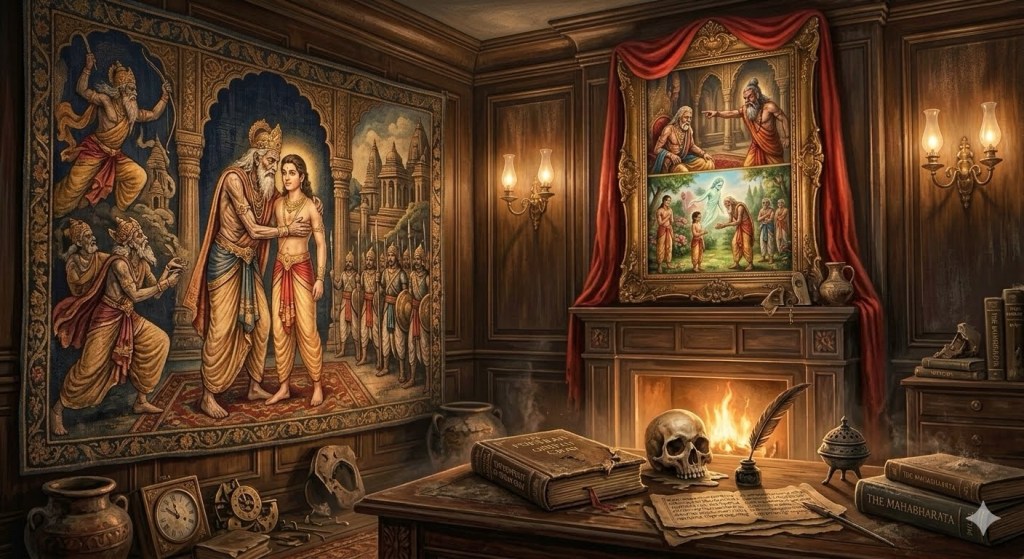
This dynamic is not a new human temptation. Thousands of years before Oscar Wilde conceived of Dorian Gray’s magic portrait, the Mahabharata gave us the story of King Yayati. Cursed with sudden old age, Yayati begged his sons to trade their youth for his decrepitude so he could continue enjoying worldly pleasures. His youngest son, Puru, consented, bearing his father’s infirmity.
But where Dorian Gray chose complete self-destruction, Yayati found wisdom. After a thousand years of chasing pleasure, Yayati realized that desire is never appeased by gratification—it only burns hotter. He took back his old age, freed his son, and accepted his mortality.
As a society, we are currently acting like Dorian Gray, letting our digital portraits carry our burdens. But we must find the strength to act like Yayati: to recognize that outsourcing our vital human struggles to a machine will never satisfy us. We must have the wisdom to pull back before we hollow ourselves out completely.
So, here’s my final word of advice to you: Enjoy the tools. Harness the technology. But please, do not give away the keys to your own intellect. Do not let a digital canvas live your life, make your mistakes, or do your thinking for you. The struggles, the doubts, and the mortality that AI lacks are exactly what make your intelligence, your creativity, and your soul worth protecting.
May the Cosmic Force be with Thee, all Ye, my young and brave friends !
(Concluded)