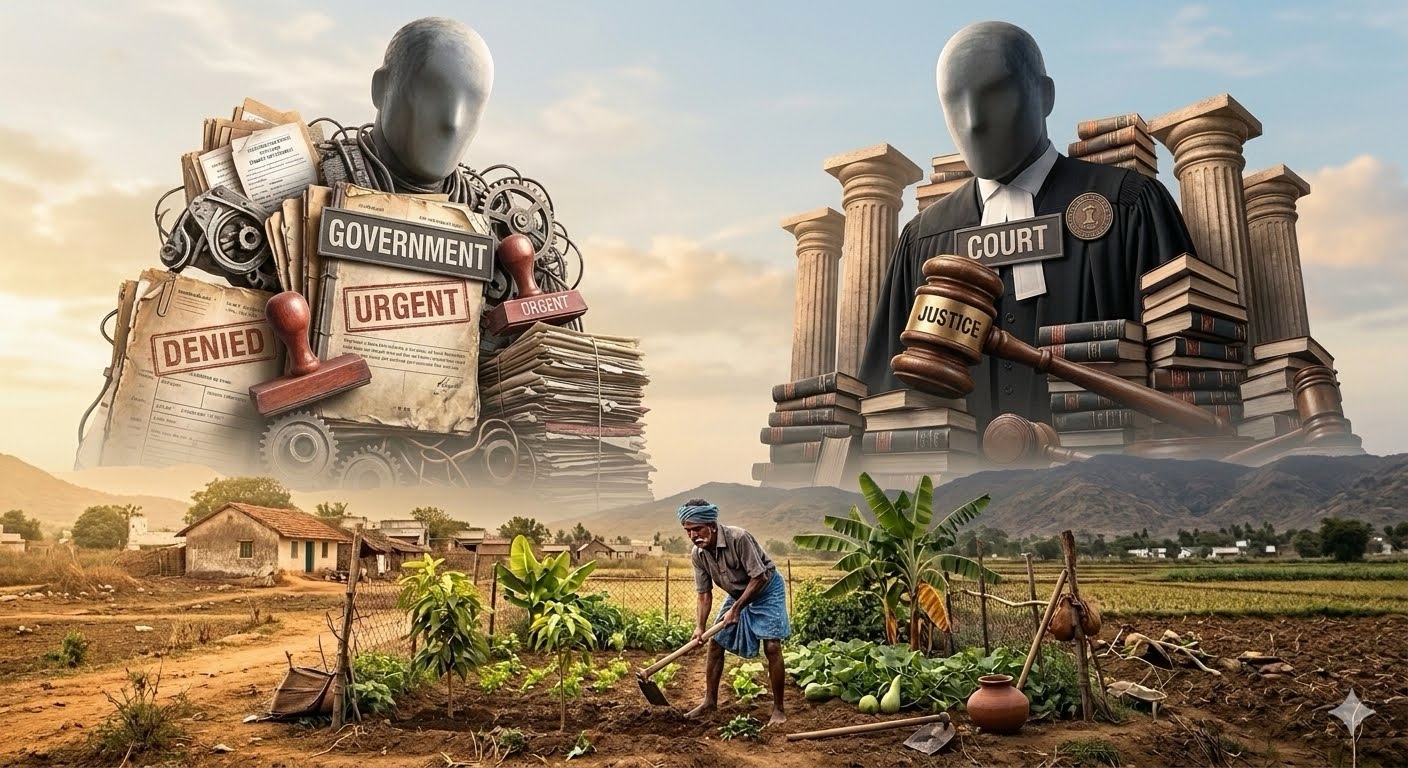
I am an ordinary citizen, if that is what I am called when the State is in a good mood and when the paperwork agrees with my face.
I do not want to be dazzled by doctrines, nor trapped in the glittering maze of legal distinctions between nationality, citizenship, identity, proof, presumption, and recognition.
I do not want to know which court has said what, which ministry has clarified what, or which document is supposed to carry the mystical burden of confirming what my life has already long since lived. I only want to tend my small garden patch, water it, weed it, and survive in peace.
And yet the modern State seems unable to let a citizen simply be. It asks me to prove myself in the same breath that it tells me I belong.
It celebrates my passport abroad as a badge of national pride, and then, at home, in the fine print of administrative reason, informs me that the same passport may not be enough to prove what I am.
It is an astonishing thing: a document can be a symbol of dignity on an aeroplane and a mere travel pass in a hearing room. One is expected to feel honored by the first and humiliated by the second, and to call this consistency.
The trouble, I think, is not merely legal. It is philosophical. A civilized society should not require an ordinary man to become a hermeneutician of his own belonging. It should not make him assemble a genealogy of seals, countersigns, birth extracts, school records, domicile papers, electoral listings, affidavits, and witness statements in order to demonstrate that he is not a ghost. If the State wishes to govern in the name of justice, it should make justice legible to the weakest person, not only to the lawyer, the bench clerk, or the judge.
For the poor, this is never an abstract matter. A city-bred person may debate citizenship as a point of doctrine; a villager experiences it as a condition of anxiety. He owns a little land, maybe only enough to feed his household if the rain is kind. Then one day someone says that the land may not be his because he may not be a citizen, and suddenly his life is no longer lived but audited. He is told to travel from office to office, from seal to seal, from desk to desk, until his days are consumed by proof. The result is not merely inconvenience. It is a quiet moral violence. The man who wished only to live is converted into a claimant in an endless tribunal.
This is where legal language becomes dangerous: not because law is unnecessary, but because law can become a self-enclosed ritual that forgets the human being at its center. It speaks in the grammar of authority and then wonders why the ordinary person hears only threat.
It distinguishes nationality from citizenship, proof from evidence, presumption from presumption rebutted, and expects the citizen to find consolation in these fine distinctions while his life hangs in the balance. But the peasant with the garden patch does not need a seminar in constitutional theory. He needs certainty. He needs peace. He needs the State to remember that recognition should serve life, not consume it.
Citizenship, in the end, ought to be a shelter, not an ordeal. It should mean that a person can wake, work, vote, travel, educate his children, and tend his plot of earth without fearing that belonging itself may someday be put on trial. A State that turns belonging into a labyrinth may still call itself lawful, but it ceases to feel just. And a citizen who must perpetually prove his own existence is not living under confidence; he is living under suspicion.
So I return to my garden patch: Let the philosophers of law continue their distinctions if they must. Let courts interpret, ministries clarify, and clerks stamp and re-stamp. But spare me please the theater of uncertainty. I ask for no grand privilege. I ask only that the State leave enough peace in a man’s life for him to tend what little ground he has been given, without having to argue for the right to stand upon it.
Citizenship, like beauty, is often in the eye of the beholder; only here the beholder is the State, and when the State hesitates, the Court steps in to gaze again.
Sudarshan Madabushi