
Today is July 10, 2026 and happens to be Friday, always regarded as blessed and auspicious since it’s the day all Hindus specially offer worship to Goddess Mahalakshmi.
If you are in the holy city of Kanchipuram today, you’d be headed towards the temple of Sri Varadaraja Perumal to have darshan of his Divine Consort, Goddess and Mother Compassionate, Sri Perundevi Thaayaar.
Today, for me, is also a perfect day for a darshan of another sort: of a Mother —not a divine one though — but who, nonetheless, as mere human Perundevi, personified the qualities of Compassion, Sacrifice and Grace with unpretentious humility during her lifetime.
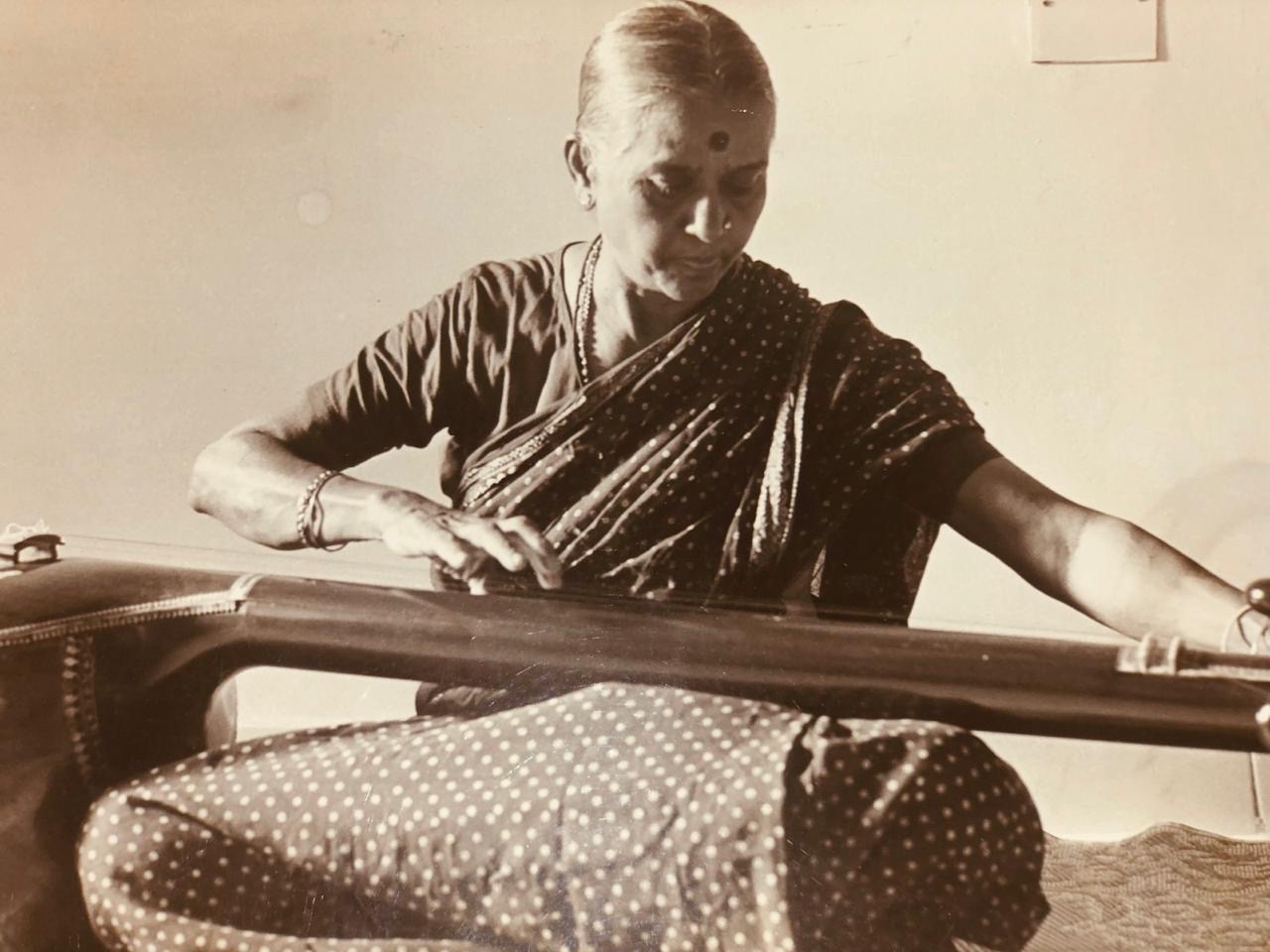
The darshan I am taking about is the one to be had through recollections of my mother, Sangitha Kalanidhi Smt. Mani Krishnaswami (1930-2002).
Mani Krishnaswami’s public profile — as a famous, outstanding musician in the history of Carnatic Music — is even today so well remembered by legions of her Rasikas. Her archival music lives on, immortally, in public memory, ears and hearts. However, there’s to be found hardly any archive, either public or familial, that can tell her Rasikas anything about the personal side of her life… or, in other words, about how before she became Mani Krishnaswami, she had been born and had grown up, firstly, as Mani Perundevi.
On this blessed day today of Friday graced by Kanchi Perundevi Thaayaar, I happened to be casually rummaging through some family archival memorabilia: scraps of letters, photos and sundry souvenirs. Perchance, I stumbled upon two old musty postcards from 1947-48. As soon as I read them, I turned into a makeshift self-appointed historian of my mother’s family and her teenage years. I felt an overwhelming urge — perhaps because I am my mother’s only son and offspring — that the slice of family history that I had stumbled upon serendipitously from Mani Perundevi’s early life must be told and shared too in the public domain.
Both her family and her Rasikas, I felt, did deserve a rare glimpse into Mani Krishnaswami’s early life… a life of filial “tapas” appearing to me, in hindsight, to be the equal of the “tapas” I know she underwent later in life as an outstanding Carnatic musician who reached the heights of artistic fulfilment in her long, illustrious career as a Vidushi.
So, here below is a cameo-recounting of the slice of family history I suddenly discovered today on this blessed Friday.
In Loving Memory of
MANI PERUNDEVI (1930-2002)
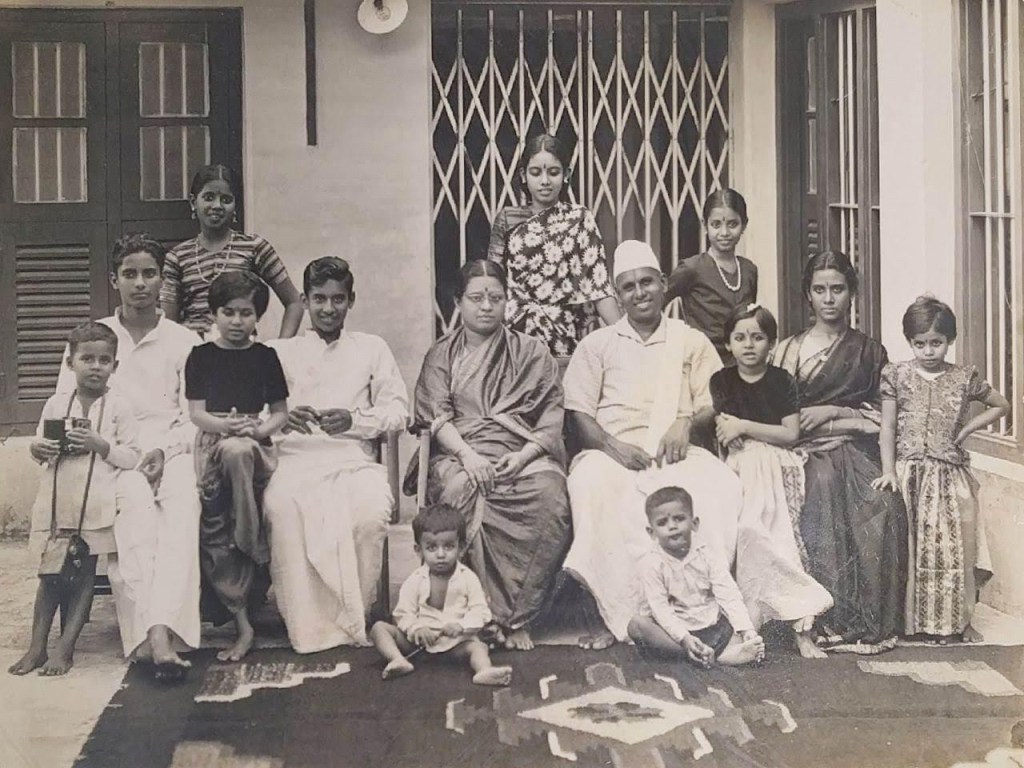
Who, at the tender age of eighteen, gracefully stepped into the shoes of her parents to mother, nurse, and guide her eleven younger brothers and sisters. The slice of family history recounted here is dedicated to her enduring legacy of cheerfulness, silent sacrifice, and unyielding equanimity. Over fifty years later, her siblings carry her memory with boundless, eternal gratitude.
“You must rise up by your own merit.”
In the post-independence dust of March 1948, a steam train jolted its way toward Arkonam Junction.
Inside one of its carriages, a father balanced a fountain pen against a slip of cardboard, his script horizontally compressed to conquer every square millimeter of space. He wrote with the rapid, unflinching discipline of a Victorian-era education, drafting an “advice, not a censure” to his eldest daughter, Mani, whom he had named Perundevi.
To the post office, she was Miss Mani Perundevi, 1st Year Student, Sangeetha Siromani Course, Kalakshetra. To her father, she was a reliable lieutenant. But to history, she was an eighteen-year-old girl born in 1930, standing on the precipice of adulthood, holding together a universe of eleven younger siblings whose ages cascaded all the way down to a one-year-old infant.
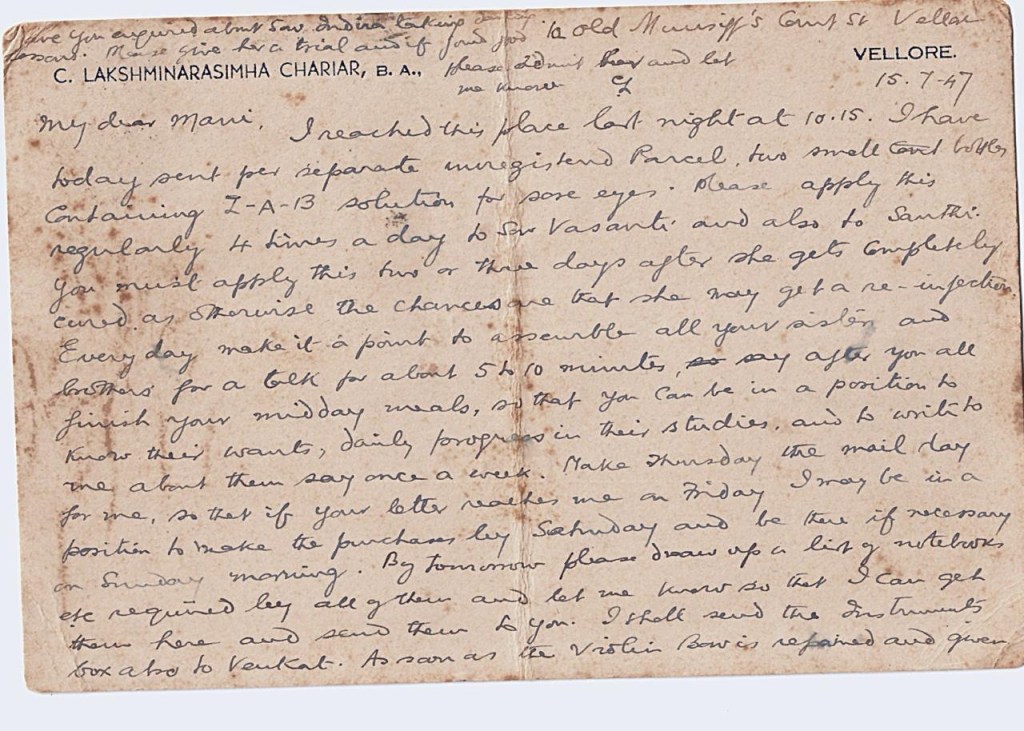
Old Munsiff’s Court St. Vellore
C. LAKSHMINARASIMHA CHARIAR, B. A.,
VELLORE.
15.7-47Postmarks & Stamps:
- ADYAR DELY. 16 JUL. 47
- SAIDAPET-VLY 15 JLY. 47
- INDIA POSTAGE stamp (1½ annas.)
Address Layout:
Miss Mani Perundevi
Student, I st year
Sangeetha Siromani Course
Kalakshetra
Adyar
MADRAS-20Body of the Letter:
My dear Mani,
I reached this place (Vellore) last night at 10.15. I have today sent per separate unregistered Parcel, two small card boxes containing Z-A-B solution for sore eyes. Please apply this regularly 4 times a day to Sow. Vasanti and also to Santhi (Perundevi’s sisters). You must apply this two or three days after she gets completely cured, as otherwise the chances are that she may get a re-infection.
Every day make it a point to assemble all your sisters and brothers for a talk for about 5 to 10 minutes, so, say, after you all finish your midday meals, so that you can be in a position to know their wants, daily progress in their studies, and to write to me about them, say, once a week. Make Thursday the mail day for me, so that if your letter reaches me on Friday I may be in a position to make the purchases by Saturday and be there if necessary on Sunday morning. By tomorrow please draw up a list of notebooks etc. required by all of them and let me know so that I can get them here and send them to you.
I shall send the (musical) instruments box also to Venkat (eldest son, younger than Perundevi). As soon as the Violin Bow is repaired and given to you, please let me know how much they have charged you for the same.
As far as you are concerned, you must study your lessons & music everyday and should not accumulate them to a later date. Too much talk will not help you but land you in unnecessary complications. “Lend thy ear to every body, but none thy tongue”. Choose your friends carefully and maintain always decorum in speech, behaviour, and action. Remember “Too much familiarity will breed contempt”. As my father put it, “You must rise up by your own merit”. Please take care of your health. Once a fortnight you must take the mag sulph purge and this will help to keep you fit. Expect your letter about the health of Sow. Vasanti etc by Friday morning or even earlier.
yours affly
[Signature] C. Lakshminarasimha ChariarPS: Have you enquired about Sow. Indira (another sister of Perundevi) taking (music) lessons. Please give her a trial and if found good please admit her and let me know.
CLN
The Burden of the Eldest
The postcard reveals a family dynamic where parental presence was delivered by mail, but parental governance was thrust entirely onto Mani.
Willy-nilly, she was made the loco-parentis and the hostel matron for all her siblings. Her father’s letter reads less indeed like tender familial updates and more like organizational directives sent to a regional manager:
- The Assembly: She was ordered to gather the children daily for ten minutes after their midday meals to track their academic progress.
- The Nurse: She was tasked with administering “mag sulp” purges and applying Z-A-B eye solutions four times a day to her sisters, Vasanti and Santhi.
- The Accountant: She was expected to draft inventories of notebooks, track the repair costs of violin bows, and report everything back on a strict weekly “mail day.”
There is a striking juxtaposition in an eighteen-year-old girl being also given sermons rooted in Shakespearean tragedy—“Lend thy ear to every body, but none thy tongue”—while simultaneously being told to act as a surrogate mother to a household of eleven children. Mani Perundevi was surrounded by the vibrant, awakening cultural landscape of Madras in those years, yet her personal world was strictly rationed.
The Sangeetha Siromani Course & Miss Padmasini
Mani’s sanctuary from this heavy domestic weight was her enrollment at Kalakshetra, an academy founded by Rukmini Devi Arundale to revive traditional Indian classical arts. She was a first-year student in the prestigious Sangeetha Siromani (Jewel of Music) course, a rigorous four-year diploma in Carnatic vocal and instrumental music.
In 1947 and 1948, the academy still operated from its original home on the serene, leafy grounds of the Theosophical Society in Adyar. Admittance into this course meant Mani was walking among giants, learning under legendary musical titans like Tiger Varadachariar, Mysore Vasudevachar, Budalur Krishnamurthy Sastri and M.D. Ramanathan among other notables, who shaped the academy’s early faculty.
Yet, even within this artistic haven, her father ensured her duties of family supervision was never far away. He explicitly directed Mani to show his letter to Miss Padmasini (Smt. Padmasini), the legendary first caretaker and warden of the Kalakshetra student hostel. Padmasini was one of Rukmini Devi’s closest institutional pillars. Known for being fiercely protective and acting as a surrogate mother to the early batches of arts students, she enforced strict discipline. Her legacy is so deeply tied to Kalakshetra that the historic lily pond amphitheater on the campus is officially named Padma Pushkarini in her honor. By invoking Padmasini, the father cleverly inveigled the alignment of his paternal anxieties with the hostel’s unyielding rules.
The Cinema and the Martyr
At the heart of another postcard’s tension that Lakshminarasimha Chariar wrote to Perundevi lay a young girl’s simple, unspoken wish: the desire to go to the cinema.
Writing just a month after Mahatma Gandhi’s assassination, the father invoked the Mahatma’s recent martyrdom not as a historical event, but as a moral surveillance apparatus. Gandhi, he wrote, was now an “angel and celestial being… watching over our Country’s welfare.”
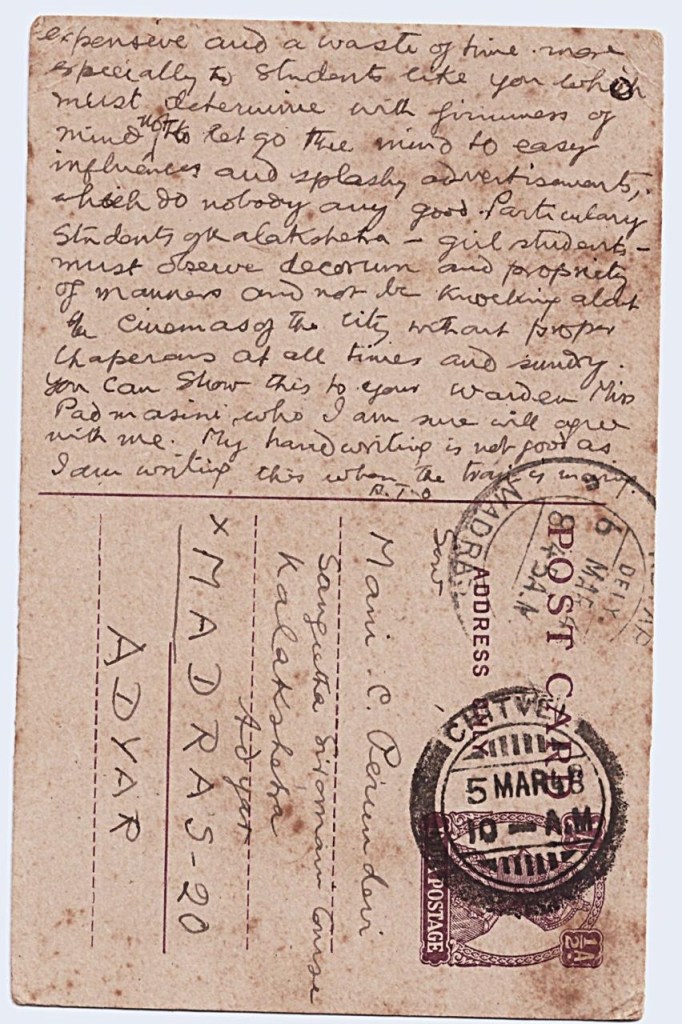
In the father’s eyes, Gandhi’s austere aversion to films—which the Mahatma viewed as corrupting, Westernized influences that distracted youth from spiritual duties—became a mandate for Mani’s discipline. Mani was told that movies were a “waste of time” and that Kalakshetra girls (!) must not be seen “knocking about the Cinemas of the city” without a proper chaperone.
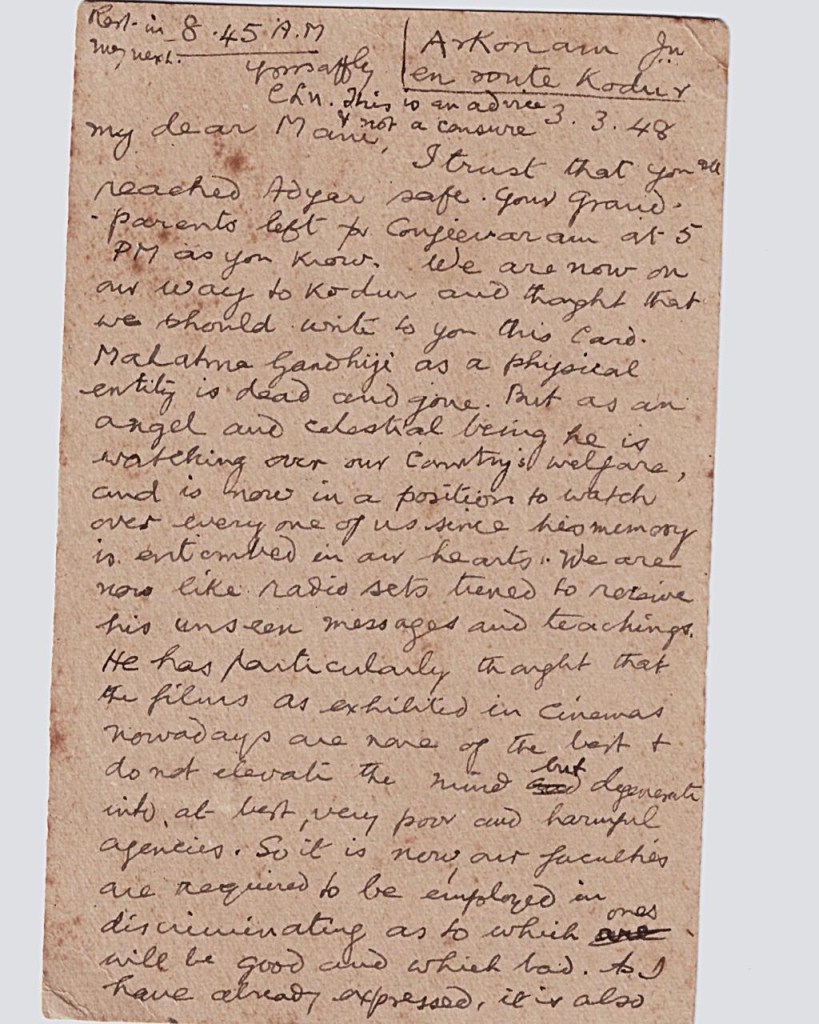
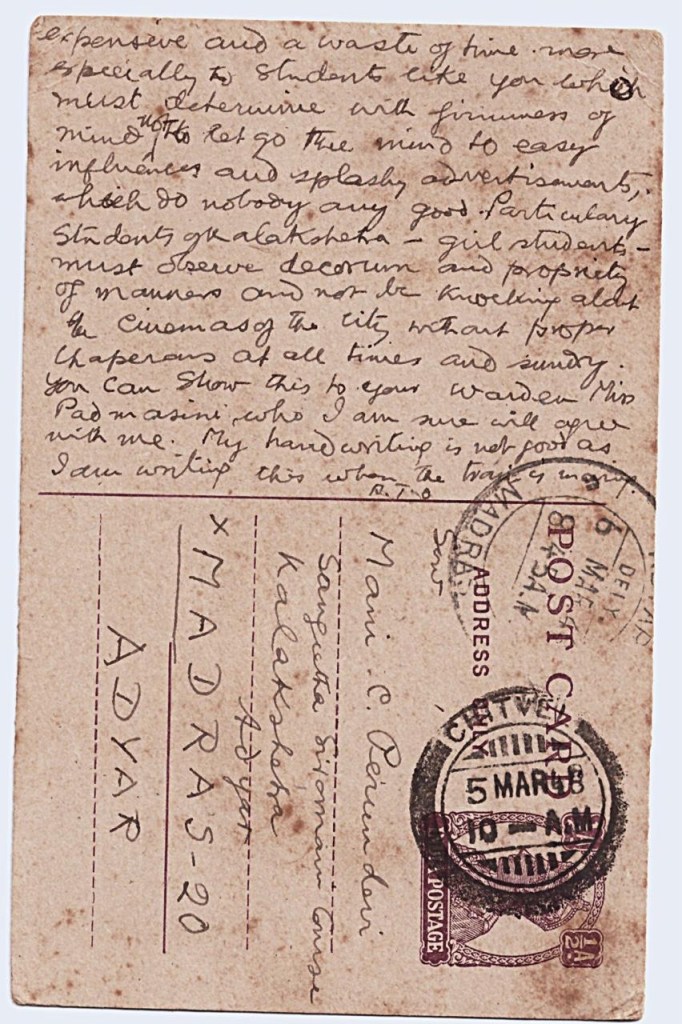
- Recd. in 8.45 A.M
- Arkonam Jn en route Kodur 3.3.48
Body of the Letter:
My dear Mani,
I trust that you all reached Adyar safe. Your grand-parents left for Conjeevaram at 5 PM as you know. We are now on our way to Kodur and thought that we should write to you this Card.
Mahatma Gandhiji as a physical entity is dead and gone. But as an angel and celestial being he is watching over our Country’s welfare, and is now in a position to watch over every one of us since his memory is entombed in our hearts. We are now like radio sets tuned to receive his unseen messages and teachings.
He has particularly thought that the films as exhibited in cinemas nowadays are none of the best & do not elevate the mind but degenerate into, at best, very poor and harmful agencies. So it is now our faculties are required to be employed in discriminating as to which ones will be good and which bad. As I have already expressed, it is also expensive and a waste of time, more especially to students like you who must determine with firmness of mind not to let go the mind to easy influences and splashy advertisements, which do nobody any good. Particularly students of Kalakshetra – girl students – must observe decorum and propriety of manners and not be knocking about the Cinemas of the city without proper chaperons at all times and sundry. You can show this to your Warden Miss Padmasini who I am sure will agree with me. My handwriting is not good as I am writing this when the train is moving.
P. T. O
Yours affly CLN. This is an advice & not a censure
A Legacy of Equanimity and Moving Mail
Even the physical postcard of the father itself speaks to this atmosphere of scarcity and restraint in which Mani Perundevi, a lass just eighteen years old, had to come to terms with.
Frugality was a postal virtue; ink was packed tightly to save the cost of an envelope. Every inch of paper was squeezed for utility, just as Mani’s youth was squeezed for duty.
Yet, the efficiency of the colonial-era postal system they both relied on was remarkable indeed from a Historians point of view. Despite being handled completely by steam rail transport and physical sorting, a postcard written on a moving train near Arkonam Junction on March 3 passed through a sorting facility in Chittoor on March 5, and arrived at the Adyar Delivery Office in Madras at exactly 6:45 AM on March 6. It took precisely three days to travel from a rumbling train carriage in rural undivided Madras Presidency straight into Mani Perundevi’s hands at her hostel desk in Kalakshetra.
The true narrative of Mani’s life is found in what happened long after that moving mail arrived and the ink dried. Her parents eventually passed away, but the role she was cast into at eighteen became the blueprint for the next fifty years of her life. She and her husband, later in their lives, took upon themselves the responsibility of grooming all Perundevi’s siblings, ensuring every one of them was well educated and they launched themselves into successful careers in various professions, were married off well and all went on to raise happy families of their own.
Perundevi endured this massive cascade of responsibility without a single word of complaint, moving through the decades (1960s through the ‘80s) cheerfully and with an unwavering equanimity until she passed away in 2002.
Mani Krishnaswami, Née Perundevi, did not get her carefree afternoon at the cinema. Instead, she gave her siblings a childhood and passage to adulthood. Decades later, her father’s handwritten text on the faded cardboard remains cramped, but the gratitude of the eleven siblings she raised is perhaps boundless.
Today is auspicious Friday. As son to Perundevi, I realise fully now what that Upanishad “vaakya” truly signifies: “maatru devo bhava” … मातृ देवो भव।
(Concluded)
Archival Correspondence