by M.K.Sudarshan
July 9, 2026: Chennai, India
Is the centuries-old doctrine of state sovereignty collapsing before our eyes?
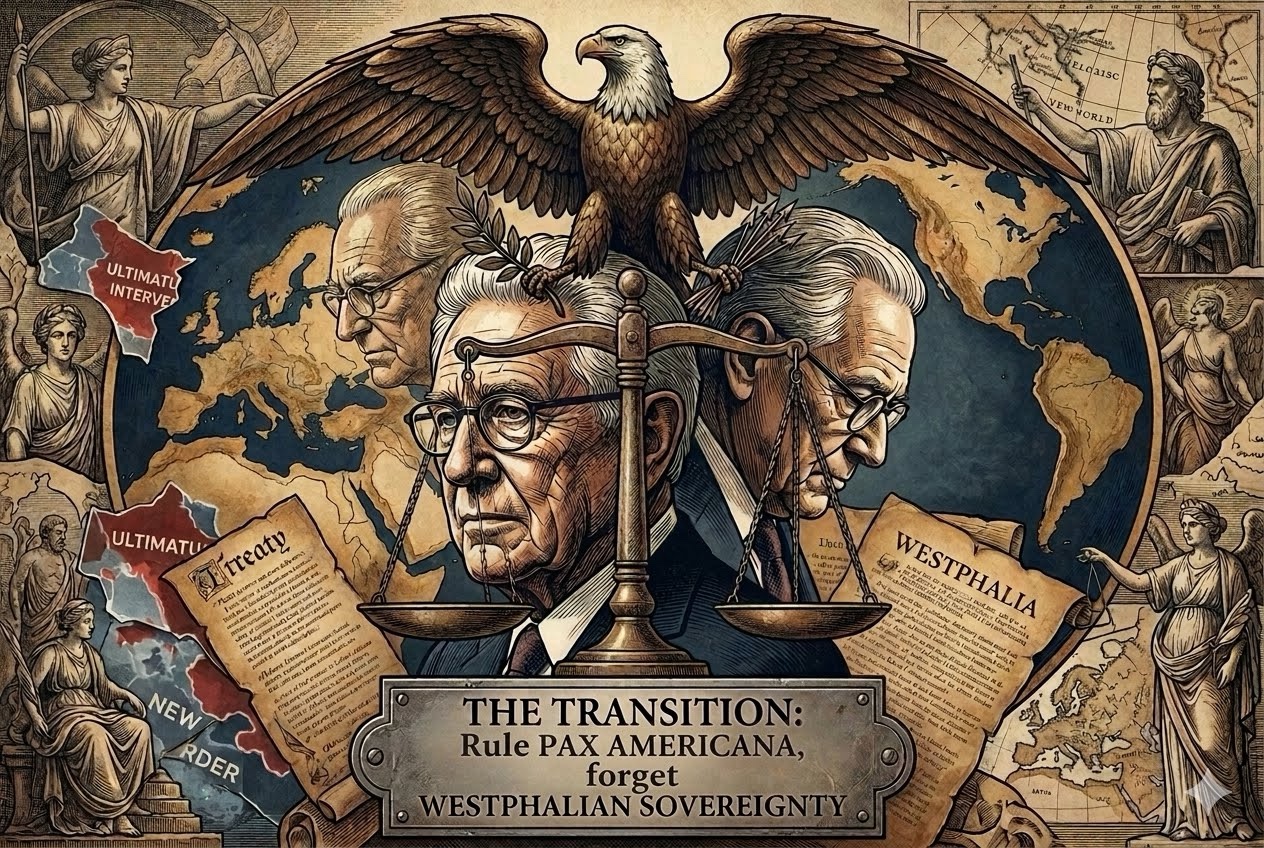
In his seminal work World Order, Henry Kissinger warned against a single hegemon rewriting the rules of global legitimacy. Yet, the systematic dismantling of Westphalian principles—seen in Iraq, Libya, Syria, and now the extreme defense ultimatums placed on Iran—proves that sovereignty has become a privilege, not a right.
When international law offers no protection, raw military power becomes the only currency of survival. As the American-Western axis pushes regional red lines to the limit, the strategic patience of Russia and China is rapidly exhausting.
The Birth of the Sovereign Shield
In 1648, Europe emerged from the ashes of the Thirty Years’ War—a catastrophic conflict driven by religious zealotry and imperial overreach that slaughtered millions. The solution was the Peace of Westphalia.
This historic compact established a revolutionary blueprint for global survival: the doctrine of state sovereignty. It decreed that all states, regardless of size, ideology, or internal governance, possess absolute authority over their territory. Most importantly, it codified the principle of non-intervention.
Westphalia was not agreed upon out of moral altruism; it was a pragmatic, existential necessity to prevent perpetual, total warfare by establishing that no foreign power had the right to dictate how another nation guarded its borders or ruled its people.
Kissinger’s Bedrock of Order
In his seminal work World Order, Henry Kissinger expatiated upon this Westphalian doctrine not as a flawless moral system, but as the indispensable bedrock of global stability.
Kissinger argued that the genius of Westphalia lay in its procedural neutrality. It did not require nations to share the same values, only to respect the same rules of engagement. For nearly four centuries, this balance-of-power model served as the foundational architecture of international relations.
Kissinger warned that any functioning global order requires a shared sense of legitimacy; if the dominant powers abandon procedural rules in favor of imposing their own moral or strategic dictates, the system collapses into chaos.
Henry Kissinger absolutely presaged this exact tension in World Order, explicitly warning that the collision between American exceptionalism and the Westphalian system would lead to the rewriting of state sovereignty.
In his analysis of global systems, Kissinger diagnosed a fundamental incompatibility between how the United States operates and how classical Westphalian sovereignty is defined. He outlined several core concepts that directly explain the current U.S.-Israel approach to Iran.
A cornerstone of Kissinger’s realism—dating back to his earliest academic work and synthesized in World Order—is the concept of the “Revolutionary Power.”
- The Rule: A revolutionary power is a state that refuses to accept the legitimacy of the existing international order and seeks to alter the regional balance of power.
- The Hegemonic Response: Kissinger noted that an international system faced with a revolutionary power cannot rely on standard Westphalian diplomacy. Instead, the dominant powers must either completely contain, isolate, or force the capitulation of that state to protect the architecture of the system itself.
The Broken Shield: Iraq, Libya, and Syria
Yet, the modern era has seen this foundational architecture systematically dismantled, forced to capitulate to the unilateral dictates of Pax Americana and Pax Judea. The regime changes in Iraq and Libya, alongside the violent splintering of Syria, stand as egregious examples of this shift.
In each instance, the Westphalian shield was aggressively shattered under the guise of humanitarianism or security, reducing once-sovereign states to fractured territories and serving as a stark warning to any nation resisting integration into the Western orbit.
The Ultimatum: Hollow Sovereignty
Today, this same hyper-interventionist paradigm has culminated in three uncompromising demands issued by the United States and Israel against Iran:
- The total forfeiture of nuclear weapons and the domestic capacity to develop them.
- The complete elimination of Iran’s ballistic missile arsenal.
- The surrender of Iranian control over the Strait of Hormuz.
The three extreme demands on Iran are a textbook execution of neutralizing what Washington and Israel define and as what Kissinger explained to be a revolutionary threat.
The ramifications of these demands do not merely alter Iranian policy; they effectively end Iran as a sovereign state.
Deprived of its advanced conventional air force due to decades of Western embargoes, Iran relies entirely on its ballistic missile program as its primary strategic deterrent against regional adversaries. Stripping Tehran of this capability, while forcing it to cede maritime authority over its own territorial waters in the Strait of Hormuz, leaves the nation completely defenseless. It reduces a country of 90 million people to a status of conditional, vassal-like existence—completely vulnerable to the military whims of foreign actors.
A Travesty of Order
This ultimatum represents a total travesty of the Westphalian-Kissinger model. By issuing these demands under the threat of severe destruction, the U.S. and Israel are operating on a paradigm of exceptionalism that Kissinger himself explicitly in his book had warned against.
Kissinger noted that when a hegemon treats its own security parameters as absolute and universal, it transforms into a destabilizing force. Denying Iran the Westphalian right to territorial self-defense—while the hegemon and its regional allies maintain massive conventional and nuclear arsenals—shatters the principle of reciprocity. It replaces a system of sovereign equals with a rigid, enforced hierarchy where power dictates right, and non-compliance is met with threats of structural erasure.
The Impotence of Global Institutions
As the Westphalian compact is overridden, the premier institutions of the modern international order have been rendered entirely impotent and nugatory.
The United Nations Security Council sits paralyzed, reduced to a theater for vetoes and performative rhetoric.
The International Atomic Energy Agency (IAEA) and the Non-Proliferation Treaty (NPT)—which historically guaranteed a nation’s sovereign right to peaceful nuclear energy—have been weaponized as tools of selective enforcement rather than neutral arbiters.
Organizations like the G-20 , BRICS and OIC (Organisation of Islamic Countries) look on helplessly, incapable of enforcing international law or curbing unilateral actions.
These bodies no longer preserve order; they merely manage the optics of a decaying system where global rules are bypassed whenever they conflict with Western strategic mandates.
A Dark Prophecy: The Coming Blowback
The crumbling of a Westphalian and UN-anchored world order does not mean the end of resistance; it signals the dawn of a far more dangerous era. As the traditional system is forcibly replaced by a hegemonic order imposed by the American-Zionist-Neo-Con-Neo-Liberal axis, the global balance of power is reaching a breaking point.
This aggressive redefinition of state sovereignty is exhausting the strategic patience of the world’s other major nuclear powers. Watching the systematic cornering of Iran, China and Russia see a direct preview of their own eventual encirclement.
By demonstrating that international law offers no protection to independent states, the West is inadvertently proving to its rivals that raw military power is the only valid currency of survival. As Washington and its allies push their regional ultimatums to the absolute limit, they risk crossing the final red lines of a multipolar world—impelling China and Russia into defensive pacts, economic blockades, or direct, catastrophic military responses that could plunge this century into a global conflagration.
(Concluded)
