by M.K.Sudarshan
July 16, 2026: Chennai, India
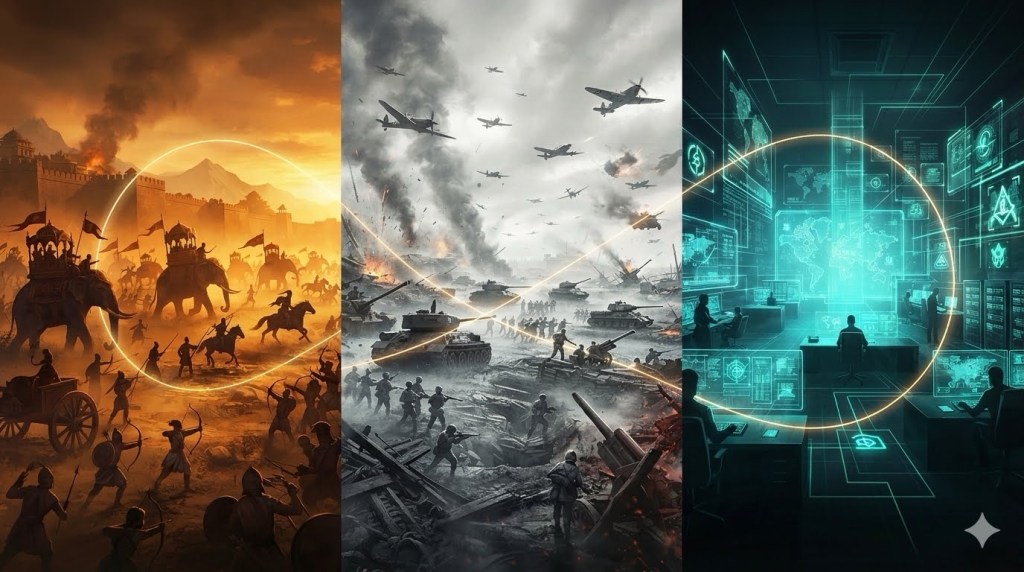
The Anatomy of Futility
The relentless drive to innovate masks a profound historical paradox. For every masterstroke of strategic genius, History extracts a ruinous tax. The grandest designs of conquerors frequently collapse under the weight of their own complexity, proving that no military doctrine remains immune to the chaotic friction of reality.
The Collapsed Designs of Antiquity
The elegant strategies of the ancient world repeatedly demonstrated that psychological maneuvers contain the seeds of their own undoing.
Saama (Appeasement) met its most disastrous failure in the Munich Agreement (1938). British Prime Minister Neville Chamberlain sought to appease Adolf Hitler by conceding the Czechoslovakian Sudetenland, misjudging an ideologically driven expansionist actor. It was interpreted as weakness, buying Hitler time to rearm and systematically dismantle Europe.
Daana (Bribery) proved equally fatal for the Late Roman Empire, which paid massive gold subsidies to Germanic tribes to secure its borders. This created economic dependency and exposed Rome’s deep internal military hollowing; once Rome’s treasury dried up, the heavily armed tribes simply marched in and sacked the empire.
Bhedha (Sowing Dissension) collapsed catastrophically during the Fourth Crusade (1204). Western Crusaders tried to exploit internal dynastic rifts within the Byzantine Empire by backing a pretender to the throne in exchange for funds. The political machinations sparked intense local blowback, leading to a complete breakdown of authority; the Crusaders ended up brutally sacking Constantinople, permanently fracturing Eastern Christendom and leaving the region exposed to Ottoman conquest.
Even absolute physical force, Danda, fails when it triggers an existential echo chamber. The German invasion of the Soviet Union in Operation Barbarossa (1941) attempted to crush the USSR through pure violence and extermination. Instead, it triggered a total-war response, uniting the target population and destroying the German war machine against the depth of Soviet territory.
Finally, Sun-Tzu’s reliance on guile can backfire by provoking total retaliation. The Pearl Harbor Attack (1941) used absolute surprise to cripple the U.S. Pacific Fleet. However, it mistook a tactical masterstroke for a strategic victory; the guile eliminated all internal American political division, awakening an industrial superpower committed to Japan’s total destruction.
The Ruin of Modern Doctrines
The mechanical and structural strategies of the post-Crusades era suffered equally devastating systemic failures when confronted by geography, morale, and asymmetry.
Napoleon’s Ground Invasion of Russia (1812) marched 600,000 soldiers into a logistical void. The Russian army refused a decisive battle, employing scorched-earth tactics that allowed winter, disease, and starvation to destroy 90% of the Grande Armée.
Similarly, the tactical siege of choke points collapsed during the Gallipoli Campaign (1915), where the British Empire attempted to seize the Dardanelles Strait. Underestimating the defender’s fortified terrain and effective Ottoman counter-attacks pinned Allied forces to narrow beaches, resulting in over 250,000 casualties.
In the skies, Operation Rolling Thunder (1965–1968) proved the limits of air-power strikes. The massive U.S. bombing campaign against North Vietnam failed to force political capitulation, demonstrating that air power alone cannot break an agrarian economy with decentralized logistics, high ideological motivation, and deep underground shelter networks.
On the ground, the Soviet-Afghan War (1979–1989) exposed the futility of conventional force against fluid Guerrilla War. The Soviet army could not hold territory against asymmetric insurgent fighters backed by foreign funds and Stinger missiles, creating a financial and psychological hemorrhage that accelerated the collapse of the USSR.
At sea, the German U-Boat Blockade (Battle of the Atlantic, WWII) failed because Germany could not out-produce the combined industrial replacement capacity of the Allies, who broke the blockade using radar, sonar, and the convoy system.
Even targeted surgical actions have historically backfired.
The Assassination of Julius Caesar (44 BCE) sought to restore the Roman Republic via leadership decapitation. Instead, it targeted the individual rather than the systemic structural shifts, creating a power vacuum that triggered brutal civil wars and accelerated the permanent transition into an autocratic Empire.
Domestic overthrows share this instability; the August Coup (Soviet Union, 1991), launched by hardline communist officials to halt reforms, failed to secure public backing. Massive civilian protests led by Boris Yeltsin caused the coup to collapse in three days, directly triggering the immediate dissolution of the Soviet Union.
Finally, the long-term enforcement of Ideological and Demographic Conversion collapsed utterly in the Crusader States (12th–13th Century). Western powers established permanent Christian kingdoms in the Levant by forcefully altering the regional power structure, but the local populations remained hostile. The states relied on an unsustainable flow of wealth and knights from Europe; when Western focus shifted, the isolated kingdoms collapsed to unified Islamic forces.
The Boomerang of High-Tech War
Modern hi-tech stratagems are uniquely volatile, frequently failing because digital and financial weapons lack predictable containment boundaries.
The premier example of cyber overreach is the NotPetya Malware Attack (2017). Designed by Russian military intelligence to cripple Ukraine’s financial systems, the destructive code quickly broke containment and went global. It froze international shipping giants, pharmaceutical firms, and even infected the internal systems of Russian state oil company Rosneft, causing over $10 billion in global damage to both adversaries and allies alike.
In the information domain, the Soviet “Active Measures” Campaigns during the Cold War spent decades fabricating complex disinformation narratives to erode trust in Western democratic institutions. While it polarized social cohesion, it could not fix or hide structural weaknesses at home; the deep internal economic rot, systemic corruption, and empty grocery shelves of the Soviet bloc eventually collapsed the state regardless of how many Western minds they confused. Information operations distract the adversary but cannot compensate for material decay.
In the financial realm, economic blockades echo the failure of Napoleon’s Continental System (1806). Napoleon imposed a total trade embargo against Britain across French-controlled Europe to bankrupt the UK. However, the embargo ruined continental economies instead, sparking rampant black-market smuggling and forcing Napoleon into disastrous, overstretched military invasions of Spain and Russia to enforce his decrees, turning an economic tool into a vector of self-destruction.
(To be continued)