by M.K.Sudarshan
July 26, 2026: Chennai, India
The forced resignation of Minister Dharmendra Pradhan is being trumpeted about by the youthful street agitators belonging to the Cockroach Janata Party of India as triumph of Youth.
Other professional “social activists” like Yogendra Yadav , Arundhati Roy, Arvind Kejriwal , T.M.Krishna et al are waxing exuberant over what they describe as a victory for democracy.
Rahul Gandhi and his Congress Party are walking about with triumphant chests all puffed up now and almost equal in size to Narendra Modi’s famous 56 inch chest….
But I for one as an ordinary citizen see all this as victory for anarchic democracy not parliamentary democracy.
I see the success of the Cockroach Party not as representing youth power but as the power of the streets and its demagoguery.
The Congress Party can gloat as much as it wants over the “victory of democracy” but to my mind this is a hollow victory because the Indian education system has suffered an institutional defeat at the hands of un-civil society in India — a fringe that is growing in both size and force at an alarmingly rapid pace in our country.
This not a Movement of Youthful India but of Urban Naxalism 2026 Model.
************
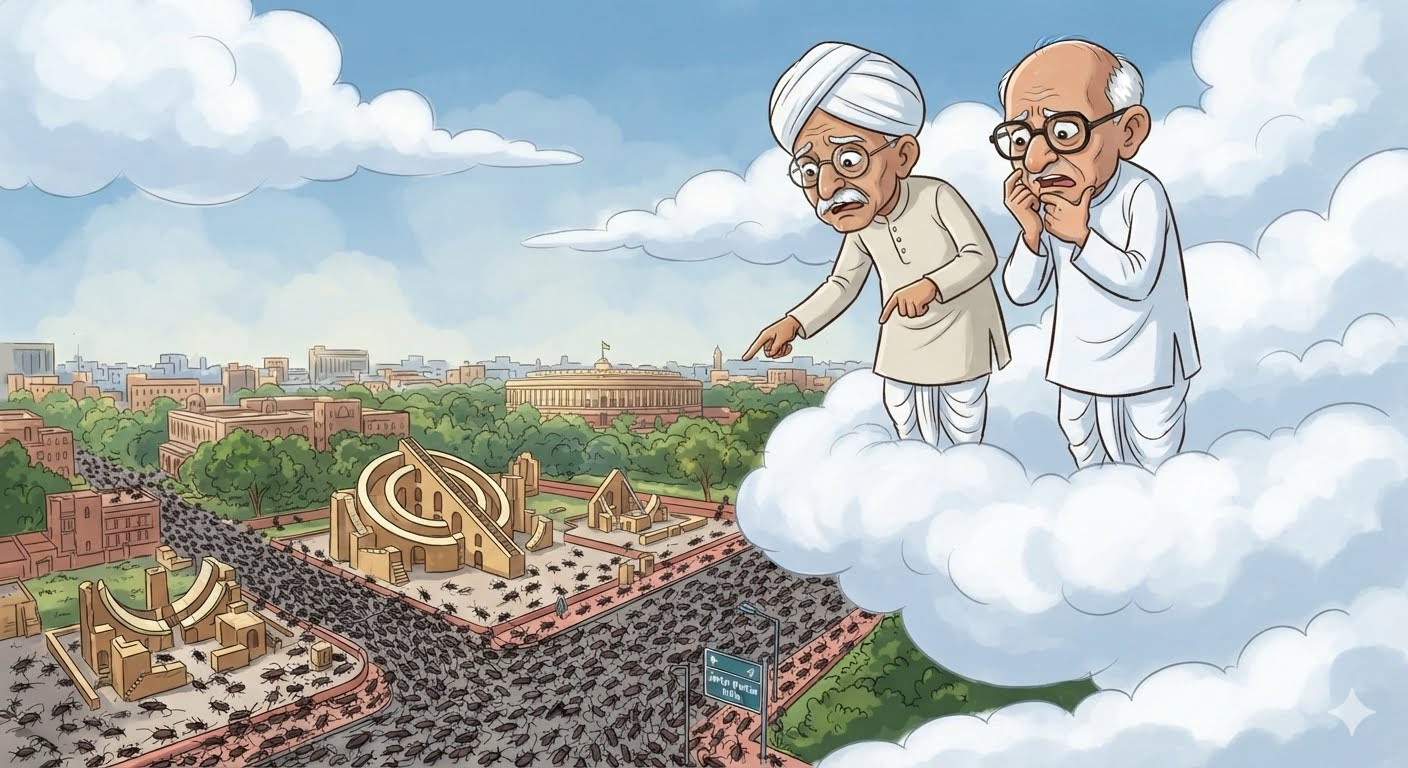
I wonder what someone like Rajaji and Rt. Hon’ble Srinivasa Sastri —- both great patriots of the Independence movement and who were in their own right and time, very popular youth leaders — might have said about this dubious victory of democracy if they had been alive today ?

Turning the pages of History , I came across two sterling speeches both men on different occasions delivered publicly that roundly condemned rabble-rousers calling themselves “civil society” warriors and instigating street agitations of the sort that today we see being the methods of the Cockroach Party of India, the Congressr Party and the now nearly sinking Aam Aadmi Party of Arvind Kejriwal desperately trying to still survive in politics clutching at straws.
The speeches of Sastri and Rajaji so relevant today on the morning after the resignation of Minister Pradhan are reproduced below ⬇️:
1923 Speech of Rt Hon’ble Srinivasa Sastri:
In the early 1920s, Sastri grew deeply alarmed by how mass political mobilization was reshaping civic psychology. In a landmark address delivered to public workers and students, he warned that bypassing established legal frameworks would permanently infect the nation’s political DNA.
“Order, peace, and security are not merely conservative virtues; they are the absolute prerequisites for any civilized society. When political factions teach the public that the laws of the land or the decisions of an administration can be overturned by the sheer weight of mass intimidation, they unleash a force they cannot later control.
You may believe that a crowd in the street represents the will of the people, but more often, it represents only the loudest and most organized minority. If a government yields its executive authority to the clamor of the streets rather than the quiet deliberation of constitutional bodies, it abdicates its primary duty.
Once the populace learns that an administration can be terrorized or coerced into submission by public disruption, you destroy the very idea of representative government. You do not achieve freedom; you usher in an era where the loudest voice, the heaviest stone, and the most aggressive mob dictate national policy.”
C. Rajagopalachari: Address on Institutional Discipline (August 1948)
Shortly after taking office as Governor-General of independent India, Rajaji delivered a remarkably prophetic speech warning that citizens were mistaking the disruption of public institutions for the exercise of democratic freedom
“During our struggle for independence, we weaponized public agitation to break a foreign yoke. But the habits formed during a revolution can become fatal diseases during a period of reconstruction. It deeply pains me to see that while our people found it easy to show discipline under foreign rule, they find it exceedingly difficult to respect the authority of their own democracy.
Freedom does not confer a mandate upon any faction or student group to dismantle the instruments of governance. If a policy is flawed or a minister is unfit, the remedy lies in the patient, orderly processes of the legislature and the ultimate verdict of the ballot box.
When we permit street crowds, emotional demagogues, or localized agitations to force the hands of the executive, we suffer a profound institutional defeat. We replace the majestic rule of law with the volatile rule of the whim. If our public institutions are subjected to the political vandalism of un-civil society, the fabric of our Republic will unravel from within.”
***********
If both statesmen were alive, they would likely look past the political gloating and issue a stern warning to the nation. They would argue that true democracy survives through robust parliamentary debate and electoral mandates, not through the veto power of street mobilization. In their eyes, allowing un-elected or agitational groups to force executive capitulation weakens the state fabric, transforming a constitutional republic into an unpredictable ochlocracy (mob rule).
Both the above speeches reflect a shared conviction: the methods used to achieve a political victory matter just as much as the outcome. Sastri and Rajaji both maintained that when a democracy validates street-level coercion over parliamentary process, it compromises its own longevity.
(Concluded)

One thought on “A Movement of Youthful India or is it Urban Naxalism 2026 Model?”