
by M.K.Sudarshan
July 26, 2026: Chennai, India
A comparative perspective on the Financial and Strategic Costs that America imposes on the whole world
1. Asymmetry of Engagement
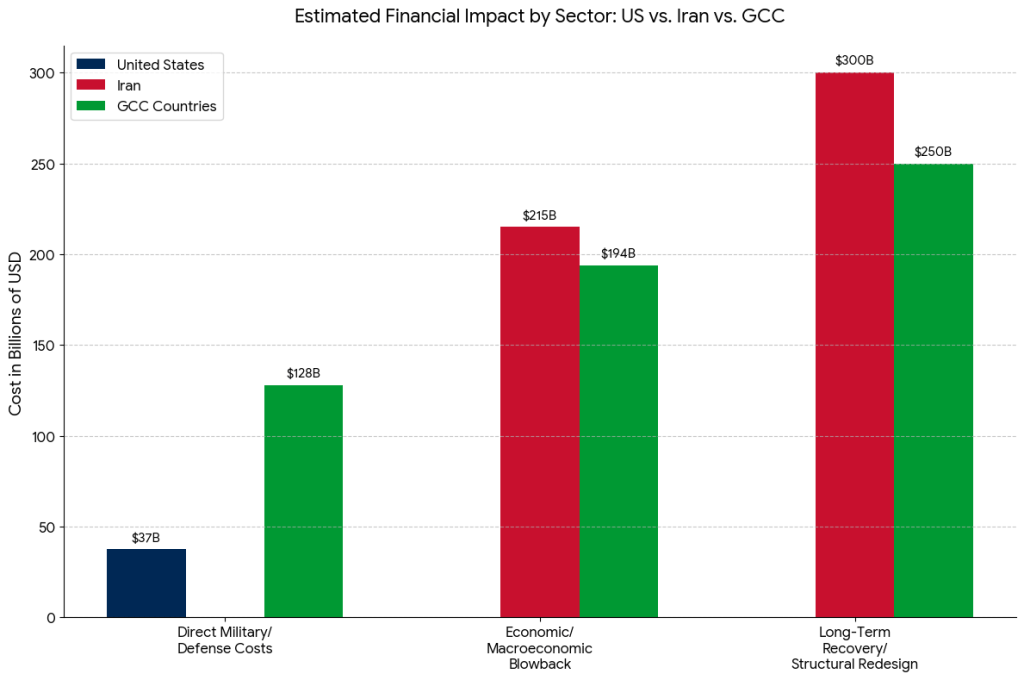
The financial and economic ledger of the ongoing conflict in West Asia reveals a starkly asymmetric distribution of costs across the three primary blocks involved as seen in the Infograph ⬇️ below.
While the United States bears the friction of projectable military power, the theater states face structural devastation. Moving forward, the conflict marks a definitive turning point where the traditional model of undisputed American power projection is breaking down under the weight of a rising multipolar world order.
2. Itemized Strategic Ledger
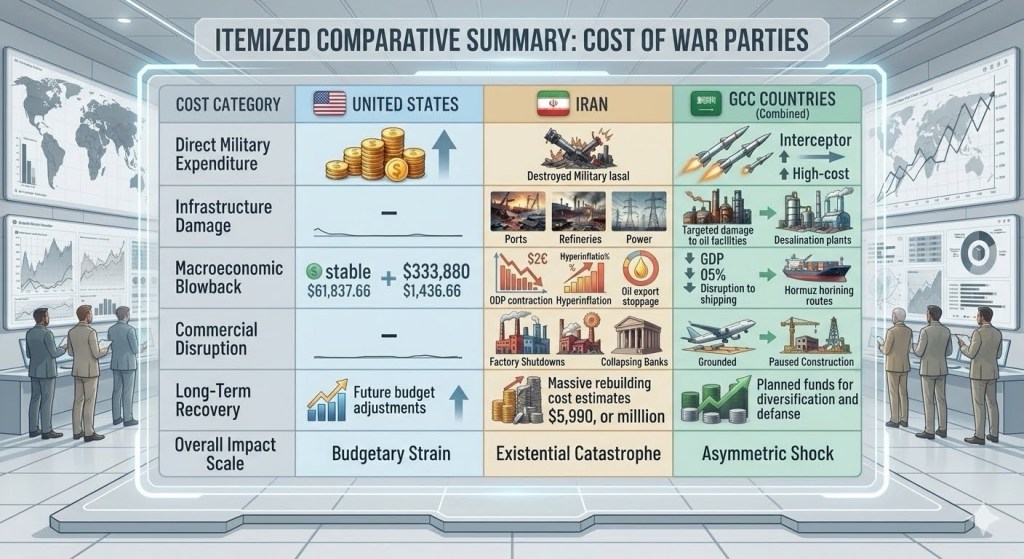
The United States (Budgetary & Material Friction): Direct operational expenditures stand at an estimated $37.5 billion.
This cost is primarily absorbed as budgetary friction—drawn from existing defense outlays and emergency supplemental funding. The material cost is concentrated on munitions depletion and forward positioning asset wear, rather than domestic economic disruption.
Iran (Existential Economic Ruin): For the primary theater state, Iran, the cost is existential.
Direct infrastructure damage is estimated between $80 billion and $350 billion, paralyzing ports, power grids, and refineries.
Compounded by a 15% to 25% GDP contraction, hyperinflation reaching 68.9%, and a complete halt to oil exports, the domestic economy has suffered near-total system failure.
Long-term industrial rehabilitation is projected to require up to $500 billion.
The GCC Countries (Asymmetric Regional Shock): Sitting directly adjacent to the conflict zone, the GCC block bears a massive economic shock despite its substantial financial cushions.
Short-term direct losses stand between $186 billion and $194 billion due to sharp GDP downgrades (notably Qatar’s -14.7% contraction) and a 97% collapse in Strait of Hormuz shipping traffic.
Crucially, the asymmetric “munitions math”—deploying $4 million Patriot interceptors against low-cost drone arrays—presents an unsustainable long-term defense drain, forcing a planned $200 billion to $300 billion structural pivot toward total strategic self-reliance.
3. Guesstimate of Hidden & Unquantifiable Global Economic Friction
Beyond the direct accounts of the combatants, the global economy has absorbed massive, unquantifiable frictional drag.
An educated guesstimate places these hidden global costs well into the hundreds of billions of dollars, driven by three systemic pressures:
A. Supply Chain Recalibration: The near-total closure of the Strait of Hormuz has forced the permanent rerouting of maritime trade and global aviation. The compounding cost of longer shipping lanes, soaring marine insurance premiums, and air freight detours acts as a hidden, regressive tax on global consumer goods.
B. The “Security Premium” Capital Drain: Widespread regional instability has triggered massive capital flight and caused international investors to price a permanent “geopolitical risk premium” into emerging markets. Billions of dollars in foreign direct investment (FDI) originally destined for cross-border infrastructure, green energy transitions, and technology hubs have instead been frozen or diverted into defensive assets.
C. Opportunity Cost of Sovereign Wealth: Trillions of dollars held within regional sovereign wealth funds—which previously anchored global capital markets and mega-projects—are being aggressively defensive-walled. Diverting these funds toward emergency food corridors, domestic water security, and munitions manufacturing represents an immense lost opportunity for global economic expansion.
4. The Intangible Toll: Diminution of American Hegemony
The most grave, inestimable, and irreversible cost of the conflict is borne by the United States. It cannot be quantified on a balance sheet, as it strikes at the core pillars of American global leadership:
— Erosion of Moral Stature: The execution of a highly destructive conflict on Iranian soil has deeply alienated the Global South. For much of the international community, the resulting humanitarian fallout and infrastructural ruin are seen as a unilateral exercise of destructive power, severely compromising America’s traditional claim to being a rule-based defender of international law and human rights.
— Systemic Foreign Policy Failure: The outbreak and escalation of the war mark a definitive breakdown in strategic deterrence and diplomatic architecture. Rather than isolating or containing regional threats, the conflict has accelerated a dangerous counter-alignment, forcing America’s adversaries into tighter military and economic syndicates.
— Diminution of Trusted Leadership: Perhaps the most lasting casualty is the unravelling of strategic trust among traditional allies, particularly within the GCC. Confronted with the immediate vulnerabilities of a disrupted energy corridor and localized security threats, regional partners are concluding that total reliance on the U.S. security umbrella is an unacceptably high risk. This structural shift away from Washington toward multi-aligned, self-reliant defense postures signals a profound, permanent retreat of American trusted leadership on the world stage.
5. The Emerging Reality: The Limits of Force Projection
The conflict has exposed a critical inflection point in global geopolitics: the traditional model of undisputed American power projection is breaking down under the weight of a rising multipolar world order. Moving forward, Washington will find it increasingly difficult, costly, and politically unsustainable to project decisive military force globally due to four shifting realities:
The Proliferation of Cost-Asymmetric Denials
The era of the U.S. Navy operating with near-total impunity in global littoral zones is ending.
The proliferation of low-cost, high-yield technology—such as anti-ship ballistic missiles, precision drone swarms, and smart sea mines—allows mid-tier powers and non-state actors to establish formidable Anti-Access/Area Denial (A2/AD) bubbles. When a defensive network must repeatedly deploy a $4 million interceptor missile to stop a $20,000 loitering munition, force projection shifts from a demonstration of power to a war of financial and material attrition that even the wealthiest superpower cannot sustain indefinitely.
Deepening Adversarial Syndicates and “Cross-Shielding”
In a unipolar world, unilateral U.S. military action could economically and logistically choke a target state. In the emerging multipolar architecture, major revisionist powers provide economic lifelines, alternative financial networks, satellite intelligence, and electronic warfare capabilities to states facing American pressure. This “cross-shielding” ensures that targets of U.S. force projection no longer collapse under isolation, thus dramatically lowering the coercive political efficacy of American military deployments.
The Industrial Constraints of the “Arsenal of Democracy”
Decades of defense sector consolidation and a hyper-focus on expensive, niche platforms have left the U.S. domestic defense industrial base optimized for peacetime production rather than high-intensity, prolonged conflict.
Munitions stockpiles—ranging from artillery shells to advanced cruise missiles—deplete at rates that domestic factories require years, not months, to replenish.
Attempting to project force across multiple competing theaters (e.g., the Middle East, Eastern Europe, and the Indo-Pacific) simultaneously exposes a dangerous material bottleneck, forcing Washington to make zero-sum strategic trade-offs.
The Rise of “Strategic Autonomy” and Multipolar Hedging
Historically, U.S. force projection relied on a vast network of global forward bases and unhindered access to foreign airspace and waters. However, as middle powers grow economically and militarily assertive, they are aggressively pursuing “strategic autonomy.” Reluctant to be dragged into catastrophic regional conflicts or viewed as staging grounds for Washington’s unilateral operations, these nations are increasingly denying airspace access, restricting base usage, and hedging their relationships across multiple global powers. Without guaranteed geopolitical access points, American logistics pipelines become unsustainably fragile.
The beginning of the end of Pax Americana is unfolding in much the same way as Pax Romana and Pax Brittania : rampant profligacy on expanding imperial footprint across the seas of the world in the attempt to impose rule more through projection of force than Force itself.
(Concluded)
