by M. K. Sudarshan B.Com. F.C.A.
July 29, 2026: Chennai, India

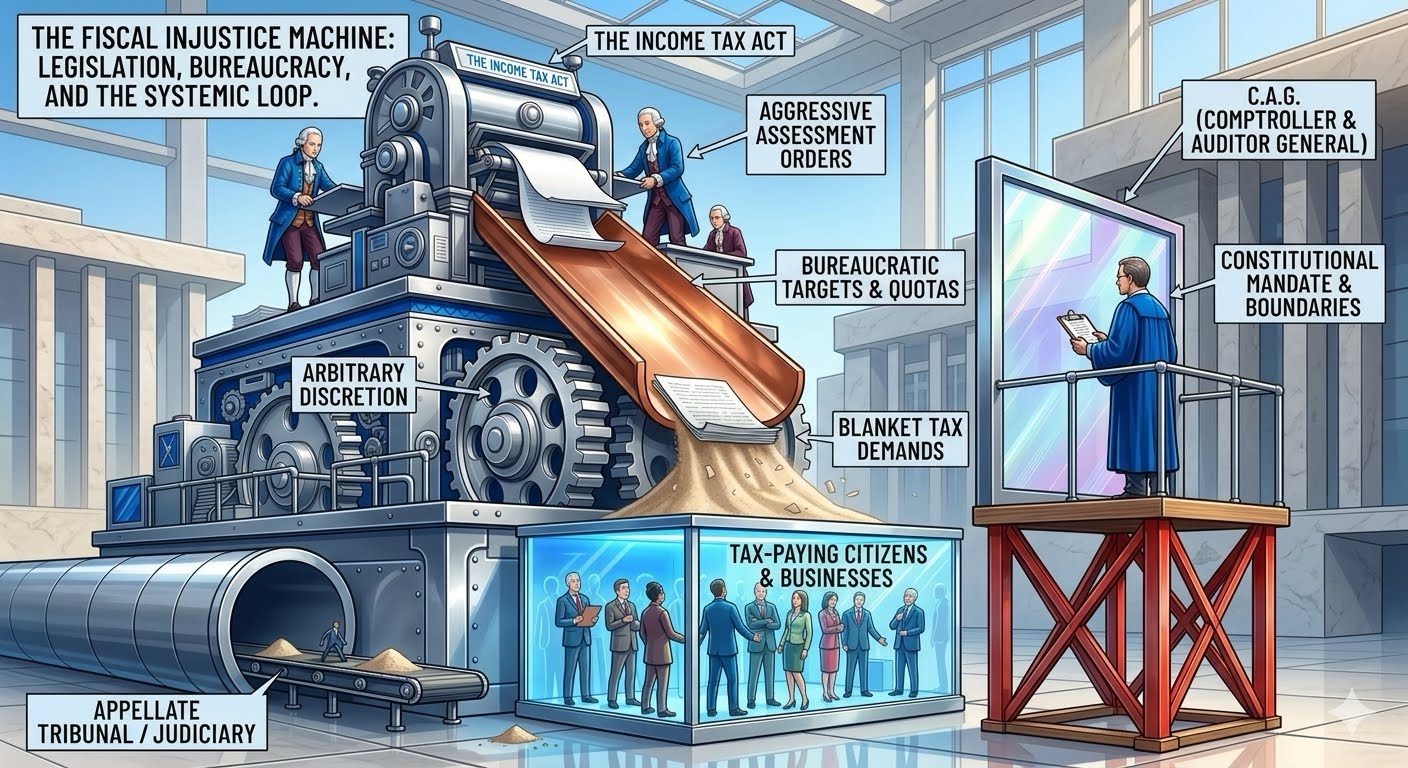
There is in India a thing called a systemic loop of “tax terrorism” that is deeply entrenched within the architectural design of Indian tax administration, constitutional divisions, and budgeting conventions.
In his very recent interview on Raj Shamani‘s podcast Figuring Out, https://youtu.be/jr0k_fOR1b0?si=-p8JVNJ_lEDa8n1i , Mohandas Pai highlighted this thing called a “tax terrorism loop”. He quoted a humungous sum of ₹38 lakh crore being the total volume of pending tax disputes in our country.
The amount Pai talked about is the total cumulative revenue under dispute listed across all direct and indirect taxes in the Union Budget’s explanatory memorandum. It includes legacy cases, penalty disputes, multi-layered demands on the same income, and unresolved departmental tracking.
Mohandas Pai’s contention is fundamentally valid and backed by official data, though he delivers it with a sharp, rhetorical edge to force systemic accountability. His argument is not a manufactured exaggeration. Instead, it highlights a structural failure in how the Indian tax administration tracks and reports bad debt.
Here is a breakdown of why his claim is valid, and where the rhetoric serves a purpose:
Why His Contention is Valid (The Hard Facts)
- The Number Exists in the Budget: The ₹38 lakh crore figure is not made up. It is a verified data point pulled straight from the Receipt Budget (Statement of Revenue Foregone / Disputes) presented by the Finance Minister.
- The “Uncollectable” Reality: Pai’s breakdown—that roughly half of this amount (₹19 lakh crore) is practically unrecoverable because the assessees are untraceable, defunct, or have zero assets—is a reality openly acknowledged even by CAG (Comptroller and Auditor General) reports and the Income Tax Department‘s own internal metrics.
- The Target-Driven Assessment Trap: His core criticism of “tax terrorism” points to a factual systemic flaw. Assessing Officers (AOs) face strict, aggressive annual tax collection targets. To protect themselves from scrutiny by oversight bodies (like the vigilance department), they routinely raise highly inflated, legally weak tax demands at the end of the financial year. They pass the buck to the appellate system, knowing the taxpayer will be forced to appeal.
Where His Argument Shifts to Rhetoric
While Pai’s structural diagnosis is entirely accurate, his framing uses intentional rhetoric to advocate for corporate India and honest taxpayers:
“Bogus” and Untraceable Demands
Pai highlighted in the interview that ₹19 lakh crore (exactly half of his quoted figure) consists of what he calls “bogus” disputes. In these specific cases, the IT department has raised aggressive, arbitrary tax demands, but the assessees are untraceable, unavailable, or possess no assets to recover the funds from.
“Channel-stuffing” by the Assessing Officers of the IT Dept. would amount to fraudulent accounting if done in a private sector company
In the private sector, accounting of revenue by companies in their books has to strictly adhere to IAS — Indian Accounting Standards. Sales cannot be booked at the end of the year just to inflate revenue through what is commonly known in audit terminology as “channel stuffing”. The company auditor usually scrutinises end of the year sales registers and if bogus invoicing is unearthed, the revenue booked is reversed.
However, channel-stuffing is exactly what the assessing officers of the IT Department— according to Pai — do at the end of year just to meet revenue targets set for them by booking cases against bogus assessees. Under revenue recognition standards of the IAS, IFS or GAAP, the practice would be regarded as fraudulent.
Any professional accountant might want to ask the question: Why this double standard of accounting — one for the private sector company and another for the IT Department?
The Institutional Double Standard
The fundamental operational mismatch persists due to a core conflict of interest: the government acts as both the regulator and the beneficiary of the accounting rules.
- Sovereign Immunity vs. Corporate Liability: If a corporate executive intentionally practices channel stuffing to hit a bonus metric, they face criminal prosecution for financial fraud under the Companies Act. If a tax officer issues an inflated assessment to hit a regional target, they are protected by sovereign immunity because they acted under the color of law, even if the demand is later thrown out by a court.
- Preserving Paper Assets: A private corporation must write off bad debts to give a true and fair view to investors. The government resists writing off uncollectable, disputed demands because keeping that massive backlog on the books allows it to maintain an artificially inflated projection of potential sovereign assets.
Ultimately, the double standard exists because the state has designed a system where it is legally insulated from the very rules of financial discipline it imposes on the private sector.
“Tax Terrorism” and Fast Demands
Pai heavily criticized the system, noting that 80% of that ₹19 lakh crore chunk was piled on purely through tax demands raised by assessing officers over the last 5 years. He argued that officers routinely issue inflated assessments to meet collection targets, knowing the demands will quickly enter an endless cycle of appeals.
- “Bogus” vs. “Protective” Demands: Calling the entire ₹19 lakh crore chunk “bogus” simplifies a complex administrative issue. A large portion of these are “protective assessments.” For example, if a scam or complex transaction occurs involving multiple shell companies, the IT department legally raises the same tax demand on all suspected entities simultaneously to ensure the state doesn’t lose out, intending to drop the duplicate demands once the primary culprit is legally nailed. This artificially balloons the total dispute figure on paper, even if only one chunk of it is real.
- A Political Weapon Against Bureaucracy: By calling out the Finance Minister and demanding that officers face negative entries in their Confidential Reports (CR) for losing frivolous appeals, Pai is using public rhetoric to pressure the executive branch into reigning in an over-aggressive tax bureaucracy.
The Bottom Line: Pai is thus using a hyper-accurate symptom (the staggering ₹38 lakh crore listed in the budget) to expose a chronic disease (over-assessment and systemic harassment by the IT Department). While his delivery is aggressively rhetorical to grab headlines, his mathematical and procedural critique of the direct tax system is entirely sound.
What has been done to cure the chronic disease ?
There are exactly 5.4 lakh (540,000) pending income tax appeals across India.
This updated figure was officially detailed by Union Finance Minister Nirmala Sitharaman at the recent 167th Income Tax Day celebrations.
Key Dispute Data At A Glance
- Total Pending Cases: 5.4 lakh appeals remain unresolved.
- Locked-up Revenue: Over ₹5 lakh crore in disputed tax demands is currently tied up in these pending cases.
- Recent Disposals: The Income Tax Department executed an aggressive disposal drive during the last financial year (FY26), resolving a record 2.24 lakh appeals. This outpaced the 1.7 lakh newly filed cases, resulting in a net reduction of roughly 34,000 cases from the previous backlog.
- Forums Involved: The vast majority of these disputes (~4.95 lakh cases) are first-tier appeals pending before the National Faceless Appeal Centre (NFAC) / Commissioner of Income Tax (Appeals). The rest are distributed across the Income Tax Appellate Tribunal (ITAT), various state High Courts, and the Supreme Court.
From the above disclosure made by the Finance Minister, it is clear the goal-post she is focusing on is not the goal-post Mohandas Pai is talking about.
Nirmala Sitaraman makes no mention at all of the ₹.38 lakh crore “tax-terrorism” that Pai is screaming about from the rooftops. Instead, the Finance Minister is sort of patting herself on the back for her Government’s measures taken to attenuate the chronic disease differently defined.
Reduction Measures in Effect
To actively mitigate this judicial burden of ₹38 lakh crore or ₹. 5 lakh crore (whichever way one wants to quantify it) , the Central Board of Direct Taxes (CBDT) has implemented a litigation prevention strategy. This includes increasing the monetary thresholds required for the department to file appeals (raising the limits to ₹60 lakh for ITAT, ₹2 crore for High Courts, and ₹5 crore for the Supreme Court), which has successfully forced the administrative withdrawal of thousands of low-value, legacy cases.
Vivad se Vishwas Schemes: The government introduces temporary amnesty windows. If a taxpayer pays the core disputed tax, the government waives all penalties and accumulated interest, instantly deleting the case from the backlog.
Bravo ! But what about the ₹19 Lakh crore “bogus” and “preventive” cases that still sits on the government’s balance-sheet as Receivables ?
Why can’t the CAG do an audit to establish the bogus cases … and have them deleted from the legacy backlog ? It’s after all just a one-time clean up operation and must be simple to do, no? That way, the basic motivations for “tax terrorism” by the IT Dept., going forward, goes away or could be significantly reduced, right?
The Clean-up that is Constitutionally blocked
While a one-time clean-up seems simple on paper, the Comptroller and Auditor General (CAG) cannot delete these cases because it lacks the legal authority, and the “clean-up” itself is legally blocked.
Under the Constitution of India, the CAG is strictly an external auditor, not a tax administrator or a judge. It can flag errors, but it cannot delete tax demands or settle judicial disputes.
The process is stalled by three major systemic barriers:
1. Legal Barriers (The CAG Has No Executive Power)
- Audit vs. Adjudication: The CAG can audit a file and write a report stating, “This ₹1,000-crore demand is unrecoverable because the company is bankrupt.”However, only an Assessing Officer (AO), a Commissioner, or a Court has the legal power under the Income Tax Act to formally delete or write off that demand.
- A corporate auditor can force a company to pass a journal entry to reverse a bogus invoice. The CAG cannot do this for the Income Tax Department due to severe constitutional limitations:
- Judicial Independence vs. Audit Power: A corporate invoice is an administrative document. A tax assessment order is a quasi-judicial decree issued under powers granted by the Income Tax Act. The CAG is an accounting auditor, not a court of law. It possesses no legal authority to quash or rewrite a judicial order passed by a designated statutory officer.
- The Post-Facto Mandate: The CAG operates entirely as a post-facto auditor. It reviews files after the financial year has closed. It cannot intervene in real-time to halt an assessment or stop an officer from issuing an order on March 31.
- The Power to Flag, Not Force: The CAG regularly exposes this dynamic. In its annual Compliance Audit Reports on Direct Taxes, the CAG consistently flags that over 97% of outstanding tax demands are highly uncollectable and artificially inflated. Yet, the CAG’s jurisdiction ends at tabling this report in Parliament; it cannot force the department to delete the files.
- The Appeal Trap: Once a tax demand enters the formal appeal process, it becomes a quasi-judicial matter. The CAG has absolutely no jurisdiction to interfere with or cancel a case that is pending before an appellate authority or a court.
2. Operational Barriers (The “Simple” Clean-up is a Massive Illusion)
What looks like basic bookkeeping data is actually a legal minefield. A simple clean-up is operationally impossible for three reasons:
- Multi-layered “Protective” Demands: If a ₹5,000-crore financial fraud involves five interconnected shell companies, the IT Department raises a ₹5,000-crore demand on all five companies simultaneously to protect government revenue. On paper, this registers as ₹25,000 crore in disputes. You cannot simply delete four of them until the final court ruling proves exactly which company is legally liable.
- Fear of Vigilance Scrutiny: Writing off a tax demand requires an official signature. Tax officers are terrified to sign off on deleting large balances. If they delete a demand against a defunct company, the Central Vigilance Commission (CVC) or CBI can later accuse the officer of corruption or collusion with the taxpayer. Passing the buck to a court is always the safer career move for a bureaucrat.
- Tracking Untraceable Assessees: To formally declare a tax demand “uncollectable,” the department must legally prove they exhausted all search options. Proving a company has zero assets or that a promoter has permanently fled the country requires years of inter-agency coordination, making it a slow, painful process rather than a swift clean-up.
3. Political and Budgetary Barriers (The Paper Wealth Effect)
- Artificially Inflated Assets: These disputed tax amounts are listed as “receivables” or potential revenue in government accounting. Deleting ₹19 lakh crore from the ledger instantly wipes out a massive chunk of the government’s theoretical asset base on paper, which looks politically unfavorable.
The legislators, abetters, victims and bystanders of “tax terrorism”
So, does it all mean that the “tax terrorism” Pai alleges is being enabled and perpetuated by the IT laws and statutes themselves? By constitutional boundaries? And by budget conventions? And so, nothing can be done about it except to deal with the “chronic disease” with whatever feeble measures the Government can come up with, from time to time, on an ad hoc knee-jerk basis?!
There is no doubt that the architecture of Indian Taxation system is self-perpetuating and is laid out across three institutional layers:
1. How System Architecture Perpetuates the Loop
- The Legislative Target Trap: The Income Tax Act grants Assessing Officers (AOs) vast discretionary powers to make additions during assessments. Simultaneously, the Ministry of Finance sets aggressive revenue collection targets for the Central Board of Direct Taxes (CBDT) every budget cycle. This forces AOs to use their legislative discretion to maximize high-pitched, arbitrary assessments to meet their immediate regional quotas.
- The Constitutional Standoff: The strict separation of powers creates a judicial firewall. Once an AO issues an assessment order, it transforms from an administrative file into a formal legal dispute. The executive branch cannot simply command a clean-up, and external bodies like the CAG cannot breach this boundary, forcing every single case to grind through the understaffed appellate machinery.
- The Budgetary Fiction Convention: Listing ₹38 lakh crore under dispute acts as an accounting cushion in the Union Budget documents. Wiping this ledger clean through a massive executive write-off would instantly force the government to declare a massive reduction in its theoretical assets, heavily impacting fiscal deficit perceptions and international sovereign credit ratings.
2. Why Radical Solutions Face Institutional Resistance
To break this cycle, the government would need to implement drastic measures, but each choice carries a significant institutional penalty:
- Radical Option 1: Executive Immunity for Tax Write-offs
- The Measure: Grant a high-level committee the absolute power to permanently delete or write off tens of thousands of unrecoverable, “bogus” corporate tax cases.
- The Roadblock: Bureaucratic self-preservation. No civil servant will sign off on deleting a multi-crore demand out of fear that the Central Vigilance Commission (CVC), CAG, or CBI will later classify the decision as corruption or collusion with corporate assessees.
- Radical Option 2: Abolishing Personal Accountability for Missed Targets
- The Measure: Evaluate tax officers based on the quality and legal sustainability of their assessment orders rather than the sheer volume of tax demands they generate.
- The Roadblock: Institutional inertia. The system is structurally reliant on aggressive, short-term tax demands to fill the immediate quarterly cash-flow gaps of the Union Exchequer.
The system thus remains structurally oppressive because the state/government values institutional stability and revenue protection over radical taxpayer relief.
The Long and Short of it All
The “tax terrorism” that Mohandas Pai is so incensed about is indeed structurally or organically wired into the Indian Taxation system.
The Constitution of India and the Income Tax Law have legislated it into the fabric of governance; the Finance Ministry abets it; the Comptroller and Auditor-General of India is a bystander; and the tax paying people of India remain the silent, forbearing victims.
(Concluded)
