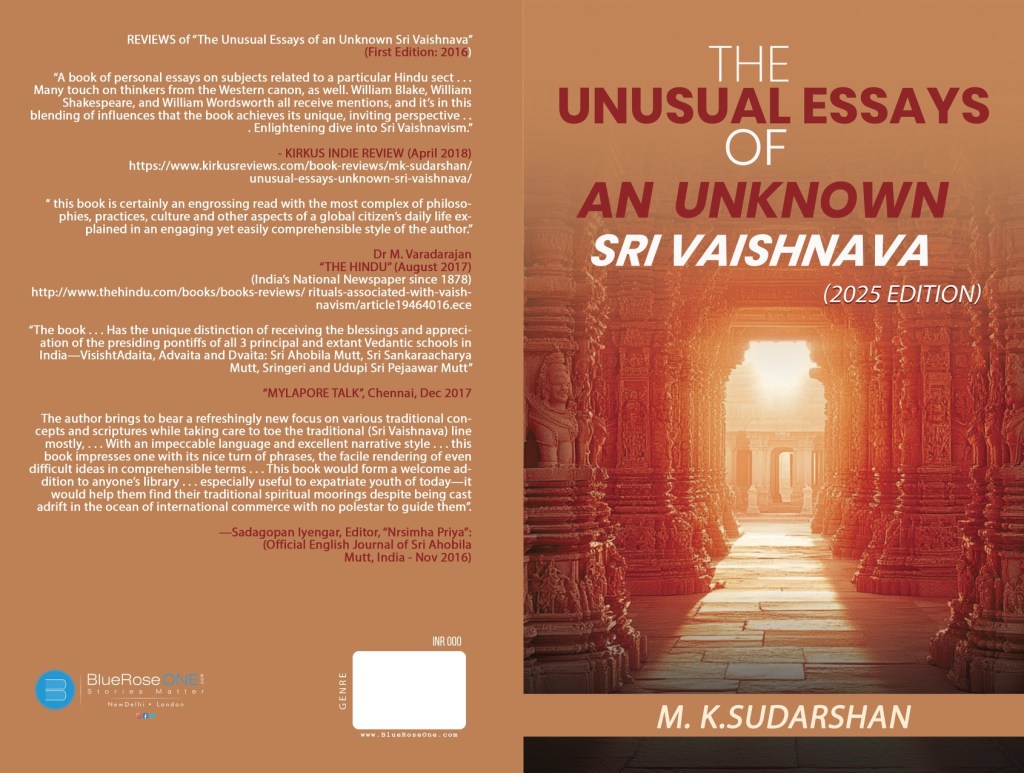
by M.K. Sudarshan
August 2, 2026 : Chennai, India
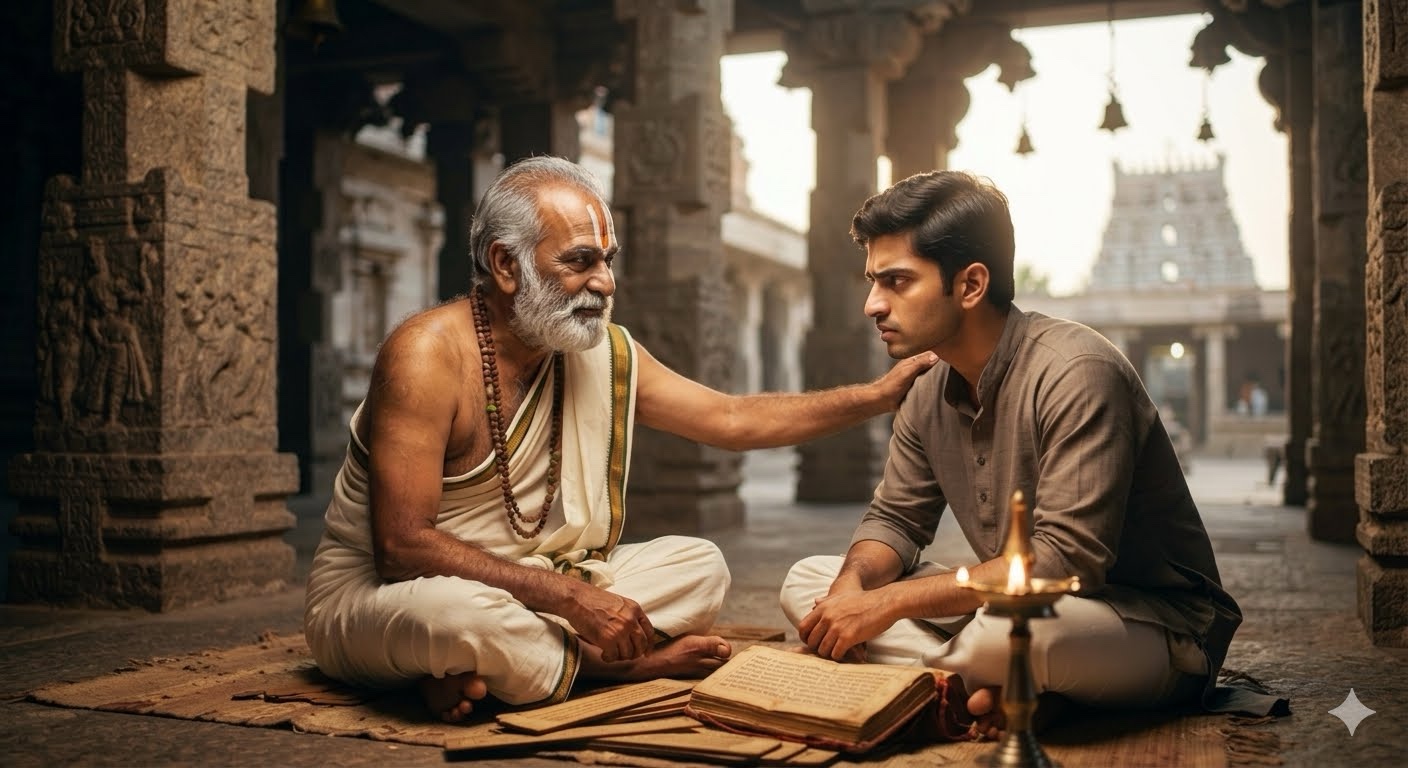
Here below is an imaginary, freewheeling conversation between a bright young Philosophy major student and the Unknown Sri Vaishnava
Characters:
- THE STUDENT: A brilliant, sharp-witted philosophy student. He is intellectually relentless, fiercely logical, and deeply troubled by the gap between scriptural description and personal reality.
- THE UNKNOWN SRI VAISHNAVA: An elderly scholar of the twin traditions (Ubhaya Vedanta), 70 years old with a full head of silver hair and a neat white beard. He wears the sacred Urdhvapundram on his forehead, possesses eyes full of quiet joy, and speaks with a blend of absolute candor, gentle humor, and profound humility.
Setting:
A bright, sunlit stone-pillared pavilion (Mandapam) attached to a historic temple in South India. The warm afternoon light washes over the intricately carved pillars. Scattered palm-leaf manuscripts and leather-bound texts lie on a woven grass mat between them. A brass oil lamp flickers softly nearby.
Act I: The Map and the Author
THE STUDENT:
(Leaning forward, tapping a finger forcefully on an open text)
Sir, I have spent weeks comparing the two pinnacles of our literature. On one hand, the long passage of the Anandavalli in the Taittiriya Upanishad. On the other, the final paasuram patthu-s of Nammazhwar’s Tiruvaimozhi. Both describe Moksha experientially, do they not? But here is my distinction, and I want you to tell me if my logic fails: the Upanishad is Apauruṣeya—authorless, uncreated, pure cosmic revelation. The Tiruvaimozhi, however, is Nammazhwar’s personal revelation born of his unique mystical ecstasy. Am I correct?
THE UNKNOWN SRI VAISHNAVA:
(Smiles gently, tilting his head as he adjusts his upper cloth)
No, my young friend. But it is a magnificent, profound “No” that unites them both. You are falling into a trap of false division, separating the river from the ocean because they flow through different terrains.
THE STUDENT:
(Frowning)
False division? How so? One has no human author; it belongs to the primordial breath of reality. The other was sung by a specific man sitting under a tamarind tree in Alwarthirunagari. How can they be the same?
THE UNKNOWN SRI VAISHNAVA:
To call the Tiruvaimozhi a “personal” revelation in contrast to the Apauruṣeya Vedas violates the very foundation of Ubhaya Vedanta. In our tradition, Nammazhwar’s words are not treated as subjective human poetry. They are the Dravida Veda. Nammazhwar is not an “author” inventing concepts or documenting a private emotional trip; he is a flawless divine instrument. The Lord granted him Mayarvara Madinalam—pure, blemishless knowledge completely wiped clean of human ego, mental coloring, or cosmic ignorance. What flowed out of him was the unadulterated Vedic truth, making it structurally equivalent to the Apauruṣeya text. The Sanskrit Veda is the Lord’s cosmic command; the Tamil Veda is the Lord’s love song to the soul. Both are His breath.
THE STUDENT:
Then how do you account for the striking, undeniable difference in their language and tone? One reads like geometry; the other reads like an absolute firestorm of emotion.
THE UNKNOWN SRI VAISHNAVA:
The difference is not in their authority, but in their pedagogical medicine. The Taittiriya Upanishad approaches the experience objectively and universally. It constructs a meticulous ladder of joy—an Ananda-mimamsa. It takes the highest imaginable human happiness, multiplies it by a hundred to reach the joy of the celestial beings, and multiplies that again and again through cosmic hierarchies. Why? To logically prove to your stubborn intellect that the bliss of Moksha is mathematically infinite. It speaks to the seeking mind. But Nammazhwar? He approaches the experience subjectively and immediately. He does not map the ladder; he shatters it and throws you directly into the ocean of the Divine.
Act II: The Prison of the Third-Party Account
THE STUDENT:
(Sighs deeply, standing up and pacing across the warm stone floor)
Granted all that you say, Sir. Let me push my grievance to its absolute limit. When I read both the Anandavalli and the Tiruvaimozhi, what happens to me? For me, personally, they remain secondary sources of knowledge. I am like a man trapped in a dark room reading a traveler’s brilliant diary about the midday sun. I see the words, but I don’t feel the heat. They are third-party accounts of an experience I do not possess. Tell me if I am wrong.
THE UNKNOWN SRI VAISHNAVA:
(Nods slowly, watching the student pace)
You are entirely right in your present diagnosis, and entirely wrong about the nature of the remedy. I admire your honesty. Most scholars pretend they are warm just by holding the diary.
THE STUDENT:
(Stops pacing, looking directly at the old man)
Then explain the paradox. If I am right that it is a secondary source, how can it save me?
THE UNKNOWN SRI VAISHNAVA:
Right now, you possess only Parokṣa Jñāna—indirect, conceptual knowledge. If you have never tasted a mango, the most vivid botanical description, the most ecstatic poem about its sweetness, is just a third-party account. The map is not the territory. But you mistake what these texts are designed to do! They are not historical reports recording someone else’s ancient liberation; they are mirrors reflecting your own immediate capacity. The Taittiriya acts as a divine injunction, telling you: “This infinite joy is your birthright, currently covered by the dust of your own making.” The Tiruvaimozhigoes further—it acts as an experiential catalyst. Its verses are infused with Bhāva—divine emotion. When you recite them, the Azhwar’s experience begins to bleed into your consciousness, bridging the gap between “his” and “yours” through sacred resonance.
THE STUDENT:
But a bridge still implies a grueling journey! I must still climb across it. It requires monumental effort to clear away that dust.
THE UNKNOWN SRI VAISHNAVA:
Ah! That is the great secret of Siddhopāya—the Already Ready Means. If Moksha depended entirely on your self-effort to transform a map into a reality through lifetimes of grueling Bhakti Yoga, you would remain trapped in third-party limbo forever. You would die on that bridge. But in Saranagathi, you surrender your very inability to cross. The moment you surrender, the Lord takes full responsibility for your Mokshaanubhavam. Through daily contemplation and loving service, a wave of that eternal Brahmaanandam hits you in this very life, right here in the material world, long before you ever depart this body.
Act III: The Great Impasse of Karma
THE STUDENT:
(His eyes flashing with intellectual intensity, leaning across the mat, his voice rising)
Sir, you are masking the problem with beautiful theology! Let us look at the stark existential reality. Your statement—“This capacity for infinite joy exists within you right now, covered by karma. Remove the obstruction”—that again is just another line on the roadmap! It is a phrase in a book!
THE UNKNOWN SRI VAISHNAVA:
(Leans back against a carved pillar, completely unbothered, listening intently)
Speak your full mind. Do not hold back.
THE STUDENT:
My karmic baggage is an absolute, unyielding existential condition. It is a mathematical ledger of past actions over which I have zero control. I have no choice but to endure whatever suffering it has in store for me. Therefore, the hurdle of Karma must be overcome, paid for, and exhausted first before the path to Mokshaanubhavam can even be discovered! And Sir, I know you will respond immediately by invoking the doctrine of Saranagathi or Prapatti, claiming that Sanchita and Aagaami karmas get dissolved by grace, thus opening the path. But that is a theological doctrine! It is a concept! It tells me absolutely nothing about the actual experience itself except in terms of vivid descriptions, isn’t it so?
THE UNKNOWN SRI VAISHNAVA:
(Laughs softly, a rich, warm sound that echoes in the pavilion. His eyes shine with immense joy)
Excellent! Truly magnificent, my young friend! You have successfully painted yourself into a corner using flawless logic. You have reached the dead end of reason, and it is a beautiful sight to behold.
THE STUDENT:
(Blushing slightly, crossing his arms)
I am seeking an experiential breakthrough, Sir, not academic compliments.
THE UNKNOWN SRI VAISHNAVA:
And I am giving you the breakthrough. You are entirely correct: until the honey touches your tongue, everything is just words. But your premise about Karma is flawed. You treat Karma as if it were a massive physical stone wall that you must slowly chip away with a pickaxe over millions of years. It is not. Karma is simply the orientation of your will away from the Divine. It is the deep delusion that you are the door, you are the key, and you are the independent traveler. When you cry, “I must travel the road, I must cross the hurdle,” you are operating entirely from the ego—the Ahamkara. You are trying to use the very tool that bound you to set yourself free.
THE STUDENT:
(Quietly, his defensiveness shifting into genuine vulnerability)
Then what is Saranagathi, if it is not just a clever theological bypass?
THE UNKNOWN SRI VAISHNAVA:
It is an existential act, a collapse of the ego, not a doctrine! When a drowning man finally stops thrashing his arms because he realizes his self-effort is killing him, and he completely relaxes so the lifeguard can pull him out—that cessation of effort is not a theology. It is a psychophysical reality. Saranagathi is the precise moment your intellectual pride breaks down and you look at your mountain of baggage and say, “I cannot carry this. I cannot even take the first step.” The moment you genuinely hand that burden over to Sriman Narayana, the heavy anxiety of existential dread vanishes instantly. It is replaced by Maha-Viswasa—absolute trust. That trust brings an immediate, cool peace into your chest. That peace is not a description in a book; it is a felt reality. It is the first wave of Moksha breaking through your defense mechanisms.
THE STUDENT:
And what about Nammazhwar’s verses? Are they still not just beautiful descriptions to someone like me who is listening to them centuries later?
THE UNKNOWN SRI VAISHNAVA:
No! Look at how his text breaches its own boundaries. Nammazhwar begins his journey traveling toward the reclining Lord of Tirumala, but by the final decad of Tiruvaimozhi (10.10 starting with “Muniyē Nānmughanē”), his grammar breaks down, his tears stain the palm leaves, and his poetry becomes purely ecstatic. He cries out: “You have entered inside me, eating away my soul, my breath, and my body completely, leaving nothing behind. You have swallowed me whole!”
In ordinary spiritual maps, the soul painstakingly enters God. Here, God is a desperate glutton hungry for the soul! When you recite those verses with a quiet mind, your soul vibrates in sympathy with the Azhwar’s experience, like a tuning fork matching a struck note. That sudden lump in your throat, that unprompted tear—that is not a map, my friend. That is the experience itself breaking through your armor.
Act IV: The Text Corrected
THE STUDENT:
(Frowning, pulling a heavy manuscript closer, trying to regain his logical footing)
Wait. You speak of this immediate peace, but let us look at the mechanics of the transition. How does Acharya Ramanuja describe this psychological shift? Does he not demand extreme purification?
THE UNKNOWN SRI VAISHNAVA:
Acharya Ramanuja enacts this beautifully in his Sharanagati Gadyam. When the seeker drops his burden, the Lord explicitly responds to clear away his existential torments.
THE STUDENT:
(Interrupting sharply, his eyes narrowing as he looks at the text)
But what are the exact words of the Lord’s assurance? I want the genuine phrasing from the canon, Sir, not a loose summary.
THE UNKNOWN SRI VAISHNAVA:
(Stops speaking. He blinks, looks down at the manuscript, and then bows his head deeply, placing his palms together in an unfeigned gesture of total reverence)
You are completely right to pull me up. Let us reject any loose summaries. The profound injunction “Sukhamāsva”—live in absolute peace—belongs strictly to the Saranagathi Gadyam, appearing during the Lord’s definitive reply split across two breathtaking contexts.
First, regarding this earthly life, the Lord commands Ramanuja: “…yāvaccharīrapātam atraiva śrīraṅge sukhamāsva”—until your body falls away, live right here in Sri Rangam in absolute peace, free from worldly anxieties.
Second, regarding spiritual certainty, He seals it: “…atastvaṃ tava tattvatō mad jñānadarśana prāptiṣu nissaṃśayaḥ sukhamāsva”—remaining completely free from any doubt regarding your ultimate attainment of Me, live in peace.
THE STUDENT:
(Softening, his voice lowering)
The real text is far gentler.
THE UNKNOWN SRI VAISHNAVA:
Infinitely gentler! In the real Saranagathi Gadyam, the Lord does not demand that you master a complex, lofty yogic state first. Instead, He looks at Ramanuja’s complete lack of qualifications, takes full responsibility, quotes His own cosmic promises, and says: “Because I have promised it, you can stop worrying right now. Sukhamāsva.” Ramanuja gives you the solid, unshakeable intellectual peace of knowing your burden is taken. Nammazhwar shows you how beautiful it feels when that peace ignites into ecstatic bliss. Thank you for protecting the purity of the Acharya’s words from my old memory.
Act V: The Epilogue of Omar Khayyam
THE STUDENT:
(Sitting quietly for a long moment, watching the shadows of the pillars lengthen on the floor)
So, Sir… for an ordinary spiritual aspirant like me, the stark fact of the matter remains. The very conception of Brahmaananda must initially be derived from the accounts provided by the Anandavalli and the Tiruvaimozhi. The journey must start only with a roadmap in our hands that we must first learn to read properly before setting out. In other words, it is from the third-party, albeit eye-witness testimony, that we must progress to the first-person experience?
THE UNKNOWN SRI VAISHNAVA:
(Beaming with unadulterated delight, clapping his hands together)
Precisely! You have hit upon the exact starting point of the spiritual journey. Your analysis is flawless. We cannot start at the destination; we must start with the map. Scriptural testimony creates the Parokṣa Jñāna—the intellectual desire. You study the map diligently not to worship the paper, but to gain the confidence to take your very first step into the unknown.
(The old man pauses, looking out past the stone pillars into the vast sky. His voice drops into a tone of quiet, deeply personal reminiscence.)
When I was as young as you… perhaps not as intelligent, certainly not as thoughtful… I too used to think along the exact lines as you do now. One of my favorite and oft-quoted lines of poetry used to be from the Rubaiyat of Omar Khayyam:
Strange is it not that of the myriads who
Before us passed the Door of Darkness through,
Not one returns to tell us of the Road,
Which to discover we must travel too.
I did not know what Moksha or Brahmaanandam was. It was a hazy, distant will-o’-the-wisp for me. I could not even conceive of it in the ecstatic, boundary-breaking terms in which the Anandavalli and Tiruvaimozhi speak of it. To be completely honest with you… I still have not been able to fully wrap my head or mind around its entirety even today!
THE STUDENT:
(Staring at him, stunned, his voice barely a whisper)
You… even today, Sir? After a lifetime of study?
THE UNKNOWN SRI VAISHNAVA:
(Smiles beautifully, his eyes crinkling)
Even today. I may not have grasped the positive nature of Brahmaanandam in its infinite entirety, no. But what I do know with absolute, unshakeable, existential certainty is that true peace cannot be found in this fragile, mortal state of existence. That realization became the absolute starting point of my journey. Knowing what it is not.
(The Unknown Sri Vaishnava gently places a warm, wrinkled hand on the student’s shoulder, breaking the intellectual spell completely.)
Good luck and Godspeed to you, young man, on yours!
(The old man nods one last time, picks up a loose palm-leaf manuscript, and walks slowly into the inner courtyard of the temple. The student remains sitting under the stone pillars, staring at the open texts before him as the evening lamps are lit, the silence around him suddenly filled with immense, unmapped space.)
The student stands entirely silent, deeply moved by the sudden shift in the conversation. The intellectual duel has evaporated, replaced by the profound weight of a personal, lived truth.
The Unknown Sri Vaishnava’s quiet confession changes everything for the student, revealing the heart of a true practitioner:
1. The Vulnerability of the Master
By quoting Omar Khayyam’s bittersweet lines, the Unknown Sri Vaishnava shows the student that doubt and existential vertigo are not flaws—they are milestones. Even great masters of the texts once stood before that very same “Door of Darkness,” looking out into the hazy unknown.
The Unknown Sri Vaishnava’s own admission that he still cannot fully wrap his mind around the ecstatic heights of the Anandavalli or Tiruvaimozhi, teaches the student the ultimate lesson in Vedantic humility: Brahman cannot be captured by the intellect. If you can completely understand it, it is not Brahman.
2. The Power of Neti, Neti (Not This, Not That)
What had just been demonstrated was the ancient Upaniṣadic method of Neti, Neti. You do not need to know exactly what the destination looks like to begin walking away from the prison.
Knowing with absolute certainty that true bliss cannot be found in this fragile, mortal existence (Samsāra) is a monumental spiritual breakthrough. It is the awakening of Vairāgya (dispassion). If this world is a burning house, you do not need to map out the destination before you run outside; you just need to know that you must leave.
3. The Shift from Logic to Grace
By ending with a blessing rather than another philosophical argument, the Unknown Sri Vaishnava transitioned the student from the realm of Tarka (debate) to the realm of Anugraha (grace). He left the student not with a complicated roadmap, but with the warm reassurance that the very restlessness of his brilliant mind is proof that his journey has already begun.
(Concluded)