
by M.K.Sudarshan
August 4, 2026: Chennai, India

Did Tyagaraja ever imagine, in his own lifetime, that his compositions would one day become the staple fare of a vast Carnatic music kutcheri circuit, sustained by sabhas, sponsors, reputations, and an entire performing ecosystem?
Probably not in any literal sense. He was not writing for a concert market, nor for a profession called “Carnatic artist” as we know it today; he was singing as a devotee, a seeker, and a composer for whom music was a mode of worship, not a platform for branding or commercial self-fashioning.
That is precisely what makes the later history of his music so remarkable.
Tyagaraja’s compositions did not spread because of media machinery, recording technology, institutional publicity, or royal patronage in the modern sense. They spread through disciples, devotional gatherings, oral transmission, and the reverberations of musical excellence itself. In that older world, the song was the advertisement, the tradition was the archive, and the listener was also the transmitter.
Tyagaraja did not become a court musician in the ordinary sense, though royal attention did at times come his way. The important point, however, is that he is remembered as having declined the lure of courtly life and patronage, preferring the integrity of his spiritual calling to the prestige of elite sponsorship. His fame therefore did not arise from being packaged by power, but from the force of a body of compositions so profound that even elites, scholars, disciples, and ordinary rasikas were drawn into its orbit.
Over time, his songs moved from the intimate space of devotion into the larger public world of performance. His disciples and the sishya parampara routes preserved and transmitted the compositions; later generations of musicians absorbed them into concert practice; and eventually they became the very backbone of the Carnatic repertoire. In that sense, the modern kutcheri circuit did not merely inherit Tyagaraja — it was, in a very real way, built around him.
Yet that inheritance carries a tension.
The contemporary sabha and kutcheri ecosystem is undeniably shaped by sponsorships, ticketing, curation, artist branding, competitive visibility, and the pressures of a cultural economy.
It is not wrong to describe it as an industry. At the same time, to reduce it only to commerce would be unfair, because the same ecosystem still sustains serious listening, pedagogy, lineage, and moments of genuine devotional concentration. The tradition remains hybrid: part public art, part cultural enterprise, part spiritual discipline.


Would this all fit Tyagaraja’s vision? Only partially. If his ideal was nadopasana — music as worship, interiority, surrender, and communion with Sri Rama — then the modern concert world, with its prestige economy and performance pressures, would likely appear compromised. Tyagaraja’s compositions were never meant to be mere entertainment, even though they undeniably possess beauty, complexity, and wide appeal. Their deepest intention was devotional transformation, not applause.
And yet the paradox is unavoidable: without his compositions, Carnatic music would not be what it is today. His kritis, Pancharatnas, Divyanama songs, and Utsava Sampradaya compositions are not peripheral to the tradition; they are central to its identity, pedagogy, and concert life. He gave the music world a repertoire, a spiritual grammar, and a standard of bhava that later musicians continue to measure themselves against. In that sense, the very system that may sometimes seem to move away from his ideal is also sustained by his genius.
A particularly telling example of this continuity is the Tirupati Sri Thyagaraja Cultural Trust, whose annual festival in 2026 ran from August 1 to 5 and included the centenary observance of its former chairman M. Krishnaswami (1926-2013).
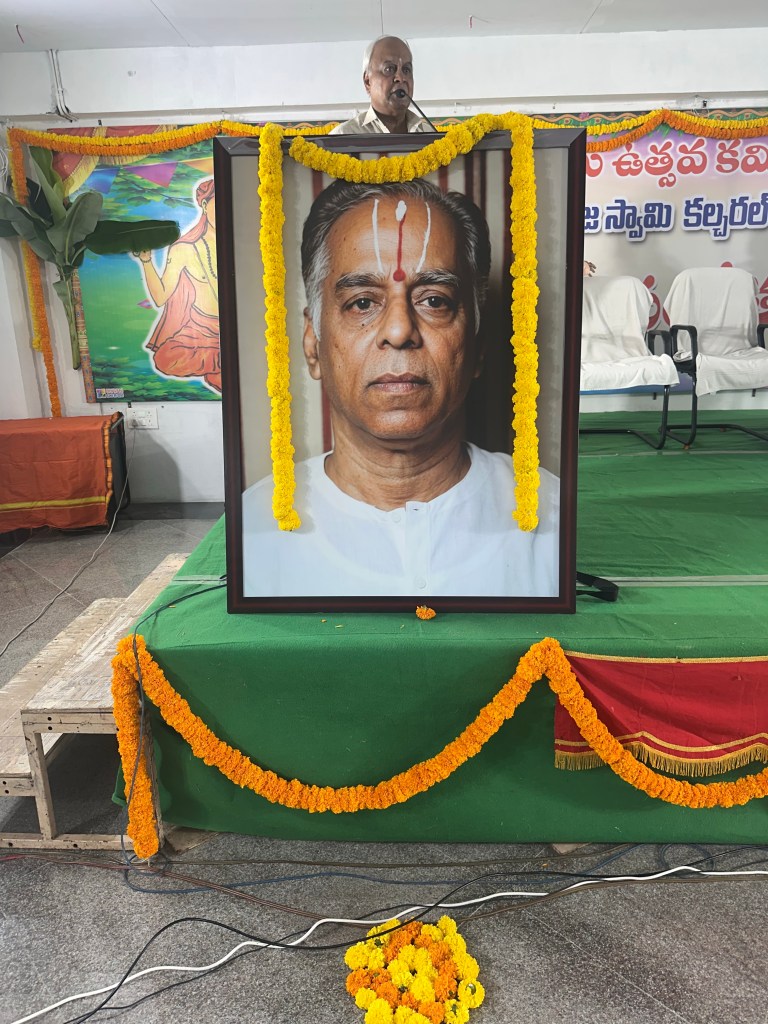
MK, as he was widely known, was the husband of Sangitha Kalanidhi, Padma Shri Dr. Smt. Mani Krishnaswami, and in the music circle he was remembered as a self-effacing but decisive force behind her career and public reach. He shaped and curated her musical journey with quiet intelligence, helping her attain the stature that eventually earned national recognition, while himself remaining out of the spotlight.

The same zeal that MK brought to his wife’s musical life he brought to the Tirupati Trust, which he helmed from the early 1970s until 2010. By all accounts, he persevered through and surmounted all the practical burdens that can make cultural work so very difficult — funding, infrastructure, manpower, organization, and public relations — yet never abandoned the cause of nadopasana at Tirupati.
Today, the Trust’s festival template — with its mix of student participation, nadaswaram vidwans, and leading artists such as Nithyasree Mahadevan and Sunil Gargeyan— was fashioned by MK and now stands as a living monument to that persistence.

This is why the Tirupati example matters so much. It shows that even within today’s professionalized, sponsor-driven, and sometimes over-branded Carnatic landscape, there remain institutions where Thyagaraja is approached not merely as repertoire, but as a sacred inheritance. The Pancharatna tradition, student ensembles, and the devotional framing of the festival all demonstrate that the old spirit has not vanished; it survives in pockets where rasikas still encounter music as worship.
So the historical answer to the larger question is both simple and profound. Tyagaraja probably did not imagine a “Carnatic music industry” in which his compositions would circulate as standard concert fare. But he did create something that outlived his own social world: music so deeply rooted in devotion, structure, and melodic intelligence that it could pass into public tradition and shape centuries of performance. If the modern kutcheri circuit sometimes strays from his ideal, it nonetheless lives in the shelter of his legacy.
In the end, Tyagaraja remains both the critic and the beneficiary of the world that followed him. He would probably not have recognized today’s ecosystem as his own ideal, but he would surely have recognized the eternal power of devotion made music. And in that sense, the deepest truth remains unchanged: the world may have commercialized the stage, but it still listens through the door Tyagaraja opened.

