
by M.K.Sudarshan
August 10, 2026: Chennai, India
In a sentence:
This piece offers a counterpoint to the argument that “cinema kept Carnatic music alive” by showing how Carnatic music—through its raga grammar, tala sophistication, and kriti structure (Pallavi–Anupallavi–Charanam)—has kept Indian film music musically alive, emotionally rich, and culturally grounded.
In three points:
Film melodies and background scores depend on Carnatic ragas and talas for their emotional range and rhythmic complexity.
The default architecture of almost all Indian film songs—mukhda/antara/charanam—is structurally a Carnatic kriti.
Composers, singers, and lyricists trained in the Carnatic tradition act as living bridges, ensuring that classical aesthetics continually renew cinema music rather than remain museum pieces.
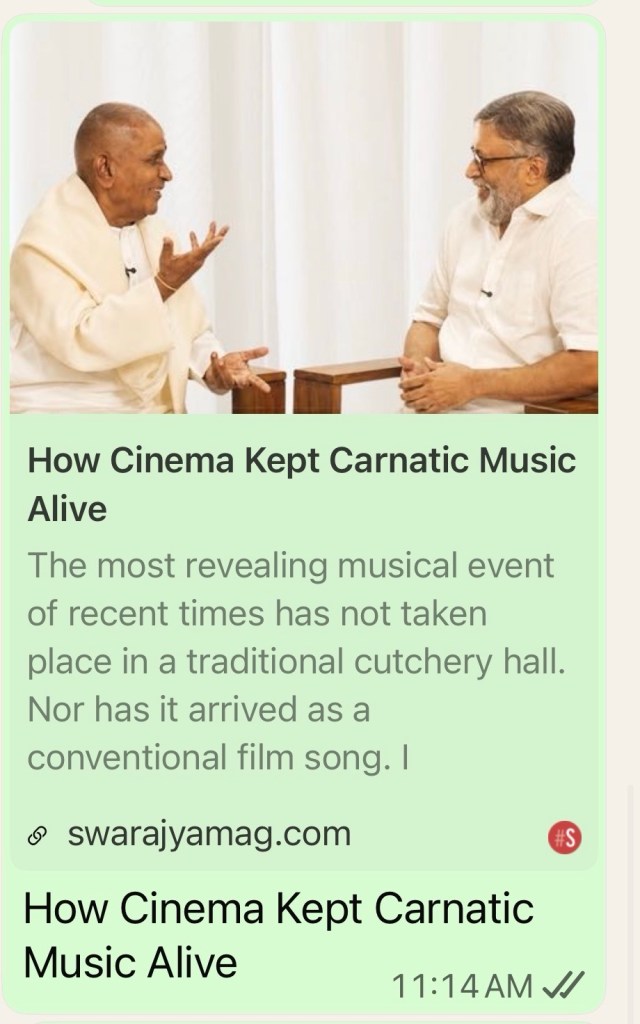
A recent piece (“Swarajya” above https://swarajyamag.com/culture/how-cinema-kept-carnatic-music-alive How Cinema Kept Carnatic Music Alive) argued that cinema kept Carnatic music alive. It is true that film songs gave classical ragas a mass audience and a steady income for many musicians. But the causal arrow points just as strongly, if not more, in the other direction: it is Carnatic music that has kept Indian cinema music alive—musically, emotionally, and structurally.
Without the raga grammar, the tala sophistication, and the kriti architecture of Carnatic music, Indian film music would have long ago collapsed into a loop of generic pop phrases and disposable jingles.
The grammar of feeling: ragas and talas as film music’s DNA
Carnatic music is a highly codified system of melodic and rhythmic organisation. Its ragas are not just scales; they are emotional universes with prescribed phrases, ornamentations, and characteristic movements. Its talas are not just time signatures; they are complex cycles that shape phrasing, tension, and release.
Indian film composers, consciously or not, draw from this vocabulary every time they write a melody:
- Shankarabharanam / Kalyani for grandeur, celebration, and devotion
- Mohana / Hindolam for tenderness, longing, and lullaby-like intimacy
- Karaharapriya / Kapi for pathos and separation
- Nayaki / Saraswati for feminine grace and romantic nuance
Ilaiyaraaja’s and A. R. Rahman’s scores are practically textbooks of raga usage in cinema. Ilaiyaraaja’s background themes and melodies often map almost note-for-note onto specific ragas, while Rahman’s work in films like O Kadhal Kanmani directly reuses Tyagaraja and Annamacharya compositions, making classical material newly audible to global listeners.
The same holds for rhythm. Even when a song sounds “pop,” its rhythmic architecture often rests on Carnatic training:
- Use of adi, rupaka, misra chapu, khanda chapu in song sections and interludes
- Complex korvais and rhythmic exchanges in dance sequences
- Background scores that borrow Carnatic percussion aesthetics (mridangam patterns, kanjira textures) to create tension, devotion, or classical “space” inside a modern orchestration
Carnatic music thus supplies the melodic and rhythmic grammar without which film music would lose much of its emotional range and structural sophistication.
The kriti inside the song: Pallavi–Anupallavi–Charanam as default architecture
The most obvious, yet least remarked, signature of Carnatic classicism in cinema is structural. Open any Carnatic kriti and any mainstream film song from Tamil, Telugu, Kannada, or even Hindi. Strip away the orchestration, the rhythm program, the language. What remains is the same three-part skeleton:
- Pallavi – the opening thematic line, repeated like a refrain; the melodic and lyrical hook.
- Anupallavi – the second section, often in a higher register, expanding the melodic idea and providing contrast.
- Charanam – the final and usually longest section, carrying the bulk of the lyrical content; there can be multiple charanams, each followed by a return to the pallavi.
In performance, a kriti typically runs:
Pallavi → Anupallavi → Pallavi → Charanam 1 → Pallavi → (Charanam 2 → Pallavi …)
Map this onto a standard film song:
- The mukhda = Pallavi
- The antara (first bridge) = Anupallavi
- One or more additional antaras = Charanams
Even when lyricists and composers use Hindi/Urdu terms like mukhda and antara, the underlying architecture is the same: a refrain that returns, a contrasting middle section, and one or more stanzas that deepen the narrative before circling back to the refrain.
This is not a superficial borrowing. The pallavi functions as the emotional slogan; the anupallavi lifts the energy or pitch; the charanam(s) tell the story, introduce plot details, shift emotional register, and embed philosophical or moral commentary. That is exactly how a kriti works: the pallavi states the raga-bhava, the anupallavi explores the upper octave, and the charanam(s) carry the sahitya and the composer’s mudra.
Film music keeps returning to this structure because it is a proven narrative engine, not a random convention. Some songs compress or vary it—there are film songs with no anupallavi, analogous to the Carnatic “samashti charanam” situation—but the default grammar remains that of the kriti.
Beneath the glossy production and changing languages, the Indian film song is still, structurally, a Carnatic kriti: a recurring pallavi, a contrasting anupallavi, and one or more charanams that carry the narrative load.
The human chain: composers, singers, and lyricists as tradition-bearers
Carnatic music keeps cinema music alive not only through abstract structures but through people: composers, singers, and lyricists who are native speakers of this tradition.
Composers as Carnatic practitioners
Many of the giants of Indian film music are not merely “influenced by” Carnatic music; they are practitioners of that tradition working in a different medium:
- G. Ramanathan, M. S. Viswanathan, K. V. Mahadevan – composers who moved seamlessly between concert hall and recording studio, embedding Carnatic sensibility into mainstream cinema.
- Ilaiyaraaja – arguably the most systematic translator of Carnatic grammar into film language; his background scores and songs are practically a textbook of raga usage in cinema.
- A. R. Rahman – who fuses Carnatic phrases, Tyagaraja and Annamacharya compositions, and contemporary production, making classical material newly audible to global audiences.
These composers do not “quote” Carnatic music as an exotic garnish; they think in its phrases, modulations, and forms.
Singers as bridge figures
The same continuum exists in playback singing:
- M. S. Subbulakshmi, D. K. Pattammal, M. L. Vasanthakumari sang film songs that are indistinguishable from classical pieces in their phrasing and ornamentation. Mani Krishnaswami only once gave a memorable kutcheri performance featuring from start to finish only vintage Carnatic music based cinema songs of yesteryears. She refused repeated requests from the public for encores.
- S. Janaki, P. Susheela, S. P. Balasubrahmanyam, K. J. Yesudas – all deeply grounded in Carnatic aesthetics, bringing gamakas, sruti fidelity, and lyrical clarity into film recording.
- Contemporary playback singers who are also concert performers ensure that the same voice that renders a kriti in a sabha renders a film song in the studio
It is this continuum of training and taste that keeps film music from becoming purely studio-constructed.
Lyricists in the Carnatic orbit
The textual dimension matters as well. Lyricists like Kannadasan, Vaali, Pulamaipithan, Sirivennela Sitarama Sastry are steeped in classical literature and devotional poetry. Their film lyrics echo Carnatic sahitya in imagery, meter, and spiritual vocabulary.
Many film songs directly quote or rework Tyagaraja, Dikshitar, Shyama Sastri, and even Annamacharya, ensuring that classical compositions circulate in popular consciousness. Carnatic music thus supplies not just melody but a literary and devotional depth that elevates film lyrics beyond cliché³¹.
Legitimacy and imagination: Carnatic aesthetics as cinematic capital
Cinema does not just “use” Carnatic music; it leans on its cultural prestige to make certain emotional and moral worlds credible.
Carnatic music as narrative legitimizer
In Malayalam and Tamil cinema, Carnatic soundscapes often signal:
- Spiritual seriousness – temple scenes, bhakti sequences, sanyasa moments
- Cultural authenticity – Brahmin households, agraharam settings, sabha milieus
- Inner transformation – a character’s shift from materialism to devotion, or from confusion to clarity
Carnatic music is deployed to “legitimise” certain bodies and spaces—sabhas, Brahmin homes, devotional settings—as sites of cultural authority.
Background score: Carnatic as emotional subtext
Background scores rely heavily on Carnatic idioms:
- Ilaiyaraaja’s and Rahman’s use of nadaswaram, veena, flute, violin in Carnatic idioms to create haunting, emotionally charged underscoring.
- Ragam-based motifs that recur through a film, binding characters and emotions to specific melodic signatures
- The “Margazhi” feel in films: using Carnatic textures to evoke a particular season, mood, or spiritual atmosphere, as in analyses of Oru Naal Podhuma and similar compositions.
Without Carnatic music’s palette, film scores would lose a crucial layer of emotional nuance.
Innovation through constraint
Carnatic music keeps film music alive by forcing innovation within discipline. Composers must solve creative problems:
- How to fit a raga into a 4/4 pop groove
- How to render a pallavi in a duet format
- How to preserve gamaka in a heavily produced track
These constraints generate new hybrid forms: semi-classical film songs, fusion tracks, and orchestral arrangements that are still recognizably rooted in Carnatic logic. This is the opposite of “cinema saving Carnatic”; it is Carnatic disciplining and enriching cinema.
From sabha to streaming: the future of the symbiosis
It is true that cinema gave Carnatic music a mass platform and a new economic lifeline in the 20th century. But the relationship is not one-way rescue; it is a symbiosis in which Carnatic music continually renews cinema music from within.
Today, that symbiosis is evolving:
- Playlists and reels recirculate semi-classical film songs, turning them into entry points for young listeners into ragas and compositions
- OTT platforms and high-fidelity streaming allow background scores to be heard as standalone works, revealing their Carnatic underpinnings
- New composers, trained in both classical and global idioms, continue to mine Carnatic ragas, talas, and forms for fresh sonic worlds
Cinema may amplify Carnatic music, but it is Carnatic music that keeps cinema music musically alive, emotionally rich, and culturally grounded.
A counterpoint, not a contretemps
To say that Carnatic music keeps cinema music alive is not to deny cinema’s role in popularising classical forms. It is simply to correct the balance. The original argument—“How cinema kept Carnatic music alive”—captures one side of the story. This piece offers a counterpoint, not a contretemps: a complementary line in the same raga.
In that raga, Carnatic music is the grammar, the lineage, and the imaginative capital that prevents Indian film music from becoming mere jingle-work. If cinema gave Carnatic music a larger stage, Carnatic music gave cinema its soul.
(Concluded)
