by M.K.Sudarshan
August 12, 2026: Chennai, India
📌 At a Glance: The Architecture of Indian Civilization
“What is Bharatiya Sanskriti? Look no further than the two epics. The Ramayana is all about what Dharma is, and the Mahabharata is all about what Dharma is not.”
⚖️ DHARMA (Virtue): The unyielding standard of absolute self-sacrifice (Rama’s exile) vs. the fractured, toxic collapse of institutional law (Duryodhana’s covetousness).
💰 ARTHA (Wealth): Material power managed as a sacred, detached trusteeship(Bharata ruling via Rama’s sandals) vs. wealth gained as unrighteous, parasitic spoils (the rigged game of dice).
🌸 KAMA (Desire): Pleasure completely sublimated into the joy of divine service (Lakshmana’s Kainkarya) vs. the descent into primal, voyeuristic depravity (the public disrobing of Draupadi).
🌅 MOKSHA (Liberation): Ultimate salvation achieved through simple, unlettered devotion (Sabari’s long wait) vs. the conscious, intellectual choice of the Divine over worldly might (Arjuna receiving the Gita).
The Ramayana shows who we ought to be. The Mahabharata shows who we frequently are. Together, they form the complete operational manual for human consciousness.
To define the sprawling, five-millennium matrix of Indian civilization in a single breath is an exercise that often reduces commentators to vague platitudes or dense academic jargon.
Yet, the foundational ethos of Bharatiya Sanskriti — Indian Civilisation— is neither amorphous nor inaccessible; it is dynamically codified. The entire architecture of the Indian civilization can be precisely crystallized into its two defining epics: The Ramayana and The Mahabharata.
If the Ramayana establishes the true north of the compass of morality or Maryada—the unyielding standard of absolute virtue—the Mahabharata maps the messy, compromised, and fractured realities of human ego and compromised institutions. Together, they function as the Yin and Yang of the entire Indian moral landscape.
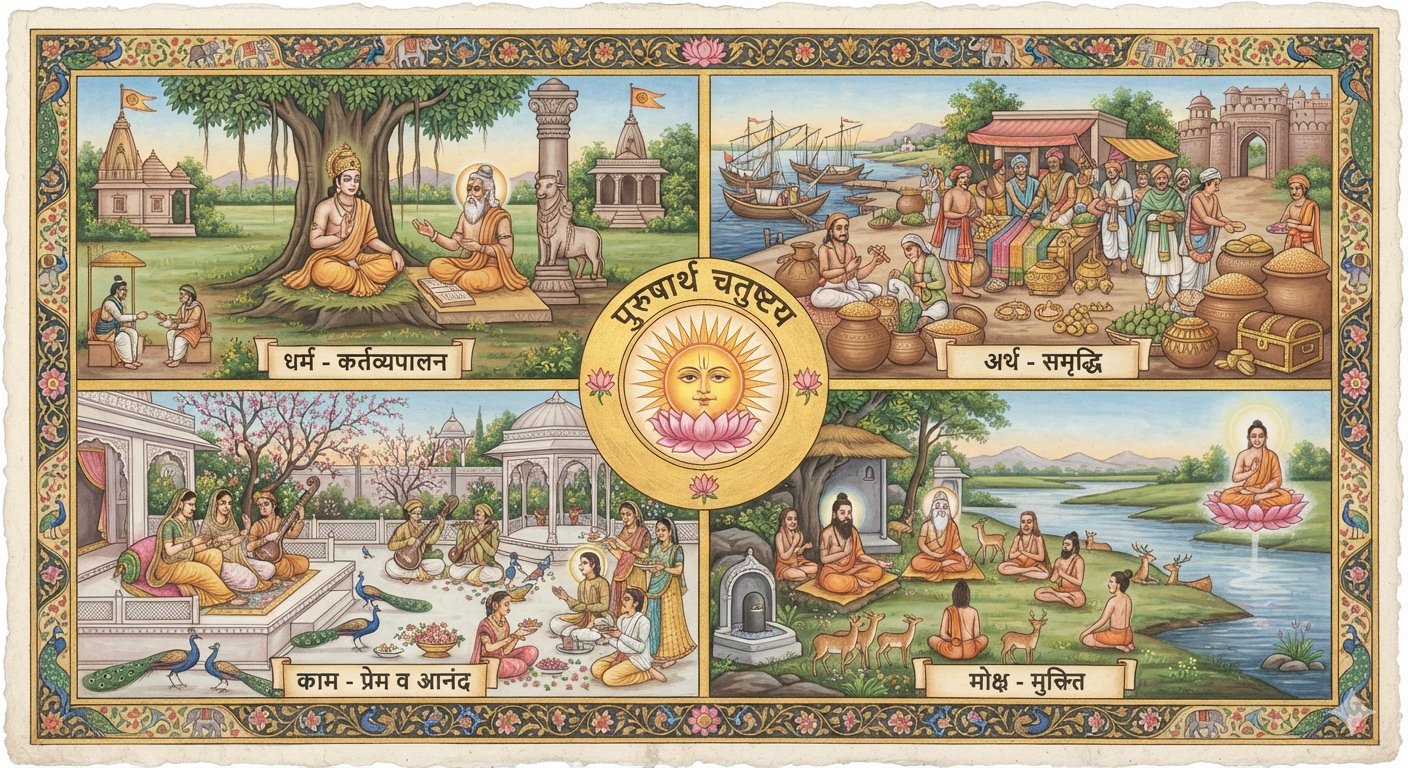
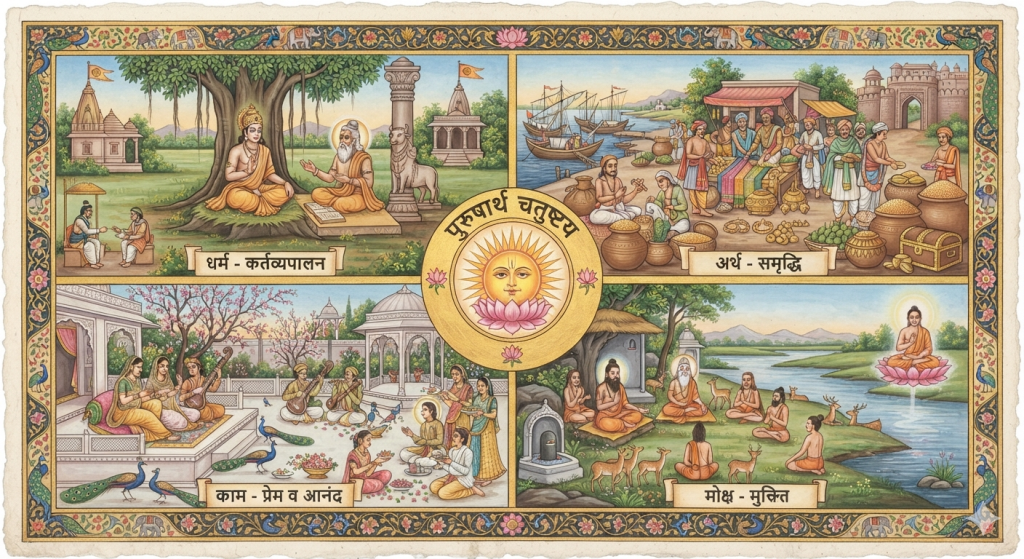
Nowhere is this dialectic tension more profound than in how these epics dramatize the four Purusharthas—the fundamental quadrants of human striving:
Dharma (Virtue), Artha (Material Prosperity), Kama (Desire/Gratification), and Moksha (Spiritual Liberation).
Through an exquisite structural counterpoint of thesis and anti-thesis, the two epics illuminate the path of cosmic alignment by vividly contrasting it with the abyss of its deviation.
I. Dharma: The Architecture of Virtue
Dharma forms the bedrock of cosmic and social order, operating not merely as static law, but as a lived commitment to righteousness under existential pressure.
- The Ramayana (The Thesis): Dharma is realized through the archetype of absolute self-abnegation. Prince Rama willingly renounces a rightful empire solely to uphold truth. His very existence is the structural definition of moral law:
- रामो विग्रहवान् धर्मः साधुः सत्यपराक्रमः।
राजा सर्वस्य लोकस्य देवानामिव वासवः॥
— (Valmiki Ramayana, Aranya Kanda, 37.13) “Rama is the living embodiment of Dharma, an equable saint whose valour is truth itself. He is the ruler of the entire world, just as Indra rules the gods.” - The Mahabharata (The Anti-Thesis): Dharma is fractured by the unchecked ego of Duryodhana. Driven by systemic entitlement, Duryodhana understands virtue intellectually but suffers from a foundational spiritual blindness—a refusal to allow righteousness to direct his actions:
- जानामि धर्मं न च मे प्रवृत्तिः जानाम्यधर्मं न च मे निवृत्तिः।
केनापि देवेन हृदि स्थितेन यथा नियुक्तोऽस्मि तथा करोमि॥
— (Prapanna Gita / Mahabharata Tradition): “I know what Dharma is, yet I am not inclined to follow it. I know what Adharma is, yet I cannot turn away from it. I only act as I am driven by the deep-seated impulses dwelling within my heart.”
II. Artha: Wealth as Trusteeship vs. Wealth as Spoils
Artha acknowledges the necessity of material prosperity, political power, and statecraft, but subdues them strictly to ethical boundaries.
- The Ramayana (The Thesis): Material wealth is elevated to the concept of trusteeship. When Bharata is handed the throne, he recoils from its ownership, ruling strictly as a proxy from Nandigram. He anchors his governance to Rama’s sandals (Padukas), demonstrating that wealth belongs exclusively to the divine order:
- पादुके ते तु सम्पूज्य सम्प्रदानं च कारितम्।
राज्यं चैतन्न्यासभूतं मया निरुद्वेगं पालितम्॥
— (Valmiki Ramayana, Yuddha Kanda, 127.54) “Having worshipped your sacred sandals, I have protected this kingdom merely as a sacred trust (Nyasa) placed in my care, administering it without attachment.” - The Mahabharata (The Anti-Thesis): Artha degenerates into parasitic, un-Dharmic acquisition through the rigged game of dice. The Kauravas view power as personal ownership and spoils to be weaponized against family, discarding the eternal warning of the Shanti Parva:
- अधार्मिकेण मार्गेण यश्चार्थान् प्रतिपद्यते।
न स लभते तेन पुण्यं पापेन कर्मणा॥
— (Mahabharata, Shanti Parva): “He who acquires wealth through unrighteous means earns no merit; his wealth is stained by sinful actions and carries the seeds of his own destruction.”
III. Kama: The Elevation of Desire vs. The Descent into Depravity
Kama addresses the human drive for pleasure, affection, and aesthetic gratification, illustrating the thin boundary between creative passion and destructive obsession.
- The Ramayana (The Thesis): While Sugriva falls temporarily into sensory indulgence, he is swiftly corrected. For the true seekers in the Ramayana, Kama is completely sublimated into Kainkarya Prapti—the profound, ecstatic pleasure found exclusively in selfless service to the Divine. It is beautifully encapsulated by Lakshmana’s declaration of eternal bonding:
- अहं सर्वं करिष्यामि जाग्रतः स्वपतश्च ते।
भवांस्तु सह वैदेह्या गिरिसानुषु रंस्थते॥
— (Valmiki Ramayana, Ayodhya Kanda, 31.25): “I shall perform everything for you, whether you are awake or asleep. You may enjoy the pleasures of the mountain ridges alongside Sita, while my joy is entirely in serving you.” - The Mahabharata (The Anti-Thesis): Kama curdles into toxic, sadistic power-play during the disrobing of Draupadi. Desire uncoupled from empathy transforms into a weapon of total subjugation. This total moral inversion is warned against by the epic’s final exclamation:
- न जातु कामात् न भयात् न लोभाद् धर्मं त्यजेज्जीवितस्यापि हेतोः।
नित्यो धर्मः सुखदुःखे त्वनित्ये जीवो नित्यो हेतुरस्य त्वनित्यः॥
— (Mahabharata, Svargarohana Parva, 5.50): “Never abandon Dharma—neither for the sake of desire (Kama), nor out of fear, nor greed, nor even to save your own life. Dharma is eternal; pleasure and pain are transient.”
IV. Moksha: The Ascent to Transcendence
Moksha, the ultimate cessation of worldly bondage, is presented as the supreme destination, achievable through varied yet equally potent trajectories of consciousness.
- The Ramayana (The Thesis): Liberation is attained through the effortless, unlettered path of Bhakti (devotion). Sabari spends decades practicing quiet, unwavering austerities, sustained only by the promise of Rama’s presence. Upon meeting him, her path is fulfilled:
- दर्शनं तव देवर्षेः प्राप्तं मे चारुलोचन।
त्वामहं द्रष्टुमिच्छन्ती प्राप्तास्मि परं पदम्॥
— (Valmiki Ramayana, Aranya Kanda, 74.31): “O beautiful-eyed Lord, by obtaining your divine sight, my life’s purpose is completed. Wishing only to behold you, I am now ready to ascend to the supreme abode of ultimate liberation.” - The Mahabharata (The Anti-Thesis): Liberation is forged in the crucible of existential crisis and conscious choice on the battlefield. While Duryodhana chooses material power (the Narayani Sena), Arjuna chooses the Divine Guide, realizing that human effort is merely an instrument to a higher cosmic design:
- तस्मात्त्वमुत्तिष्ठ यशो लभस्व जित्वा शत्रून्भुङ्क्ष्व राज्यं समृद्धम्।
मयैवैते निहताः पूर्वमेव निमित्तमात्रं भव सव्यसाचिन्॥
— (Bhagavad Gita, 11.33): “Therefore arise! Attain glory, conquer your enemies, and enjoy a prosperous kingdom. They have already been slain by Me; you, O Arjuna, be merely the instrument of my cosmic will.”
Conclusion
Ultimately, Bharatiya Sanskriti is not a culture of dogmatic denial, but a hyper-sophisticated psychological map of human nature.
By reading the Ramayana and the Mahabharata not as disparate myths, but as a singular, unified blueprint, we discover the complete spectrum of human potentiality. The Ramayana holds up the mirror to who we ought to be; the Mahabharata holds up the mirror to who we frequently are.
Between this eternal thesis and anti–thesis lies the definitive operational manual for navigating human consciousness—the timeless, beating heart of Indian civilization.
(Concluded)
