
On M.S. Subbulakshmi, the biopic boom, and the ethics of homage
by M. K. Sudarshan
September 18, 2026: Chennai, India
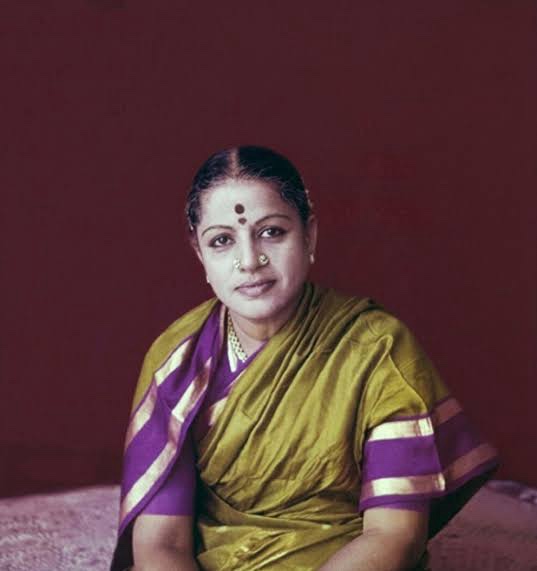
I wish today we lovers of M.S. Subbulakshmi would leave her spirit alone instead of every now and then resurrecting her from the dead only to serve some odd political and / or non-political agenda of certain sections of Tamil society or to invoke her in pretentious piety in the name of serving the arts of classical Carnatic music. M.S. has been awarded Bharat Ratna. Period.
She has been glorified enough in her lifetime and in afterlife too—and to go on glorifying her further, writing articles and books about her (T.M. Krishna et al.), building large misshapen statues for her right in the middle of city roads, or instituting sundry awards and institutional endowments in her name (the Madras Music Academy, which dragged the matter all the way to the Supreme Court of India in an unseemly, unsavoury legal imbroglio)—is not to enhance her glory but to reduce it to cheap brand-name exploitation.
All her life M.S. Subbulakshmi had been an extremely private and gracious person. She was distinctly uncomfortable under the spotlight other than when she was performing a kutcheri on stage. She was happy to live under the shadow of her husband, T. Sadasivam, who took full and masterly control of managing her public and media relationships and affairs, leaving her to concentrate on her art and devote herself to her personal spiritual pursuits.
Enter the biopic: “M.S – A Legacy On Screen”
Today, there’s now another attempt to glorify M.S. Subbulakshmi: a Bollywood-like movie biopic announced with gala fanfare and high-profile pomp and ministerial pageantry. On her 110th birth anniversary (September 16, 2026), the project was officially launched at the Music Academy in Chennai. Rashmika Mandanna will essay M.S.; Gowtam Tinnanuri will direct; Anirudh Ravichander will compose. Kamal Haasan gave the first clap. The title—M.S – A Legacy On Screen—says it all.
What is the real purpose, I ask? To pay tribute to her memory… again and again? For God’s sake, the tributes have already gone stale and pale— one only hears the same platitudes, the same rehashed inanities, the same vapid, insipid phraseology of praise and eulogy that have been repeated a hundred times before ever since the gracious soul departed! Enough, please, for God’s sake, enough!
Homage as instrument, art as afterthought
The unease I am expressing here with this continual glorification of MSS is not with remembrance; it is with instrumentalization.
Each new “tribute” risks serving agendas—cultural-political, institutional prestige, box-office positioning—more than it serves the music itself. When homage becomes spectacle, the artist’s inner life is eclipsed by iconography and hagiography. The private, spiritually oriented musician is recast as a brand, her name a banner under which present -day cultural institutions and industries … and haute couture aficionados and washed-up retired film-stars too … march.
Consider the ecosystem now assembling around the biopic: star casting, pan-India marketing, producers with deep industry clout, a launch at the very temple of Carnatic orthodoxy, and the ritual language of “legacy.” This is not merely a film announcement; it is a public-relations extravaganza dressed as devotion.
If homage must happen, let it honour the art
If the world of Carnatic music wants to pay homage to M.S. Subbulakshmi today, let it do so not by words, pageantry and public-relations extravaganzas but by emulating her artistry—by imbibing the lofty musical values she personified in her kutcheris; by respecting her paataantharam; her humility and self-effacing nature; her large-heartedness; her hard work; her penance in striving for excellence.
M.S. Subbulakshmi’s music deserved all the great accolades she received when alive and posthumously. Those awards were for her music and musical excellence alone. Not for her public persona, brand image, or “classical diva” status that got conferred upon her later without her ever hankering after it … or even being self-conscious of it.
Concrete forms of honour that would actually serve the art:
- Performance-centred tributes: Kutcheris and lecture-demonstrations that foreground paataantharam, sruti-shuddham, and repertoire choices she championed.
- Archival access and study: Critical editions of recordings, transparent sourcing, and pedagogical materials that let students engage her art without hagiography.
- Restraint in iconography: Fewer statues and awards; more support for serious scholarship and for artists who embody her discipline.
The biopic’s promise—and peril
Biopics can humanize icons, but they also compress complexity into narrative arcs designed for mass appeal. Given M.S.’s discomfort with the spotlight outside performance, the film’s success as “tribute” will depend on whether it resists turning her life into a brand story and instead lets the music—and the ethics behind it—lead.
Today the true nature of the public adulation and all the razzmatazz surrounding her legacy seems less like a genuine tribute to an artiste and far more like media hype and cleverly packaged PR stunts. Fine by me , I won’t bother too much … but only with a caveat.
If that’s the grandstanding way the public mood today wishes to celebrate M.S. Subbulakshmi, I suggest that the biopic movie being planned for her ought to be a biopic on her husband, the inimitable and consummate Sri T. Sadasivam, whose management skills are what made the “M.S. mystique” what it became. Celebrate Sadasivam Sir if you have to. And please leave Subbulakshmi alone, for God’s sake—she’s very happy where she must surely be in the high heavens and she doesn’t really need your hallelujahs.
Postscript: On the same week as the Chennai biopic launch, Union Finance Minister Nirmala Sitharaman was chief guest at a separate M.S. Subbulakshmi 110th-birth-anniversary music festival in Bengaluru, where she became emotional listening to M.S.’s songs and spoke of her contribution to Carnatic music.
The inclusion of such high-profile ministerial presence—across cities and formats—only sharpens the question this op-ed raises: when homage becomes state-adjacent spectacle, does it honour the artist or instrumentalize her memory?
Sudarshan Madabushi is a senior bilingual writer, author and independent blogger based in Chennai. He writes on literature, religion, philosophy, cultural history, and public affairs. He is the son of Sangitha Kalanidhi Dr Smt Mani Krishnaswami with whom M S Subbulakshmi shared a very close and warm relationship — both professional and personal.
(Concluded)