
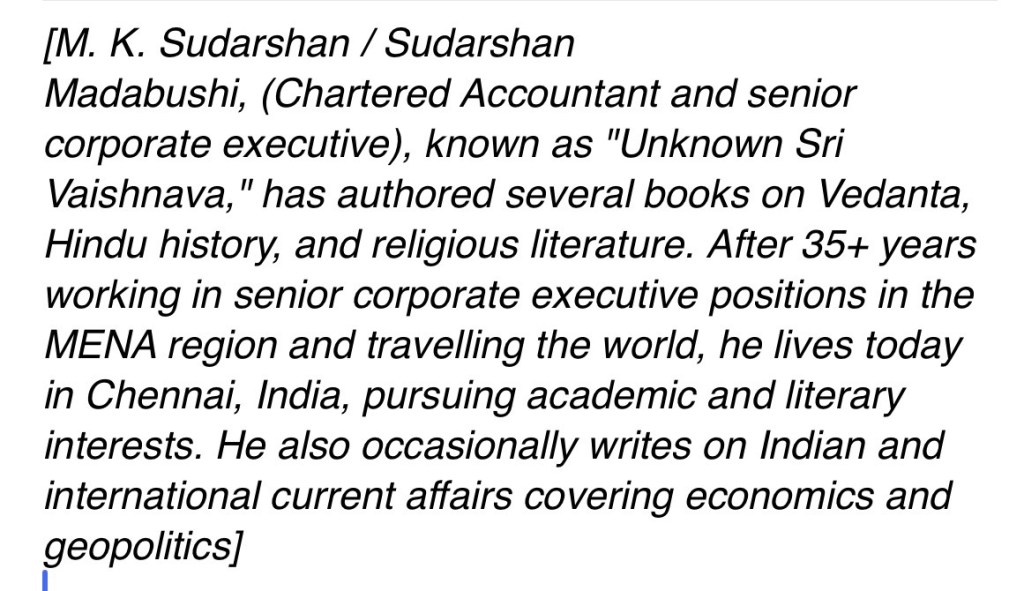
By Sudarshan Madabushi
October 5, 2026: Chennai, India
Tamil Nadu’s temples are not merely places of worship. They are repositories of land, jewellery, sculpture, manuscripts, ritual tradition, and centuries of public trust. The State, through the Hindu Religious and Charitable Endowments (HR&CE) Department, claims to be their custodian. If that claim is to mean anything, the first requirement is elementary: the custodian must know what it holds.

That is precisely the purpose of the Section 29 Register under the Tamil Nadu HR&CE Act, 1959. It is the statutory master record of every religious institution: its history and administration, its trustees and service-holders, its jewels and valuables, its endowments, title deeds, and other documents. It is the institutional memory of the temple.
And yet, decades after the Act came into force, there is no credible public evidence that this register exists, in complete and current form, for every temple under HR&CE administration. The Department publishes temple counts, festival information, donation portals, and occasional land data. It does not publish a temple-wise account of whether the foundational register has been prepared, approved, verified, or updated.
That silence is the smoking gun.
What the law plainly requires
Section 29 of the HR&CE Act is not an optional administrative convenience. It requires a register for every religious institution, in the form directed by the Commissioner. The register must contain the institution’s origin and history, details of trustees, the scheme of administration, offices and emoluments, jewels, gold, silver, precious stones, vessels and utensils, and particulars of all endowments, title deeds, and related documents.
Section 30 then requires annual verification. Section 31 requires a consolidated register once every ten years, incorporating additions, omissions, and alterations. Together, these provisions create a simple and sensible cycle: prepare the record, verify it annually, consolidate it periodically, and correct it as facts change.
The statute therefore already contains the machinery for accountability. What is missing is not legal authority. It is administrative will.
A register that cannot be found
The HR&CE Department administers tens of thousands of institutions. Its own recent figures place the number above 46,000, including more than 43,000 temples. Of these, the overwhelming majority are small, non-listed temples with modest incomes. But the problem cannot be dismissed as one affecting only obscure village shrines.
Even for the 582-odd temples with annual income of ₹10 lakh or above—the temples with the greatest revenue, the most valuable properties, the most significant jewels, and the greatest need for scrutiny—the Department does not publish a clear, temple-wise compliance statement: How many have Section 29 registers? How many have been approved? How many were verified in the last annual cycle? How many have current ten-year consolidated registers?
If the answer were “all,” the Department would say so. If the answer were “most,” it would publish the number. The absence of a straightforward public figure is itself revealing.
The Department’s website, meanwhile, warns that its temple information is for general information only and cannot be used as evidence. It disclaims completeness, accuracy, reliability, and availability. A custodian that cannot vouch for the completeness of its own public record cannot credibly claim to have completed the statutory record of its custodianship.
The Court’s frustration
This is not a charge invented by critics. The Madras High Court has repeatedly encountered the same administrative void.
In the 2021 proceedings arising from T.R. Ramesh v. State of Tamil Nadu, the petitioner asserted that registers required under Sections 30 and 31 had “not been prepared at all.” The Court did not treat every allegation as proved, but its broader findings were damning. It observed that the HR&CE Department, despite being the custodian of temples, idols, lands, and properties, had failed in its primary duty to protect and maintain them.
The Court issued as many as 75 directions. It directed the Department to update registers concerning jewels, icons, valuables, antiques, and stolen or missing articles. It required district committees to take stock of temple lands: survey numbers, extent, tenancy, rent, arrears, encroachments, litigation, and alienations. It demanded reports, timelines, and corrective action.
In other words, the Court effectively ordered the ingredients of a fresh, credible record-building exercise. It did not ask for a poetic declaration of devotion to heritage. It asked for inventories, documents, survey numbers, accounts, and action.
Why the limbo persists
The continuation of this limbo is not accidental. It arises from a structural design in which the temple is permanently subject to administration, while the administrators are only temporarily answerable.
Commissioners come and go. They are flotsam and jetsam — Joint Commissioners, Assistant Commissioners, Executive Officers, Collectors, Revenue officials, and police officers are transferred according to administrative convenience and political circumstance. Each new officer inherits files, but not necessarily responsibility. Each can defer a difficult recovery, postpone a survey, or allow a disputed file to sleep, knowing that the next incumbent will inherit the problem.
The result is bureaucratic amnesia. The Department has statutory power, but no stable institutional ownership of outcomes. The temple has no effective voice. The devotee has no dashboard. The trustee, where one exists, is often dependent on the Department. The official who fails is rarely named, punished, or made personally accountable.
The High Court’s later contempt proceedings in the Karur Vennaimalai temple matter exposed this pathology in sharp relief. Six years after a 2019 order, the Court found that HR&CE had taken no effective steps to recover over 500 acres of temple land. It described the Department’s action as merely “namesake,” summoned officials, and criticised the Commissioner for failing even to escalate the non-cooperation of district authorities to the Revenue and Home Secretaries.
That is the anatomy of administrative limbo: a court order exists; a statutory duty exists; the land remains occupied; the file moves from desk to desk; and no one is held answerable.
“Title disputes” cannot excuse inaction
The usual bureaucratic defence is that temple-property questions involve disputed titles, tenants, encroachers, and civil litigation. That is true—but it does not justify doing nothing.
An inventory can record facts without adjudicating title: the survey number, extent, physical possession, documents available, rent received, encroachment alleged, and the nature of the dispute. The register can separate undisputed entries from contested claims. Disputed questions can then be referred to the appropriate civil forum, while the undisputed record is completed and published.
Indeed, the Madras High Court has recognised that a Section 29 register, prepared without notice to all interested persons, cannot by itself settle rival title claims. But that is an argument for a fair, transparent, objection-based process—not for leaving temples without any reliable register at all.
The Department cannot use the difficulty of title adjudication as a perpetual alibi for failing to count its jewels, photograph its idols, catalogue its documents, measure its lands, or identify its encroachments.
The cost of buried records
When the Section 29 Register is missing, stale, or inaccessible, the loss is not merely archival. It becomes a governance loss.
Temple lands become vulnerable to encroachment and adverse claims. Jewels and antiquities become difficult to trace. Leases become opaque. Income becomes difficult to audit. Renovation decisions become unaccountable. The distinction between temple funds and departmental convenience becomes blurred.
A temple without a current register is a temple whose past can be manipulated and whose future can be quietly alienated. The register is not a bureaucratic formality. It is the difference between custodianship and mere control.
What must now be done
The remedy is neither mysterious nor impossible. It requires a time-bound, transparent, temple-by-temple programme, beginning with the 582-odd revenue-rich temples and extending outward to every institution under HR&CE control.
- Conduct a dated physical inventory of every temple: land, buildings, jewels, icons, vessels, documents, leases, and encroachments.
- Reconstruct the Section 29 Register de novo where it is missing, incomplete, or unreliable.
- Publish a provisional register with a defined objection window for tenants, adjoining landowners, service-holders, devotees, and other affected persons.
- Maintain a separate dispute register, so that contested title does not stall the recording of undisputed facts.
- Complete annual Section 30 verification and publish the date and result for each temple.
- Treat the next Section 31 consolidation as a statewide baseline, digitally preserved and publicly searchable.
- Create a public dashboard showing register status, verification date, land particulars, encroachment status, and pending litigation.
- Impose personal accountability on officers who fail to prepare, verify, escalate, or enforce statutory requirements.
The question the State must answer
The question is no longer whether the HR&CE Act requires a Section 29 Register. It plainly does. Nor is it whether the courts have recognised the Department’s failures. They have, repeatedly and with increasing impatience.
The question is simpler and more uncomfortable: Why does the Department not know, or will not disclose, what it holds?
A temple’s register is its civil identity. Its land records are its economic spine. Its jewel and icon registers are its cultural memory. Its title deeds are its legal defence. To leave these buried is not neutrality. It is negligence dressed up as administrative routine.
The Section 29 Register was meant to prevent exactly this. If it remains buried, it will not be because the law failed. It will be because those entrusted with the temples preferred the comfort of unaccountable power to the discipline of public stewardship.
Sources and legal note: This article draws on Section 29, 30 and 31 of the Tamil Nadu Hindu Religious and Charitable Endowments Act, 1959; the Madras High Court judgment in T.R. Ramesh v. State of Tamil Nadu, W.P. No. 17468 of 2016, dated 24 August 2021, and the related suo motu proceedings in W.P. No. 574 of 2015; the HR&CE Department’s policy notes and temple portal; and recent Madras High Court contempt proceedings concerning temple-land recovery. The register is a vital statutory record, but an entry in it is not, by itself, conclusive proof of title in a disputed civil claim.
A very informative educative write up. High time every Hindu be aware of the key details said here