M.K.Sudarshan
November 28, Chennai, India
Summary:
The Delimitation Bill, 2026 will expand the Lok Sabha to as many as 850 seats and enlarge State Legislatures. But nowhere does it explain how more MPs and MLAs will make Parliament more effective, government more responsive, or citizens’ lives better.
This is not democratic renewal—it is the risk of institutionalising over-governance.
India is about to debate a constitutional amendment that will enlarge its political class on a monumental scale.
The Delimitation Bill, 2026 proposes raising the Lok Sabha’s maximum strength from 550 to 850, with a 50% increase in seats across States and Union Territories, alongside a proportionate expansion of State Legislatures.
The political argument will predictably centre on fairness: which States gain, which lose relative weight, and how constituency boundaries are redrawn. These are legitimate questions. But they are not the most important question.
The most important question is this: What evidence does the Bill offer that 850 Members of Parliament will govern India better than 543?
The answer, on the face of the Bill, is: none.
A Bill About Arithmetic, Not Performance
The Bill’s stated purpose is to readjust the allocation of Lok Sabha and Assembly seats, redraw constituencies based on the latest Census, and operationalise one-third reservation for women, including within seats reserved for SCs and STs.
That may be a necessary constitutional exercise. India’s existing seat allocations rest on a 1971 population baseline, while constituency boundaries were drawn using the 2001 Census.
Population movement, urbanisation, and demographic change have made representation uneven. But correcting representational arithmetic is not the same as repairing governance.
The Bill contains no theory of how additional legislators will improve legislative quality. It contains no plan to strengthen parliamentary committees, improve Bill scrutiny, expand research support, protect debating time, or reduce the dominance of the executive. It contains no measurable commitment that a larger House will produce fewer disruptions, better laws, more accountable administration, or more responsive constituency service.
The Missing Case for Expansion
If the Government believes that more MPs and MLAs will make India better governed, it should say so clearly—and prove it.
Where is the evidence that India’s problem is too few elected representatives?
Where is the assurance that a larger Lok Sabha will spend less time on disruption and more time on scrutiny?
Where is the mechanism that will prevent a bigger House from becoming a bigger marketplace for tickets, patronage, factional bargaining, and electoral expenditure?
Where is the plan to ensure that more legislators will actually improve the delivery of welfare, health, education, policing, water, jobs, and justice?
None of these questions is answered by the Bill. Its provisions concern only constituency compactness, public consultation on boundary proposals, publication of objections and suggestions, and the finality of delimitation orders. All these are safeguards for fair map-making—not guarantees of effective government.
More Voices, More Babel?
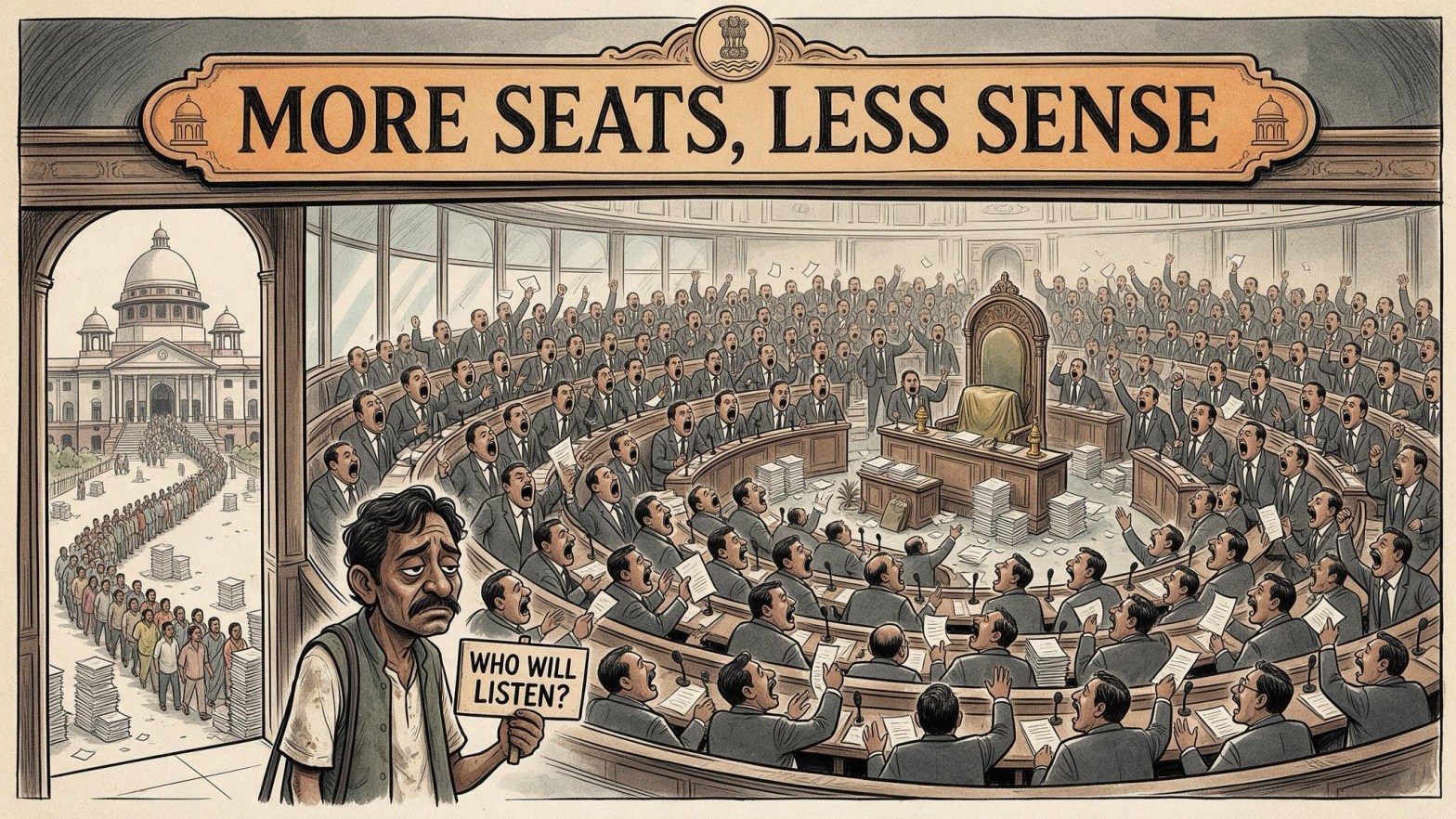
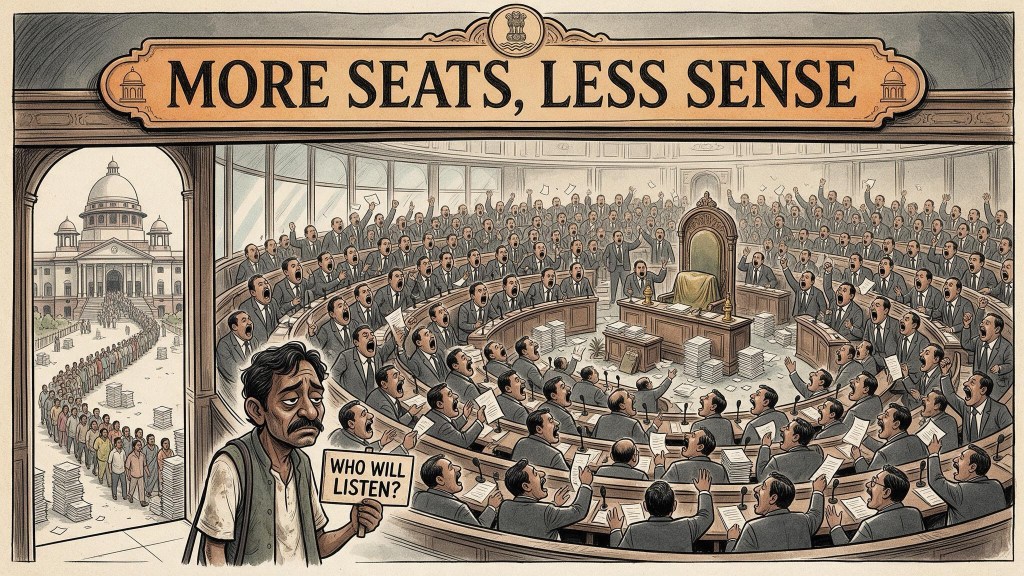
Democracy does not become stronger merely because it adds more microphones.
A larger legislature may bring representation closer to more communities. It may improve the geographical reach of constituency politics. It may create more opportunities for women, marginalised groups, and locally rooted leaders to enter elected office.
But it may also produce more competition for limited positions of power; more pressure on party leaderships; more fragmented negotiations; more legislative noise; and more expensive election machinery.
Without corresponding reform, India may simply replicate its existing dysfunctions across a larger political surface.
The danger is not that India will have too many representatives. The danger is that it will have more representatives without more responsibility, more capacity, or more accountability.
The Judiciary Will Pay the Price
The Bill may reduce litigation over constituency boundaries by making final delimitation orders non-justiciable once notified.
But that is a narrow protection. It does nothing about the wider litigation burden generated by weak administration, poor implementation, contested policy, delayed welfare delivery, and governance failures.
If expanded legislatures produce more laws, more schemes, more overlapping authorities, and more political intervention in administration—without improving execution—the ultimate burden may fall on an already overburdened judiciary.
That would be a perverse outcome: more elected representatives, more laws, more disputes, and less effective governance.
Representation Is Not Reform
The Government’s public defence is that southern States will not lose their relative share of Lok Sabha representation. It says Tamil Nadu’s seat count will rise from 39 to 59, while southern States collectively will rise from 129 to 195 seats, with their share of the House remaining broadly stable.
That may reassure States concerned about political marginalisation. But it does not answer the deeper democratic question.
A citizen does not experience governance as a percentage of Lok Sabha seats. A citizen experiences it as a functioning school, a timely pension, clean water, a responsive police station, an affordable hospital, a fair trial, a safe road, and a government that listens before it acts.
The Bill must therefore not be judged only by whether it preserves federal balance. It must be judged by whether it improves the quality of Indian democracy.
On that test, the Bill is deafeningly silent.
What Parliament Must Demand
Before passing this Bill, Parliament should demand more than a larger House. It should demand:
• A clear explanation of how expansion will improve law-making, oversight, and administration.
• A costed plan for parliamentary capacity, including research, committee staff, drafting support, and deliberation time.
• Binding standards for legislative conduct, attendance, transparency, and meaningful debate.
• A constituency-accountability framework, with measurable service standards for MPs and MLAs.
• An independent review after the first electoral cycle, assessing whether expansion has improved governance outcomes.
• A broader decentralisation agenda that strengthens local government, rather than merely multiplying elected offices.
Without these safeguards, the Bill risks becoming a monument to political expansion without institutional improvement.
India does not need a bigger Babel. It needs a more capable, disciplined, accountable, and citizen-centred state.
More seats may give more people a platform. They will not automatically give citizens better government.
(Concluded)