M.K.Sudarshan
November 29, 2026: Chennai, India
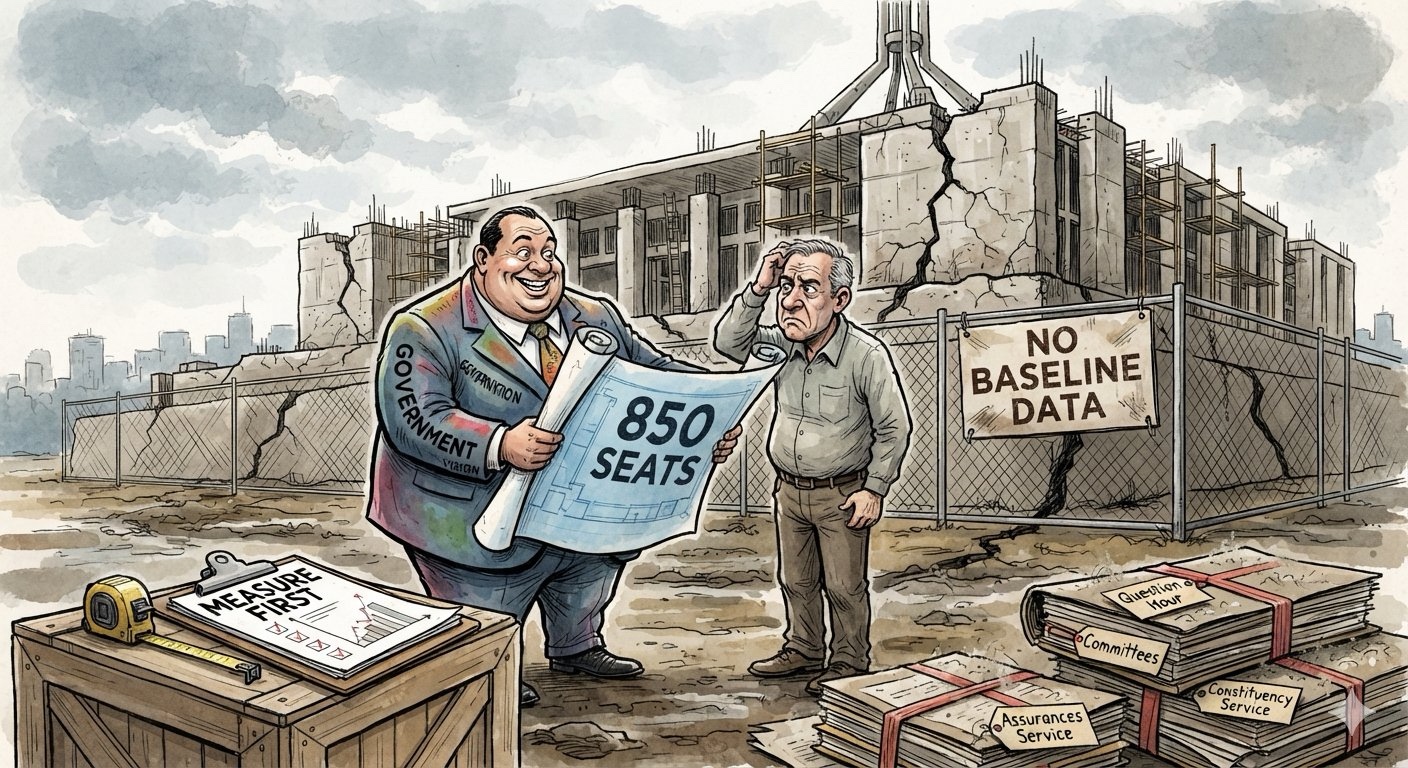
India is preparing to expand its Lok Sabha and State Legislatures without first measuring how effectively the existing institutions use their time, powers, budgets, and public trust.
By any disciplined management standard, this is putting the cart before the donkey.
More seats without measurement, diagnosis, reform, and accountability will likely produce a poor return on the citizen’s investment.
India is about to make one of the largest expansions of its political class since Independence. The Delimitation Bill, 2026 proposes increasing the Lok Sabha’s maximum strength to 850 seats and raising the number of seats in State Legislatures by 50%.
The debate will focus on federal fairness, constituency boundaries, and women’s reservation. These are important issues. But they are not the whole issue.
The deeper issue is this: India is being asked to invest in a larger political class before it has measured the performance of the political class it already has.
That is not reform. That is scale without evidence.
Six Sigma begins with measurement
Six Sigma’s DMAIC method—Define, Measure, Analyse, Improve, Control—requires an organisation to establish the problem, measure current performance, analyse root causes, improve the process, and then control the results. A credible baseline is essential because improvement cannot be claimed without knowing where the process began.
Apply that discipline to Indian democracy.
Before adding hundreds of MPs and MLAs, the Government should first answer:
- How effectively do the existing Lok Sabha and Rajya Sabha use their scheduled time?
- How many hours are lost to disruptions, walkouts, and forced adjournments?
- How well does Question Hour function?
- How many questions are answered, delayed, or ignored?
- How many government assurances are fulfilled, and when?
- How many Bills receive meaningful committee scrutiny?
- How many committee recommendations are accepted or implemented?
- How effectively do MPs and MLAs serve constituents?
- What measurable citizen benefit follows from the laws passed?
None of these questions is answered by the Delimitation Bill. Its purpose is to readjust seats, redraw constituencies, and operationalise women’s reservation—not to diagnose or repair the performance of India’s legislatures.
A dashboard is the minimum reform
India does not need a revolutionary invention to measure parliamentary performance. It needs a public, mandatory dashboard.
Every House—Lok Sabha, Rajya Sabha, and each State Legislature—should publish a regular dashboard showing:
- Scheduled versus actual sitting hours.
- Time lost to disruption or forced adjournment.
- Attendance and participation.
- Question Hour performance and ministerial response times.
- Government assurances and their implementation status.
- Bills introduced, scrutinised, amended, passed, delayed, or withdrawn.
- Committee meetings, reports, recommendations, and government compliance.
- Budget scrutiny and audit follow-up.
- Public petitions, grievances, and constituency-service outcomes.
- A common, machine-readable format for comparison across States.
India already has much of the digital infrastructure needed for this. The National e-Vidhan Application (NeVA) is designed as a common platform for State and Union Territory legislatures, covering questions, notices, Bills, committee reports, attendance, debates, and government assurances.
The technology exists. What is missing is the political will to make performance public, comparable, and consequential.
The missing business case
A responsible government does not expand an institution without a business case.
Before Parliament passes the Delimitation Bill, it should require the Government to state:
- What problem is expansion meant to solve?
- What measurable improvement is expected?
- What will it cost in salaries, allowances, staff, elections, security, and infrastructure?
- How will the additional MPs and MLAs improve legislative scrutiny?
- How will they improve constituency service?
- How will they reduce administrative failure?
- How will citizens know whether the investment has worked?
- What corrective action will follow if it does not?
Without these answers, the Bill asks citizens to accept an expansion without a return-on-investment framework.
More seats may increase representation. But representation is not the same as governance. More legislators do not automatically mean better laws, better administration, better public services, or better outcomes for citizens.
The risk of poor RoI
If India expands its legislatures without reform, it may reproduce existing weaknesses on a larger scale.
There may be more competition for tickets, more pressure on party leaderships, more electoral expenditure, more factional bargaining, and more demand for ministerial positions and patronage. There may be more legislation, but not necessarily better legislation. There may be more elected voices, but not necessarily more listening.
The danger is not merely political noise. It is institutional waste.
India may spend more public money to sustain a larger political class, while leaving unchanged the weak committees, shallow scrutiny, delayed welfare delivery, poor implementation, and weak accountability that limit citizen welfare.
That is the definition of poor return on investment.
The proper sequence
DMAIC stage
What India should do before expansion
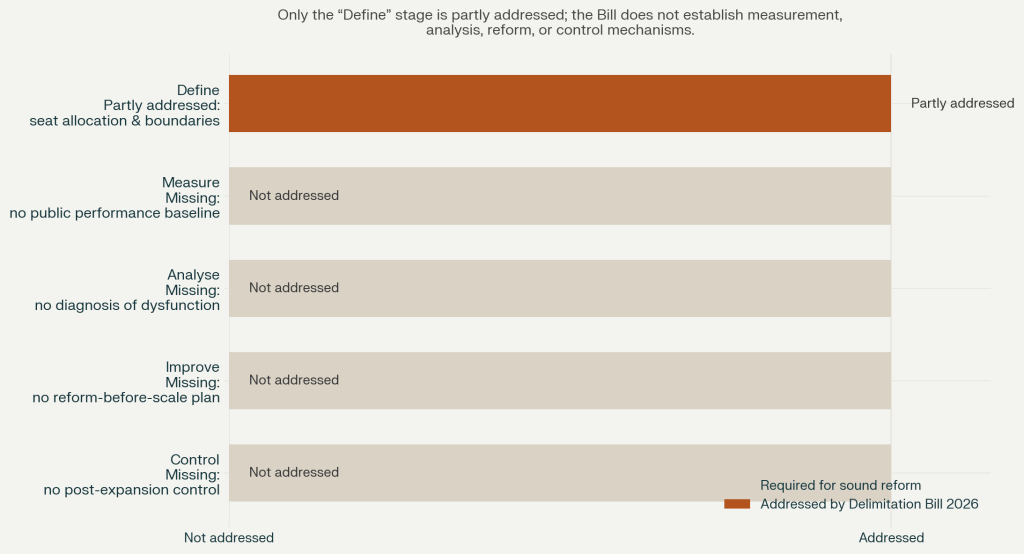
The Six Sigma principle is simple: you cannot improve what you do not measure, and you cannot claim improvement without a baseline.
The citizen’s test
A citizen does not experience democracy as a seat count.
A citizen experiences it as a functioning school, a timely pension, clean water, a responsive police station, an affordable hospital, a fair trial, a safe road, and a government that listens before it acts.
The test of parliamentary reform is not whether India has more MPs and MLAs. The test is whether citizens receive better laws, fairer representation, more responsive services, and a more accountable state.
The bottom line
The Delimitation Bill, 2026 may be necessary for updated representation and women’s reservation. But it is not, by itself, a governance reform.
India should not expand its legislatures before it measures their existing performance. It should not add seats before it builds dashboards. It should not enlarge the political class before it strengthens the institutions that make representation meaningful.
By Six Sigma standards, India is rushing headlong into a constitutional expansion without a baseline, a diagnosis, a cost-benefit case, or a control mechanism.
That is how poor investments are made.
And that is how democracies risk mistaking a larger political class for a more capable democratic state.
(Concluded)