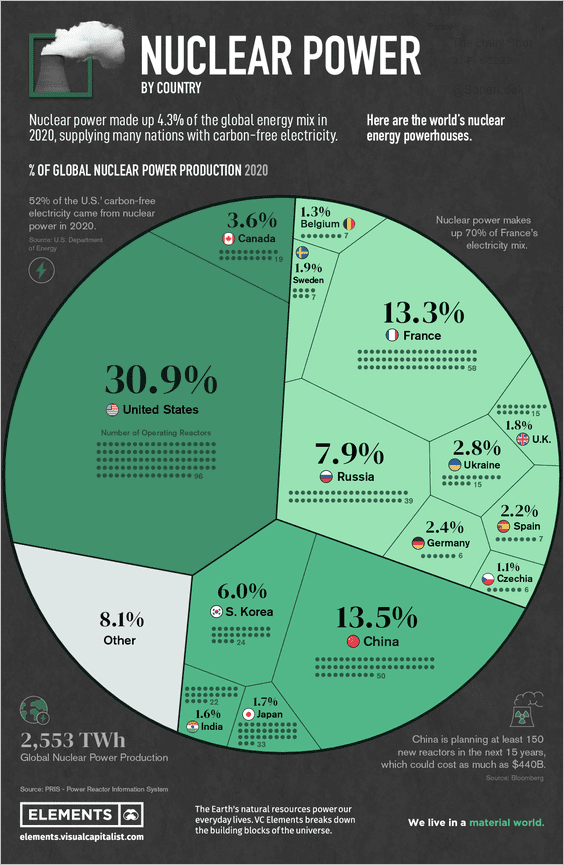
Today there are about 440 nuclear power reactors operating in 32 countries, (including Taiwan, which BTW according to China is not a country..) with a combined capacity of about 390 GWe. In 2020 these provided 2553 TWh, about 10% of the world’s electricity.
According to recent techno-financial studies by expert groups in the world, the estimated capital cost incurred by a nation to complete constructing a medium-sized nuclear power-generating plant is in the range of $ 8 to $14 billion, say, an average of $11 billion.
https://en.m.wikipedia.org/wiki/Economics_of_nuclear_power_plants
So, on the back-of-envelop calculation, the total investments mankind has already sunk in 440 nuclear power plants works out to roughly 440 X $ 11 billion = $ 5.2 trillion to produce 2.55 trillion Watt Hours (TWh) of power or roughly 4.3% of the total energy-source mix produced in the world. See chart below. This tells us that the per-capita cost for a unit of nuclear-energy is c. 2/Wh when a unit of solar-power today in the world costs $0.68/Wh!
In 2021, the global GDP has been estimated to be $95 trillion.
https://m.statisticstimes.com/economy/projected-world-gdp-ranking.php
From a macroeconomic global perspective, the nuclear-energy industry-sector thus accounts for close to 5% of the world’s GDP!
Now, let’s turn to a microeconomic perspective…
The US. Energy Information Administration said that the average electricity bill for U.S. households came in at $111.67 per month in 2017 or … $1340 per annum … in a report put out in Oct-2021. And it is also reported in recent estimates that the avg. median household income in the USA is around $67,500 p.a..
So, what that all means is that around 2% of an average. American’s annual income — call it his/her own individual or personal GDP —- gets spent on household energy consumption.
So again, if we do some back-of-envelope arithmetic, an average household in the world (assuming for the sake of virtuous simplicity and political correctness that America is the world!), spends 2% of its family GDP on energy-needs but the world at large, however, spends 5% of global GDP on just one among several other sources of energy viz. Nuclear energy! Why?!
Either something is horribly rotten about the whole economics of producing nuclear-energy in the world …. Or else, I have got my analysis and perspectives on this industry all wrong! Which one of these, perhaps, you can judge ?
After the Fukushima Daiichi disaster in Japan in the year 2011, Germany in the same year permanently shut down eight of its 17 reactors and pledged to close the rest by the end of 2022. Italy voted overwhelmingly to keep their country non-nuclear. Switzerland and Spain have banned the construction of new reactors. Japan’s prime minister called for a dramatic reduction in Japan’s reliance on nuclear power. Taiwan province’s governer did the same.
Hence, here is the $5 trillion question I ask: Why is the United States, France, China and Russia, just 4 countries accounting for 65% of the total global nuclear-power generation (see chart above), also not following suit in spite of the glaring fact staring them in the face that the economics of nuclear-energy industry makes not only any sense at all …. but , in fact, makes bad, very bad common-sense from the point of view of even any common householder in the world?
The answer to me seems to lie in geopolitics not economics.
It boils down finally to the same old familiar story — “superpower” games played by three nations today competing with each other in the global stadium called the “new world-order” — the US-EU (minus Germany and Italy), China and Russia.
These 3 powers will never loosen their respective stranglehold on market-share or concede an inch of the oligopolistic space they occupy in the nuclear-energy industry —- a $5 trillion marketplace to make and trade technology, supply-chains and manufacturing-knowhow. It gives them great command over respective “spheres of influence” in vast regions across the world. China-North Korea, Pakistan-Saudi Arabia, Russia-Iran, France-Turkey, the USA-Japan/Taiwan … all of them have a deep and abiding vested interest in ensuring the nuclear-energy industry flourishes….
To hell with economic sense or investment priorities of the world …. After all, there is both great power and great profit to be enjoyed by these nations in staying the course in promoting nuclear-energy which in a very real sense, is actually a source of great geopolitical power.
Sudarshan Madabushi
One thought on “Household common-sense and global nuclear-energy economics”