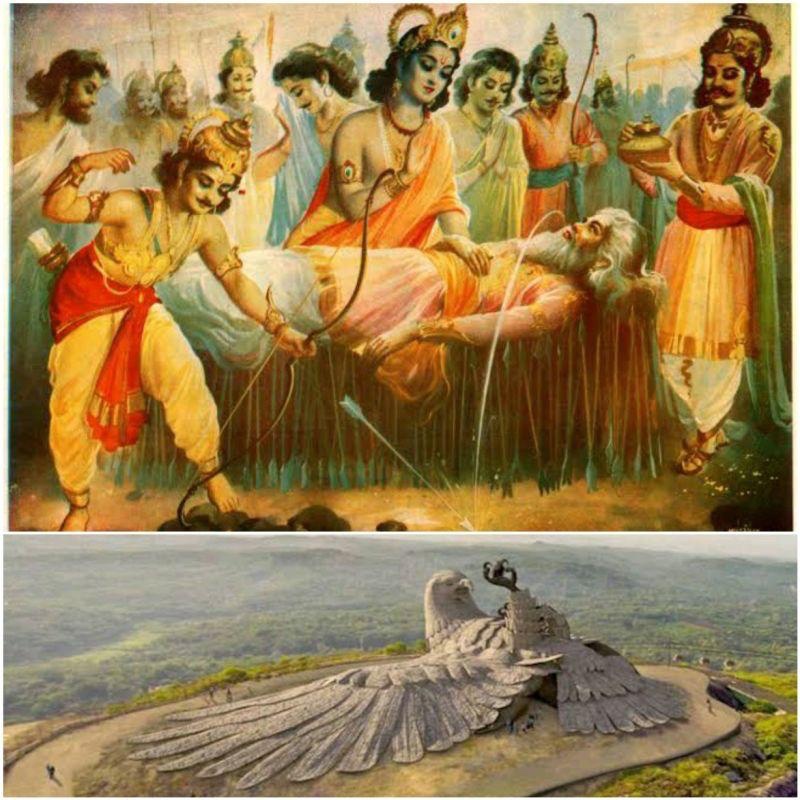
A sister-in-law of mine who lives in Houston USA forwarded to me this morning the above image and also the below appended message annotating it :
QUOTE :
“Bhishma Pitamah is known to have done only one moral blunder in life – he didn’t get angry at the right moment, when Draupdi was being disrobed.
Jatayu is known for one virtue in his life – he got angry at the right time, when Sita was being kidnapped by Ravan and he tried to save her.
When the time came, both died.
But, Bhishma Pitamah died on a bed of arrows and Jatayu died in the lap of Lord Rama.
The Vedas state that anger turns into a blessing when it is done for the cause of ethics and morality, and on the other hand, tolerance may turn into a sin when it cannot safeguard ethics and morality.
Decide when you should get angry.
I pondered over the above explication for a long moment and then I responded to my sister-in-law with my own take or spin on the matter :
Here’s another modern-age spin to the story which I offer you all as my thought :
Jataayu was more gender-sympathetic than Bhishmacharya .
Bhishmacharya looked the other way when Draupadi was being molested.
Jatayu on the other hand tried to rescue Sita when she was being abducted .
The Mahabharata thus was way ahead by at least 6000 years in championing the cause of women’s dignity in society .
A nephew of mine living in Mumbai after reading my above piece interjected then as follows :
“In the above example, Ramayana was way ahead to protect dignity of women, not Mahabharata… (i.e. how can you credit the Mahabharata ahead of the Ramayana as the forerunner of women’s rights protection?)
And my reply to him was in line with the Vedic logic called “nahi nindhaa nyaaya” : when amongst two equals, one must extol one more than the other , the latter does not really suffer diminution in worthiness in any way. In extolling the greatness of Mahabharata we in no way diminish the greatness of Ramayana .
“What you say is true but then only in the chronological sense …
“To drive home an ethical value you need two examples … one to affirm it positively and another contra to reveal it negatively … only in such comparison and contrasting can the message then get through into people’s minds fully …
Therefore the Ramayana message of the “Treta yuga” was thus not truly complete until the message of the Mahabharata too got delivered in the “dvaapara yuga”.
Another well-known doyen (an eminent ex-IAS civil servant, writer and scholar whose name I cannot reveal ) after reading my above exchanges sent me a message by way of a very thoughtful comment :
Two attributes of Rama are held supreme by Valmiki: One, he was सौलभ्यन easily accessible, easy to move with; and the other, in the context of Shri Sudarshan’s message, उचित कॊपज्ञ the right degree of anger at the right time…..but whether Rama lived up to the second one is something for Shri Sudarshan to comment……
And to which comment therefore my respectful reply was this:
Sir, with your comment you open up a whole new vista of thought on Rama’s Anger …
My own sense is that we mortals often might easily find fault with Rama for failing the test of “right degree of anger at the right time “…. His anger at the time of “Sita Agni pravesam” comes to one’s mind easily .. . quite readily and conveniently too .
But in my view , Rama was a consummate master of the techniques of Anger Management… since he was indeed a “man” who was the perfect master of self-control .
In that context , I would say that Rama had shown through his actions throughout the Ramayana that if he did give in to Anger or burning Rage for any reason … it was totally out of choice and will (Bhagavath sankalpam”). He chose to be angry because he felt it was warranted he should display anger as the most appropriate emotion under the particular subject circumstance .
Rama never became the victim of uncontrollable anger nor did he give in to blind, irrepressible rage … His Anger was always underpinned by a Dhaarmic imperative … It was always in the nature of a Dhaarmic resolution to a situation in which was present moral outrage , moral quandary and moral confusion .
The nature of Anger (“Krodham”) is that it destroys both the one whom it seizes and the one towards whom it is directed. Rama’s Anger never destroyed anything or anybody … Nor did his Anger ever affect in any way his own sublime nature. His anger in fact only absolutely redeemed those he was angry with …. whether it was Sage Jaabali, Vali, Samudraraja, Ravana or Sita…
This is my view. You may please respond with your own candid ones, Sir … whether in agreement or otherwise . 🙏
Sudarshan Madabushi