
PART 2 of 4
(b) Socio-cultural political allegory:
Throughout IP’s biography of Krishna, the hero comes across as an inveterate and incorrigible political anarchist. In the parlance of popular political life today, there is special word in Hindi to describe such a person: “andolan jeevi”. Krishna was in all of his life, except during boyhood years in Vrindavan and Gokulam, a self-confessedly professional purveyor of political intrigue and social subversion.
If anyone understands the meaning of Leon Trotsky’s famous quote: “Revolution is permanent”, and is able to contextualise it against the backdrop of Hindu cultural milieux as it existed then during Krishna’s times and as it always has existed ever since in India — one will have no difficulty at all getting a pretty good measure of Krishna’s character as avatar, of his temperament, motivations and so many of his exploits (“cheshtithangal” is the Tamil word) — all so daring, enterprising and nefarious at the same time — which IP portrays so well in this novel.
After the end of the bloody, fratricidal Kurukshetra War in which Kauravas were all killed and the Pandavas nearly all exterminated, Queen Gandhari accosts Krishna with the rage and sadness of a mother who has lost all her brave warrior-sons. She first turns to Draupadi and says piteously:
“We women have to console each other. Most of the men are dead. We have lost our husbands, sons and brothers. Both of us have lost our children. And do you know who is to blame for this? Krishna! I ask you Krishna (of the Yadava caste), was it your grand design to eliminate the kshatriyas from the face of the earth?”
Krishna’s almost sardonic reply was this:
“Caste should not be determined by birth, but by the qualities of a person. The kshatriyas have been dominant in the political sphere, just as the brahmins have been dominating the intellectual and cultural spheres. I’m opposed to domination of any kind, be it by caste or community. I’m an anarchist, a rebel. I do not believe that there is aby absolute code of conduct which is valid for all time…. Kshatriyas who have been dominating others have become arrogant. A few brahmins have also collaborated with them, whether volitionally or out of compulsion. All these people need to be taught a lesson. No one could have prevented the Kurukshetra War. It was a historic necessity”.
The Trotskyian dictum is what finds expression in what Krishna thus voiced. It, in fact, characterises the fundamental culture of India where to this very day so many little Kurukshetra-like wars are fought everyday, everywhere in the far corners of the coutnry – “dharma yuddha” they are sometimes called. The battles are being continuously fought not on bloody killing-fields but in equally vicious, virulent political theatres of engagement where caste, power, dominance, the cut-and-thrust, the din and bustle of no-holds barred, no-prisoners-taken conflicts are ever so normal. It was Krishna thus, as Gandhari had correctly assessed him, who first laid out the cultural template for, or the basic pattern in which the political life of the Indian peoples would be lived and conducted.
******************
There are twenty-three chapters in IP’s novel and most of them are grippingly retold narratives of how Krishna plied his trade as an “andolan jeevi”, a politician who was master of covert constitutional subversion.
There are very absorbing narrations of how Krishna employed all manner of guile, wile, stealth, deception, stratagem, dissimulation, sleight-of-hand, ambush and dharmic skullduggery to defeat his adversaries, outwit, outguess, outmanoeuvre and overcome them.
There are several inter-leavened, overlapping narratives that tell the story of how tyrants, asuras, villains, rapists, fraudsters, thugs and kleptomaniacs were all humbled and destroyed, one after another, by Krishna all through his career as a most feared and formidable politician. The list is long and colourful indeed — Kamsa, Jarasandha, Rukmi, Kalayavana, Sisupala, Narakasura, Banasura, Paundaraka, Satrajit, Bhisma, Drona, Radheya, Duryodhana….
At the end of it all in the Kurukshetra War, Duryodhana lay wounded in a bloody, mangled heap. As he breathed his last, he could not help venting his rage and frustration over how he had been defeated in battle not through real valour but through cunning and treachery; and all because the Pandavas resorted to downright adharmic tactics and subterfuge, all instigated by Krishna. Gasping and heaving for breath in his bloodied state, he became self-righteous and spewed venom and outrage at Krishna. It is worth reproducing a facsimile of the entire conversation from the pages of the novel:
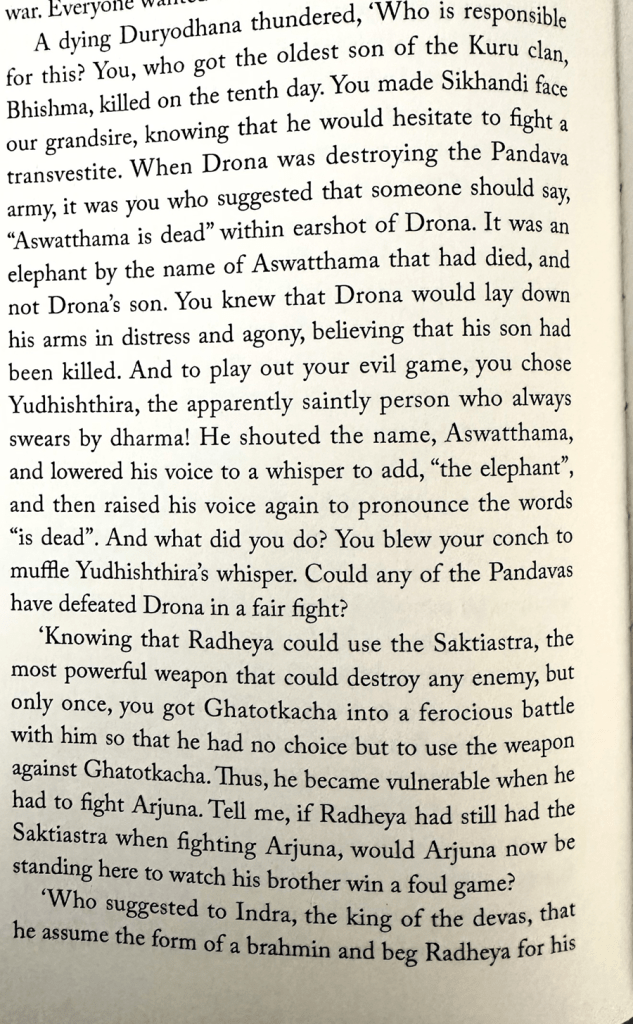
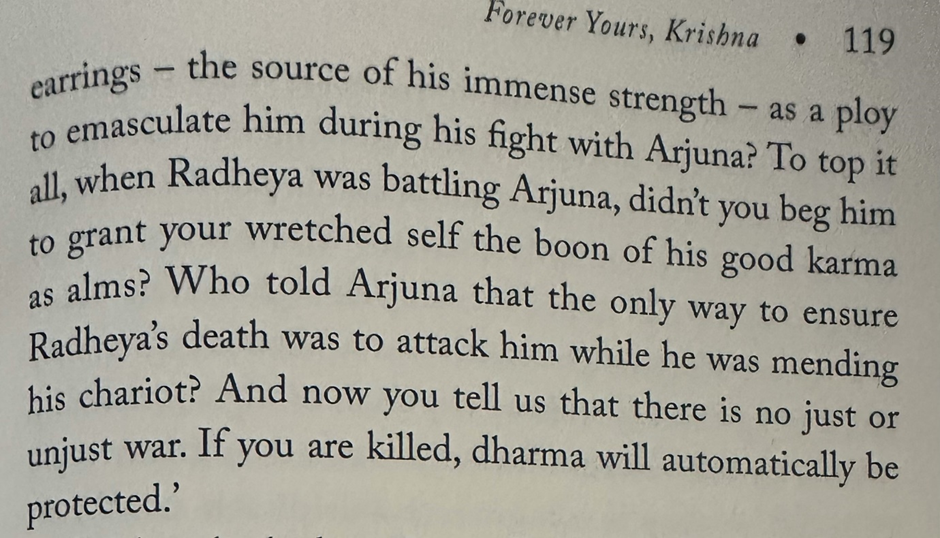
Duryodhana thus like most modern politicians and political parties, ironically, took the high moral ground! With vehemently righteous indignation, he accused Krishna and the Pandavas of unethical, “adharmic” and unconscionable sin.
Krishna’s answer to Duryodhyana was classic Krishna — laconic but profound. And outrightly cynical too! But then Krishna’s rejoinders remind us all, however, of only the quite typical way in which the dog-eat-dog wars and the worst crimes against humanity in our world today are all often justified through cynical rationalisations; by taking moral shelter under what in the Ivy League academia of America is called the “approach of the Realism School to conducting pragmatic international relations”. Krishna is thus himself an allegory for the Realism school of international relations if you listen to what he says:
“The only yardstick of the fairness or unfairness of a war is the result. The Kurukshetra War was never a dharmakshetra. Moral principles were scrupulously followed during the first nine days. But they were abandoned during the next nine days and it became a merciless battle, with both sides committing all sorts of atrocities”.
Elsewhere, Krishna also held that the “message of the Kurukshetra War was that there is no absolute standard when it comes to ethical conduct. Expediency is the primary determinant.”
A sweeping and chillingly cynical pronouncement indeed on War, Dharma and political life in general …. by no less than an “avatara-purusha” like Krishna!
*******************
The conversation between Duryodhana and Krishna didn’t end there. Krishna looks at the mortally wounded Kaurava prince and says this:
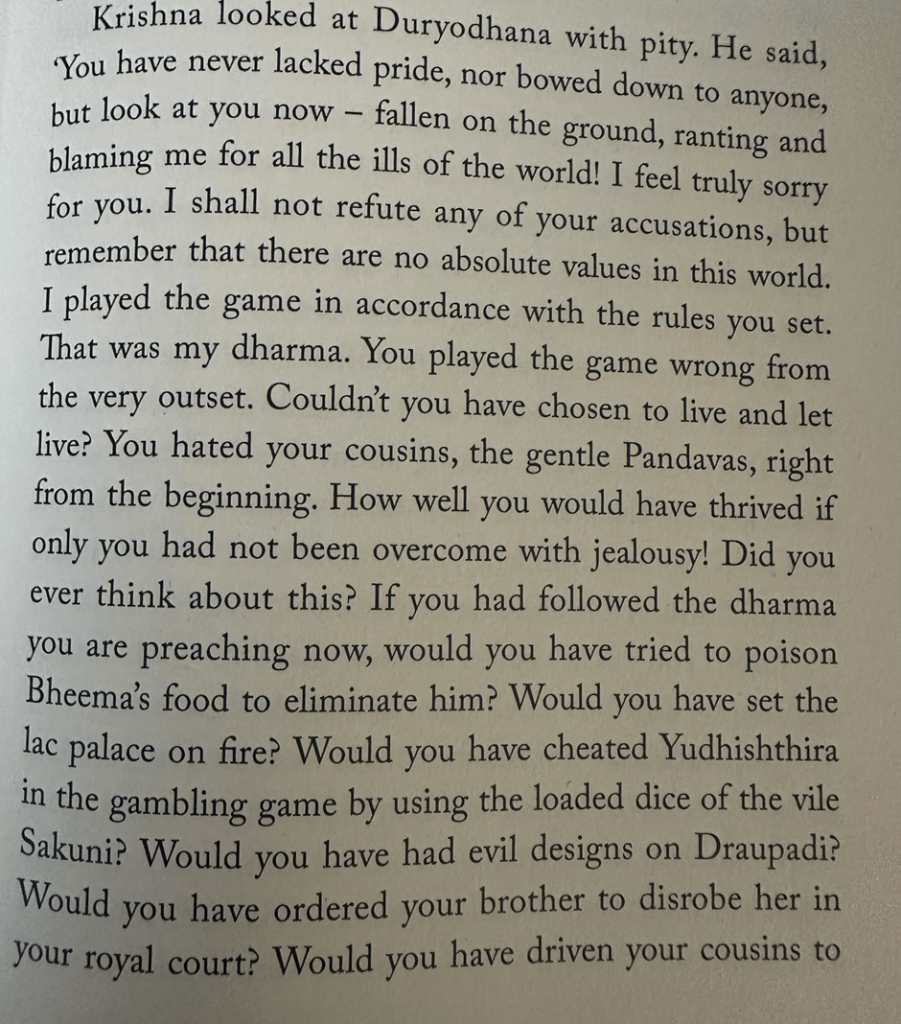

The above response of Krishna is again so very redolent of the quality and characteristics of the entire body politic of contemporary India.
In countering Duryodhana’s moral indignation and his accusations that Krishna resorted to Adharma in the Kurukshetra war, the wily politician that he is, Krishna defends himself by employing what is commonly known today as the “doctrine of whataboutery” — an extremely effectively weapon to be used tocounter ad hominem moral indignation with doubly more ad hominem moral indignation.
In our country today, for example, when one political party or politician accuses another of Corruption, Nepotism, Casteism, Communal violence and rioting, political betrayal, blackmail and many other such misdemeanours, the second party will counter it by simply turning the tables on the first with “whataboutery”.
“Oh, of all persons, you have no moral right to accuse me of corruption etc. in this instance! How dare you sit on a high horse?! Because in that other instance we all know happened 5 years ago, were you not held guilty of far worse corruption (etc.)?! What about that?!”
Thus is precisely how the doctrine of “whataboutery” is used today throughout the political landscape of India where political parties and ideologues engage and compete with each other in exposing moral failings and turpitude. The principle underpinning all “whataboutery” in politics can be summed up in just one line: “If your opponent charges you with Adharmic conduct retaliate with force by exposing the even more Adharmic deeds of his in the past. In the process, if Dharma itself becomes a casualty through obfuscation, so be it.”
Krishna was evidently employing the very same tactic of “whataboutery” to puncture Duryodhana’s moral self-righteousness.
The Krishna-Duryodhana samvaada in this particular scene in IP’s novel, must indeed be read and savoured as a telling allegory reflecting the political culture and discourse of modern Indian.
********************
One other delightful allegory in the novel is the personality of Sage Narada. He is the “cosmic traveller” and eternal busybody — the carrier of tales to-and-fro, back-and-forth between the gods, devas and asuras. Narada in a very introspective mood, uncovers for us the true nature of his own identity in a conversation he has with Jara, the hunter.
Narada in the Mahabharatha is a bit of a power-broker with privy to secrets unknown to anyone other than those in gods’ inner circles, the ones who walk in and out of the deep corridors of divine power. In the celestial realms, Narada is one who has unimpeded access to the most highly classified information of divine government and administration. He has his ears to the ground always and gathers sensitive intelligence from every quarter of the universe.
However, Narada is also a rishi of rare discretion and a grave sense of responsibility and rectitude. Narada keeps confidences and secrets and knows to whom, how, when exactly and why he must deliver news or tidings. His discreet but timely dissemination of sensitive intelligence is all for the purpose of greater good only; it is to maintain dharmic order.
In that precise sense, Narada was to the divinities what the Media and Information Broadcasting agencies are today to humans.
IP makes Narada talk about himself and his role in this regard and it is worth reproducing in facsimile:

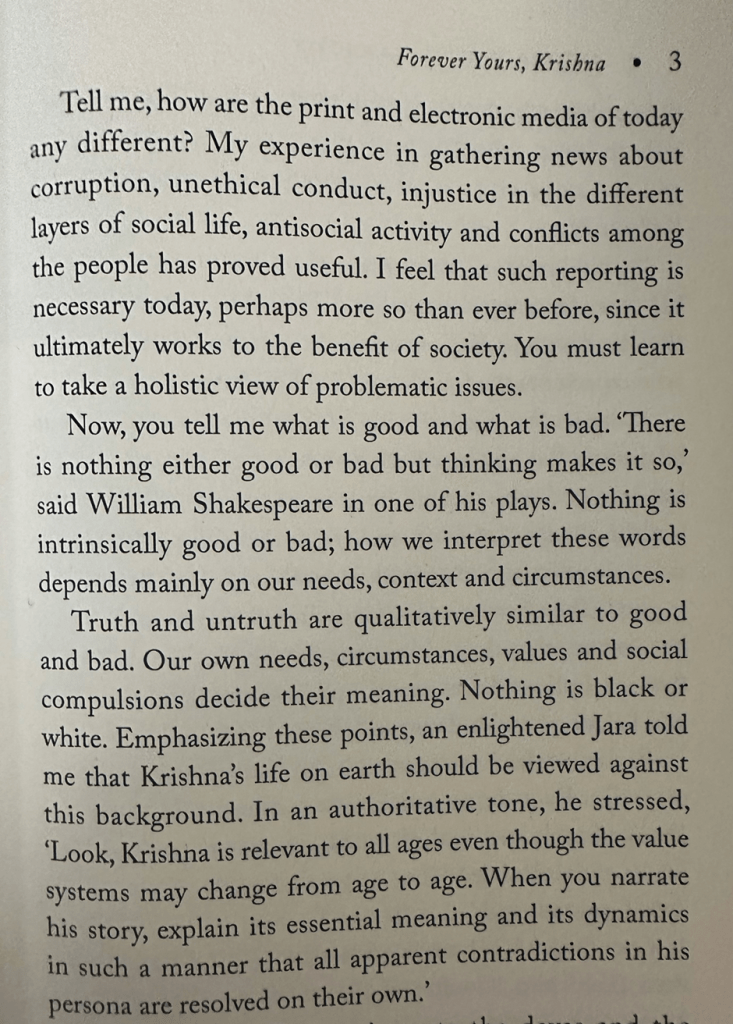
In the modern world, the Mass Media machinery and the Information Broadcasting profession invariably tend to be pro-establishmentarian. They defer ultimately to the powers-that-rule. The fourth-estate acts as their spokesman, ideological handmaiden; they promote the cause and the interests of the most powerful in the land.
Narada and Jara in that respect are really no different in that respect … certainly not if one pays close attention to how Jara and Narada conspiratorially agree between themselves how Krishna’s story must be told:
“Look, Krishna is relevant to all ages even though the value systems may change from age to age. When you (Narada) narrate his story, (do) explain its essential meaning and its dynamics in such a manner that all apparent contradictions in his persona are resolved on their own”.
That’s how today, as we all know, the Media behaves too — exactly as per the Jara mantra! And that’s yet another insightful allegory in the novel.
(to be continued)
Sudarshan Madabushi