A pilgrim’s jottings on a 3-day whirlwind pilgrimage, May 4th, 2024 (Tirunelveli-Tuticorin) of Nava Tirupati temples
As my road-journey that day wended its way towards Azhwar Tirunagari , a small part of my mind was still pondering over how divine Synchronicity was showing itself up in so many strangely serial ways, or in mysteriously coincidental events, in the past year, and ever since my astrologer-friend had told me that planet Jupiter’s influence of “guru mahadasha” would be strongly felt in my life henceforth for 16 years going forward. I couldn’t shake off Synchronicity from my mind because even in just the week and a few days before, when I had set off on my pilgrimage on May 3, 2024, — to Nava Tirupathi Kshetras and four other temples of Tiruvattar, Tiruvanparisaaram, Tirukurunkudi and Vanamamalai — events kept happening, again and again, involving either a impromptu meeting with an Acharya in an ashram, darshan at an Acharya sannidhi or else some other unexpected occasion to do with “guru sambhandham“.
- On the morning of April 27th 2024, along with my family I was truly blessed to have had wonderful darshan of our family “kuladeivam“, Tiruvenkatamudaiyan of Tirumala.
- Then after darshan we exited the temple and we found ourselves heading straight to the adjacent shrine of our family “kula acharya”, Sri Tirumala Nambi — maternal uncle to and also one of 5 Acharyas of Sri Ramanujacharya. My paternal grandmother hailed from the same lineage Tirumalai Nambi vamsham of Thozhappachariars. Hence Sri Tirumala Nambi was the “prathama Acharya” (the very first guru) for many priestly generations of my paternal family lineage having its roots in Tirupati. Below is a photo of the Tirumala Nambi sannidhi situated just outside the main temple of Lord Venkateshwara.

2. On May 2nd 2024, returning from Tirumala to Chennai, I learnt about the news that prakrutam Srimad Azhagiyasingar had just then returned from a month-long “sanchaaram” in North India to Naimishaaranyam — where he had presided over the “samprokshanam” of a new Sri Malola Temple and new precinct of the Mutt — and to Ayodhya where he had peformed “mangalaasaasanam” to Sri Ram Lalla in the grand and brand new temple which had been consecrated earlier on January 22, 2024 by the Prime Minister of India.
On a sudden impulse, I decided to go at once to Selaiyur Sri Ahobila Muttam on another personal errand but also mainly offer “dandasamarpanam” to Asmath Acharyan Srimadh Azhagiyasingar. It was at around 5 PM in the afternoon. I found the Acharya in a very relaxed mood. There were only a handful of disciples then in the room where otherwise there would have been scores of them milling around him. He welcomed me warmly with a smile and blessed me with “mantraakshadai“. The Acharya was glad to hear from me tidings about my forthcoming yaathra to Nava Tirupati kshetras. May your yaathra be successful and give you new energy, he said and wished me well!
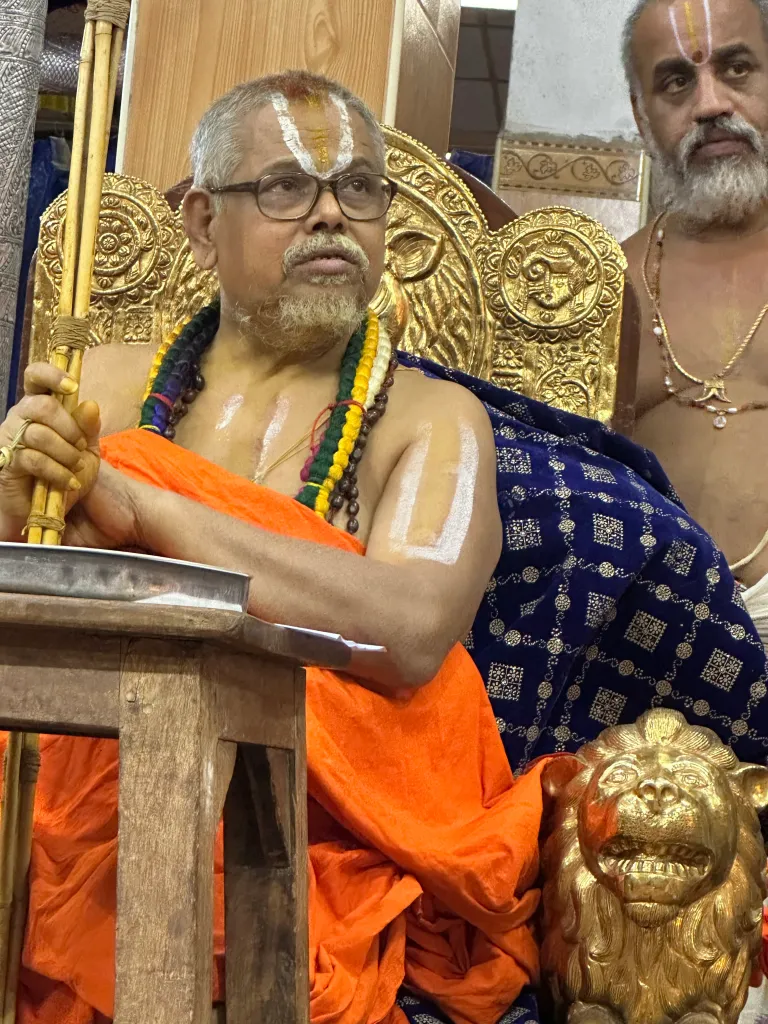
3. Finally, on May 4th 2024, I found myself on my way… at last … on my very first visit to the hallowed spot inside the great temple of Azhwar Tirunagari, the “avatara sthala” of the foremost Acharya of all Sri Vaishnavas — Tirukurughur Nambi, known to the world as Swami Nammazhwar!
The particular order in which the above events took place, in the week leading up to my arrival at Azhwar Tirunagari temple, once again seemed to me pre-programmed by some inexplicable working of divine synchronicity.... ! So little of it had been pre-arranged or scheduled by me…. I had little to do with really how they turned out to all happen, one after another in perfectly appropriate and neatly ordered, upwardly spiralled sequence.
Firstly, there had been darshan of my “kula deivam“; next followed darshan of my “kula guru“; then, darshan of “asmath acharyan“… All then finally culminating in the darshan of “prathama Acharya” of the entire community of Sri Vaishnavas, Swami Nammazhwar who also was hailed by the illustrious name of “Prapannajana Kootasthar” — the pilot of peoples who surrender absolutely unto Sriman Narayana”!
****************
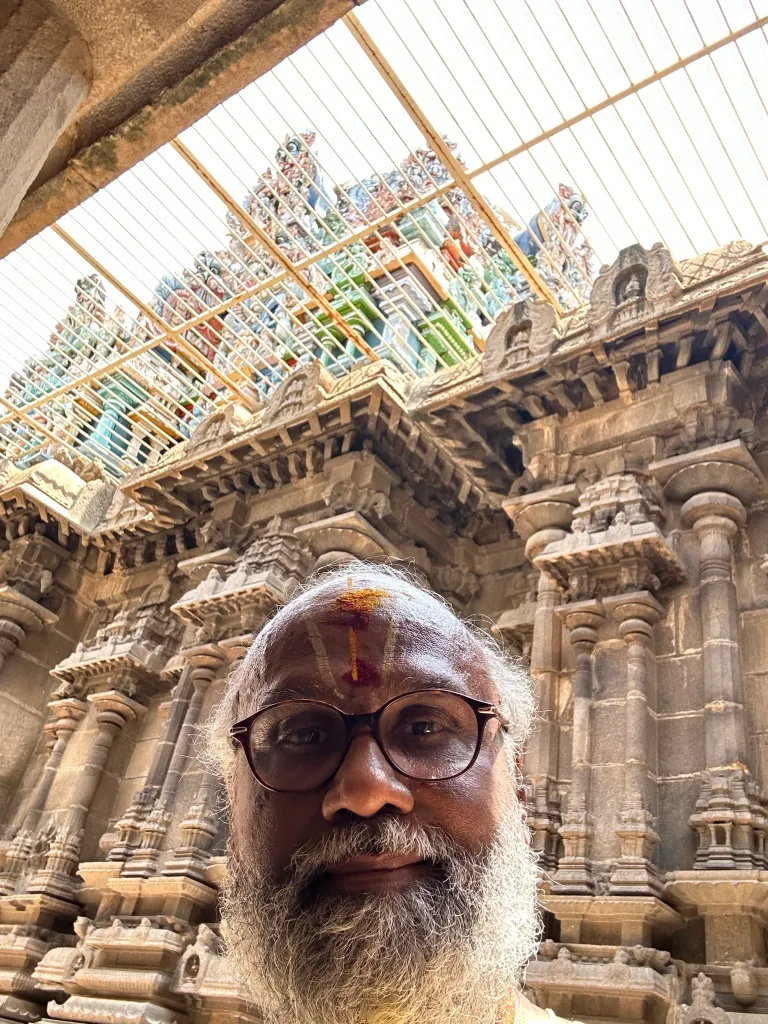
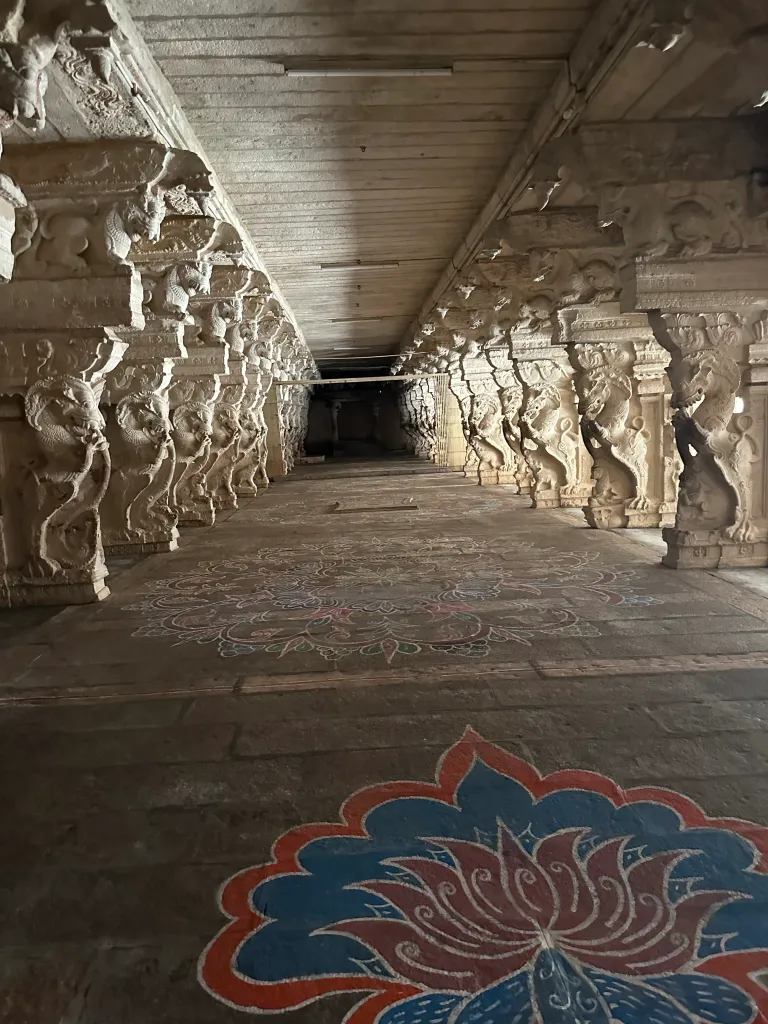
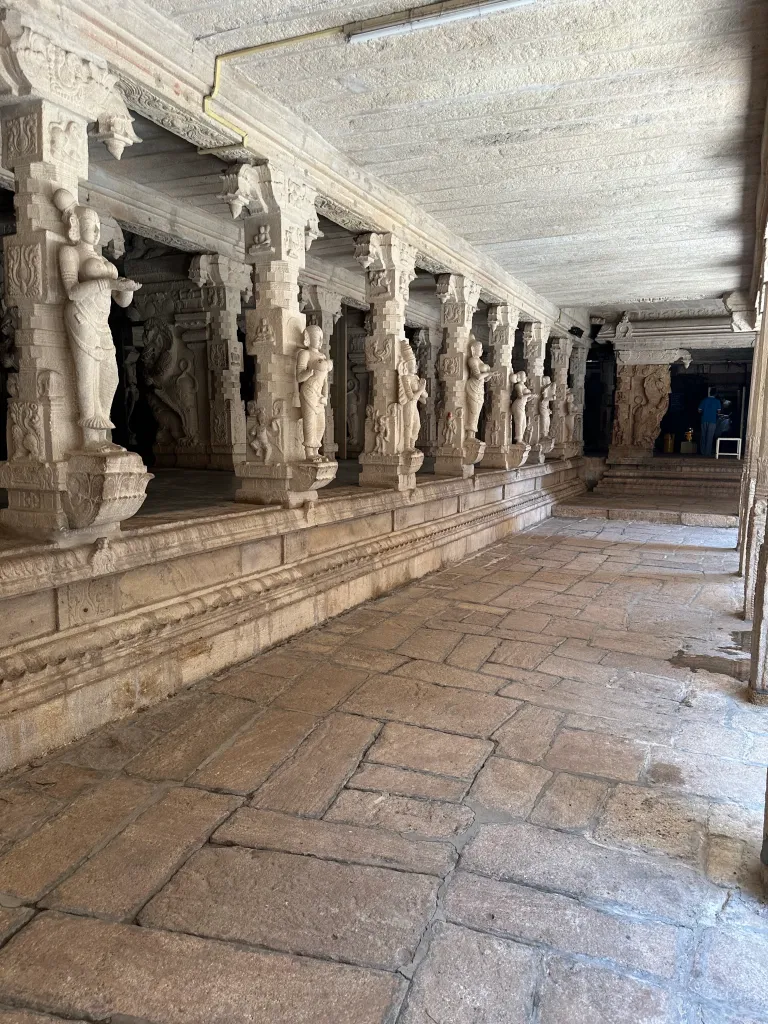
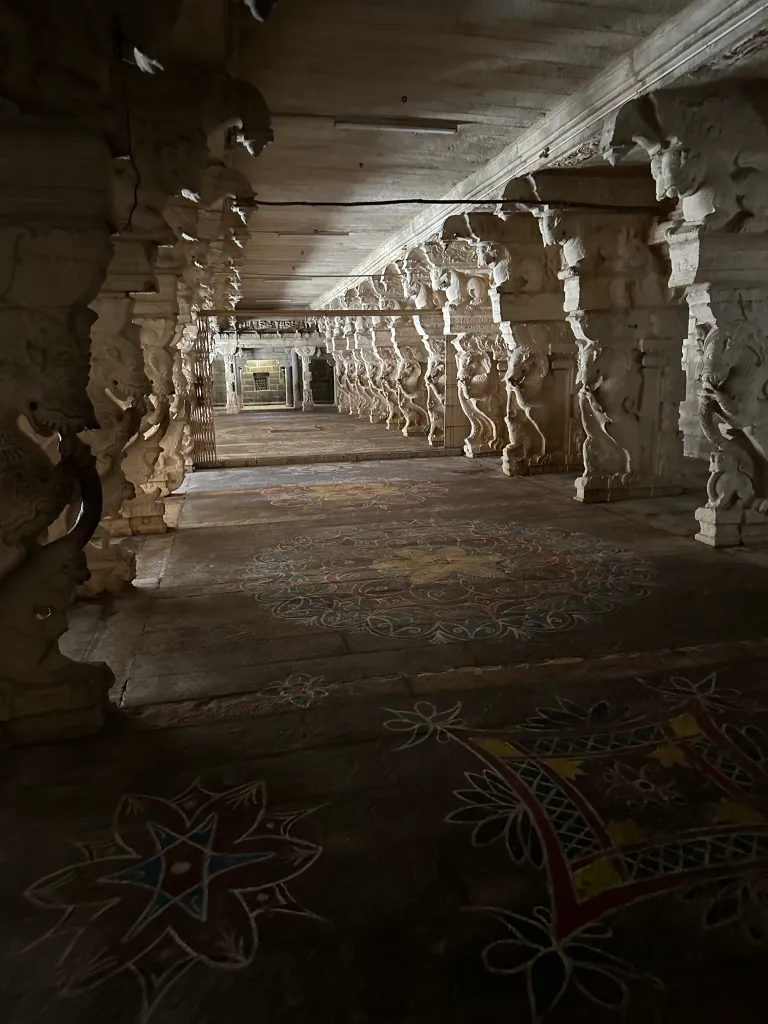
Entering past the great gatewa into the temple of Nammazhwar can be an experience arousing awe and inspiration …. especially, if one finds as I did that day, that it was virtually empty of usual thronging crowds of pilgrims. When I entered the vaulting portals of the temple, barely more than a few dozen people were walking about desultorily, here and there. The temple was virtually empty when I strolled about at my own languid pace within its bare, dark and echoing interiors….To me it also felt like I had just suddenly climbed into some science-fictional time-machine vehicle …. and was being magically transported back in time to some distant ancient, pre-medieval age in the glorious reigns of the Pandyas, Cholas in Tamil History!
The vast perimeter walls, the mantapams, praakaaras, gopurams and vimaanams, stepways and stone-floored corridors inside the temple are all vast, ornately multi-pillared sthambams, and many-splendored in architecture, design and iconography…. The grandeur of the bimbams takes one’s breath away.
I went from sannidhi to sannidhi, from sanctum to sub-shrine …. all at unhurried, unfrenzied pace … and took in the magnificent sights, all cast in cool, hard, age-weathered granite stone, yes, but what seemed to me in perspective to look also more like sublime poetry conceived, designed and hand-crafted into stone….

*******************
குருகூர் என்பது ஆழ்வார் திருநகரியின் பெயர். நம்மாழ்வாரின் மூதாதையரான திருவழுதி வளநாடனின் பாட்டனராகியக் குருகன் என்ற அரசன் இத்தலமிருந்த பகுதியைச் தலைநகராகக் கொண்டு ஆண்டமையால் அவன் நினைவாக குருகாபுரி ஆயிற்று என்று சொல்லப் படுகிறது. குருகு என்ற தமிழ்ச் சொல்லுக்கு நாரை, கோழி, சங்கு என்ற பல பொருளுண்டு. சங்கு இத்தலத்திற்கு வந்து மோட்சம் பெற்றதாலும் குருகூர் ஆயிற்று என்பதுண்டு.
Kurughur is the name of Alwar Tirunagari city in southern Tamizh countryside centuries ago. It is said that Kurukhapuri was named after Nammazhwar’s ancestor, Tiruvaluthi Valanadan’s father Gurukan, who ruled the area as his capital.
The Tamil word Kurugu has many meanings like stork, chicken and conch but it mainly refers to water birds whose ecosystem lies in and around wetlands. The city thus in ancient times was a fertile haven abounding in luxuriant flora and fauna.
It is said in native Tamizh folklore that Sangu , Maha Vishnu’s handheld conch (the famous “paanchajanya” Krishna used as war bugle in the Kurukshetra War) came to this city to secure Vishnu’s Grace and got moksha and its exalted position as well as one of two hand held “Ayudham” of the Almighty , the other being Sudarshana chakra, the divine discus.
The ancient city’s name became Kurughur by passage of time.
*****************
After I had circumabulated the rest of the temple, I was finally ready for the climax of my pilgrimage i.e. to go and offer prostrations at the Sri Nammazhwar sannidhi, the spot where Madhurakavi Azhwar met the Yogi and had had their epic, epiphanic meeting under the great awning of the now centuries-old tamarind tree.
There was not a soul around in the surroundings when I climbed the short flight of bronze-plated stepway that led to the sacred, sylvan spot under the tree… The air was surprisingly cool, and there were many birds chirping away softly but unseen somehere up in the tree-branches…. They sounded like a pleasant avian orchestra playing for the occasion. From somewhere else inside the temple sannidhis, a temple bell went ringing… its deep, metallic gongs echoing and joining in the avian choral performance, adding some kind of rhythmic beat to it. Could these birds well be “kurughu” birds that became eponymous with Swami Nammazhwar, maybe? … I thought to myself silently ….

***************
Even days before I had set out on this pilgrimage, I had been imagining beforehand the very moment when I would be standing at this very spot. Mentally, I had told myself that I would stand under the tamarind tree and by way of offering obeisance to Swami Nammazhwar, I should take some time out to recite the first decad in his mystic 1000-versed Tamil hymn that is part of the collections of the Divya Prabhadham of 4000 of the other Azhwars. The very first stanza of the Tiruvoimozhi begins with these soul-stirring words:
உயர்வற உயர் நலம் உடையவன் யவனவன்
மயர்வற மதி நலம் அருளினன் யவனவன்
அயர்வறும் அமரர்கள் அதிபதி யவனவன்
துயரறு சுடரடி தொழுதெழென் மனனே.
uyarvaRa uyarnalam udaiyavan yavan avan
mayarvaRa madhinalam aruLinan yavan avan
ayarvaRum amarargaL adhipathi yavan avan
thuyaraRu sudarodi thozhudheLu en mananE
The above verse and 9 others, rehearsed mentally by me during my road-journey, I was simply all keyed up to chant once I stood at the hallowed spot….
For some strange reason, however, when I did appear at the spot, my mind went completely blank! My senses seemed to go numb with a feeling of overwhelming awe….
When I looked up at the tree branches and then down into the hollow of the tree trunk wherein Swamy Nammazhwar was believed to have lived all his life, had sat lost in total meditation and finally attained exaltation…. I became tongue-tied! The momentous historicity of the spot left me stupefied…. The words of the Tiruvoimozhi would not tumble out. Thoughts were abruptly frozen. Time seemed to stand still …. I could do no more than simply clasp my trembling palms together in silent supplication to the memory of the great mystic Acharya…
After a few moments, my mind gathered itself recovering from its fleeting trance. All of a sudden, and again for no reason at all, it was the not the Tiruvoimozhi paasuram which I had been earlier rehearsing within my mind that I was able to recollect. Instead, out came tumbling another Nammazhwar verse from his other work, the Tiruviruttam — the second verse in which he beseeched the Almighty in poignant words:
‡ ெபாய்ந் ந¦ன்ற ஞானமும் ⋆
ெபால்லா ஒழுக்கும் அழுக்குடம்பும் ⋆
இந் ந¦ன்ற நீர்ைம இனி யாம் உறாைம ⋆
உய¥ர் அளிப்பான் எந் ந¦ன்ற ேயானியும் ஆய்ப் ப¥றந்தாய்
இைமேயார் தைலவா ! ⋆ ெமய்ந் ந¦ன்று ேகட்டருளாய் ⋆
அடிேயன் ெசய்யும் வ¥ண்ணப்பேம Á Á 1 Á Á
poyn ninṟa ñānamum ⋆
pollā ozukkum azukkuḍambum ⋆
in ninṟa nīrmai ini yām uṟāmai ⋆
uyir aḻippān en ninṟa yōniyum āy ppiṟandāy
imaiyōr talaivā ! ⋆ meyn ninṟu kēṭṭaruḻāy ⋆
aḍiyēn śeyyum viṇṇappamē
O Lord of the Celestials,
You willed your
own many births in wombs of the world —
Pray hear this petition of your humble servant:
Grant me re-birth never again —
Not another filth-ridden body, please!
Nevermore these earthly misdeeds!
And, Lord! please above all,
Save me forever
from the false-knowledge of this world!
The import of the first verse above in the Tiruvoimozhi, “uyar vara uyar nalam udaiyavan evan avan!”, is a deeply philosophical one. It has much to do with even lofty Visishishtadvaita metaphysics. In fact, tomes of scriptural commentary — “vyakhyaanam” — have been written about it in the past by several Sri Vaishnava scholars. Whereas, the other Tiruviruttam verse above is nothing but a simple, straightforward prayer — an intensely “bhakthi” brimming one, so full of abject beseechment.
Perhaps it is only good that the former stanza had completely slipped from my mind — I thought to myself — to be replaced by the latter paasuram, which in the situation, seemed far more appropriate to me: I had come to Tirukurughur to beseech… not to philosophize….
****************
The sthala-purana of Tirukkurughur is well known to every Sri Vaishnava. And I too was fairly well acquainted with so many of the legends and lore about Azhwar Tirunagari which, in fact, are easily available in the public domain — on the internet, Youtube etc…
I had also had many readings of the absorbing accounts in the hoary religious texts of Sri Vaishnavas — such as the Guru Parampara Prabhaavam etc. — about the famous meeting-ground under the tamarind tree where Madhurakavi Azhwar sang the “kanninun siruthaambu” paasuram soon after his dialogue with Nammazhwar. In spite being well-acquainted with the story of Nammazhwar and Madhurakavi’s meeting, when the good-hearted archaka-priest at the shrine began recounting the “sthala puranam” about the two Azhwars for my benefit, I could not help feeling a thrill of old recollection shooting through my veins.
Below is a short video-recording of the Archaka–swami’s riveting narration of the miracle that had happened under the tamarind tree, hundreds of centuries ago…. It was no mere re-telling of hagiography … It was true, heartfelt homage being expressed for the greatest mystic-saint of the Sri Vaishnava faith —
*****************
On my way out of the Nammazhwar sannidhi, I retraced my steps slowly towards the “dasaavatara sannidhi”. In hindsight, it seems to me why I went back to have a closer darshan of the 10 “archa murthys” of the 10 “vibhava avatara” deities in the temple was for this probable reason:
Within my mind, the mystifying questions of (1) why each of the Nava Tirupati sthalas are associated with the Navagrahas and yet none however houses a sannidhi for the planetary deities, (2) the strange influence of Guru-Mahadasha synchronicity in my life of the past year (3) Azhwar Tirunagari’s association with the planet Jupiter and (4) why the religious reticence of Sri Vaishnava sampradaaya regarding “jyotisha” or predictive Astrology? …. all such questions were still working upon me at the back of my mind…. My religious instinct told me that worshipping the “dasavatara sannidhi” would somehow help me find reasonable resolution for the niggling questions.
**************
Anyone whose faith is Sanatana Dharma and believes implicitly in the scriptural validity and authority of the Vedas cannot outrightly dismiss the reality and divinity of the powers of the Navagrahas. So many are the the Veda mantras and hymns that extol these 9 planets to be devatas each fulfilling their special and respective cosmic role and duty assigned to them. Thus if I say I an adherent of the Vedic religion, I cannot cherry-pick the Vedic deities to believe in and not to believe in…. All Vedic deities have to given due recognition for the place and space they occupy within the larger scheme and system of Vedic theism.
The “navagraha-suktam” is a Sanskrit hymn of sacred mantras taken from the Rg and Atharvana Vedas. It is in praise of the 9 celestial planets. Similarly, there are Vedic hymns called “Nakshatra Suktam” in praise of the 27 stellar deities in the Hindu astromomical pantheon. The ritualistic sections of the Vedas — found in the Braahmana Vedic texts — also abound in mantras injuncting the conduct of “ishti homam” to propitiate the Navagrahas and Nakshatras.
Then of course there are many puranas too that attest to the power of the Navagrahas and Nakshatras. For instance, the Brahmaanda Purana and Skanda Purana are full of lore and legends about how the planetary Deities were propitiated even during the course of Bhagavath-avatara and the fight of Dharma over Adharma on earth in the different “yuga” or time-eras.
According to the epic Ramayana story retold in some of the ancient Puranas (not Valmiki’s work though), Sri Rama was on his way to Lanka to wage war and free Sita Devi from Ravana, the king of Lanka. Before undertaking the journey, he is said to have performed Vinayaka Pooja in Uppur and the Navagraha Pooja in Devipattinam, a small village 20 kms from the famous seacoast temple of Rameshwaram. Sri Rama performed the pooja to appease the Graha Devatas and installed small stone obelisks just a few meters out on shallow sea-bed. He calmed the high tides of the volatile sea just by raising his hand. He then is believed to have installed the Navagrahas called the Navabashanam (9 obelisks) in Devipattinam. The nine stones today represent the nine planets.
Also in the Hindu litany of sacred mantras, stotras, incantations and chants, there are several dedicated to the Navagrahas. They are chanted to this day by millions of people of faith. A couple of popular Sanskrit ones are these below:
RAmAvatAra: sooryasaya, chandrasya yadunAyaka:
NrusimhO bhoomiputrasya, sowmya: sOma sutasya cha,
vAmanO vibudhEndrasya bhargavO bhargavasya cha
koormO bhaskara putrasya, saimhikEyasya sookara:
kEthOr meenAvatArascha yEkEchAnyapi gOcharA:

In many Indian temples, especially Saivite ones, but not so commonly in any Vaishnava temples, one will find a special altar dedicated to the nine planetary devatas.  Before leaving the temple, devotees offer prayers to these deities by circumambulating nine times around the altar, while chanting the Navagraha Stotra as prayer:
“arogyam pradadatu no dinakarah candro yaso nirmalam
bhutim bhumisutah sudhamsu-tanayah prajnam gurur-gauravam
kavyah komalavagvilasamatulam mando mudam sarvada
rahurbahubalam virodhasamanam ketuh kulasyonnatim“
May the Sun give us long life and good health; the Moon, pure
fame; the son of the Earth (Mars), charisma and prosperity; the
son of the Moon (Mercury), intelligence; Jupiter, respectability; the
one possessed of the qualities of a poet (Venus), the capacity for
unsurpassed and melodious speech; the one of slow gait (Saturn),
continual joy and pleasure; Rahu, strength and the destruction of
enemies; and Ketu, growth of the family.
*************
From the strictly “sampradaaya” perspective (i.e. age-old custom and practice) of Sri Vaishnavas, the core intent and underlying message of such shlokas as above found in many scriptural litanies of the Vedic religion are only this: that praying to the dasavatAram of BhagavAn Narayana alone is sufficent and truly efficacious for a devotee to be able to overcome, why perhaps even greatly benefit from any event, be it beneficient or maleficient, caused in life by the operation or influence of dasAbhukthis or mahadashas of the great Planets. For they are by themselves, only divine but subservient vassals of the Almighty. Their function is not to hinder or harass the Vishnu Bhaktha but to pave the way for him or her, and remove all obstacles in the way of realizing Godhood.
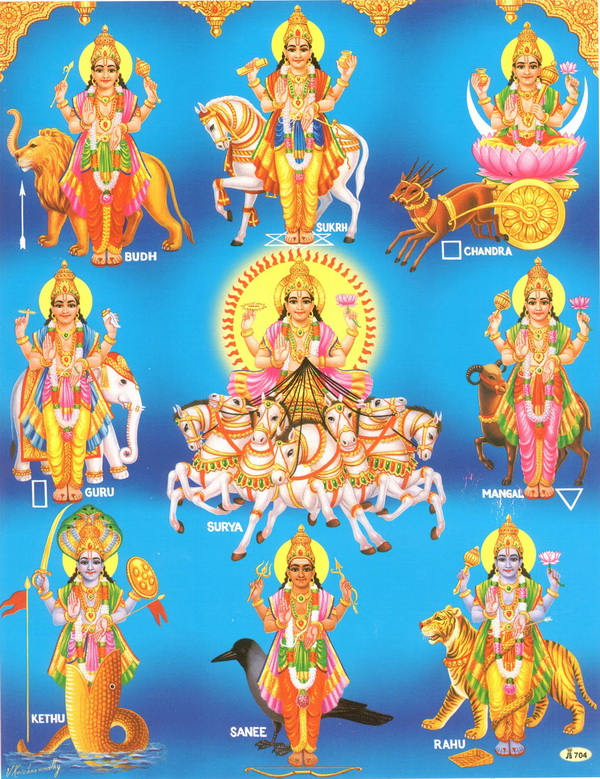
In Hindu iconography, all the Navagrahas as vassals and serving functionaries of Bhagavan Vishnu often get typically depicted in images (look closely please at image below) — with the sole exceptipn of Deity Saturn, “shanaieshwara” wearing the mark of the Saivite “vibhuthi” on his forehead — bearing the “urdhva pundhra” naamam mark signifying “daasatvam” or subservience to the Supreme Vishnu.
****************
With all the above thoughts and feelings above swirling about somewhere in the back of my mind, I strode towards the “dasaavataara sannidhi” in the temple of Azhwar Tirunagari. The shrine was bolted at that particular time of the day when the entire temple was shutting down after the morning and midday “araadanam” and “sevas“. However, I could get a clear view of all the “dasaavataara murthys” through the grill-windows.
In the Sri Vaishnava “sampradaayam“, worship of the Dasaavatara signifies unwavering total and monotheistic surrender to Sriman Narayana as the Supreme Deity. It is primarily worship of all 10 avataras of Vishnu. But then it is, ipso facto, held to be worship also of the 9 Navagraha devatas as subaltern deities who carry out the cosmic duties delegated to them by Bhagavan.
It is in that highly nuanced sense of subtle spirit of theism that Sri Vaishnavas, whenever they wish to offer worship to the Navagrahas, turn to worshipping the Dasaavataara. They see then no conflict arising in theological belief-system in that stance.
One of the most beautiful of stotras composed in Sanskrit by Acharya Sri Vedanta Desika is the “Dasaavataara Stotra”. It contains 10 stanzas each praising the 10 avatars of Vishnu, 9 of which are believed also to allude to the 9 planets. Many Sri Vaishnavas are fond of reciting the hymn at sannidhis in “divya desa kshetras” like the Nava Tirupati temples where Navagraha devatas are associated with the main Deity in the following order:
Rama avatara : Sun; Krishna avatara: Moon; Narasimha avatara: Mars; Kalki avatara: Mercury; Vamana Avatara: Jupiter; Parasurama avatara: Venus; Koorma avatara: Saturn; Matsya avatara: Ketu; Balarama avatara: Gulikan (sub-planets); Varaha avatara: Rahu.
My last act of worship at Azhwar Tirunagari temple before l left it was therefore to sit outside the “dasaavataara sannidhi” in a quiet corner and recite Swami Desikan’s all 10 verses of the “dasaavataara stotram“, the 6th verse of which is in praise of the Vaamana Avatara, ruling over the planet Guru or Jupiter.
व्रीडाविद्धवदान्यदानवयशोनासीरधाटीभट- स्त्रैयक्षं मकुटं पुनन्नवतु नस्त्रैविक्रमो विक्रमः । यत्प्रस्तावसमुच्छ्रितध्वजपटीवृत्तान्तसिद्धान्तिभि- स्स्रोतोभिस्सुरसिन्धुरष्टसुदिशासौधेषु दोधूयते ॥ ६ ॥
6. Dasavatara Stotram
****************
Sudarshan Madabushi