Dushyant Sridhar is a young ‘upannyaasaka‘ of rare ability. He is a professional raconteur of purana, itihaasa and other Vedic scriptures. His scholarship, intelligence, eloquence and stage-presence appeal to young audiences and make him an ambassador even abroad for our Indian religious culture, especially of the Sri Vaishnava strain.
None therefore should deny him his birthright as a native-born Hindu to exercise the liberty to experience the enjoyment of the Ramayana in his own personal way and share it too via what he himself has described as … “my anubhavam“.
This ‘itihasa‘, this great epic is our country’s ‘pokisham‘ after all (Tamil word for “treasure as family heirloom“) — a national treasure that every son and daughter of the soil can claim indeed to be his or her own. That legitimate claim is the reason precisely why, as the poet A.K.Ramanujan once pointed out, “there are 300 Ramayanas in the world… and the world is burdened with them!” Ramanujan went on to explain what he meant by his observation:
“…. for every Rama (conceived by anyone) there is a Ramayana. The number of Ramayanas and the range of their influence in South and Southeast Asia over the past twenty-five hundred years or more are astonishing. Just a list of languages in which the Rama story is found makes one gasp: Assamese, Balinese, Bengali, Cambodian, Chinese, Gujarati, Javanese, Kannada, Kashmiri, Khotanese, Laotian, Malaysian, Marathi, Oriya, Prakrit, Sanskrit, Santali, Sinhalese, Tamil, Telugu, Thai, Tibetan—to say nothing of Western languages. Through the centuries, some of these languages have hosted more than one telling of the Rama story. Sanskrit alone contains some twenty-five or more tellings belonging to various narrative genres (epics, kavyas or ornate Poetic compositions, purdnas or old mythological stories, and so forth). If we add plays, dance-dramas, and other performances, in both the classica] and folk traditions, the number of Ramayanas grows even larger. To these must be added sculpture and bas-reliefs, mask plays, puppet plays and shadows plays, in all the many South and Southeast Asian cultures.
“Camille Bulcke (1950), a student of the Ramayana, counted three hundred tellings. It’s no wonder that even as long ago as the fourteenth century, Kumaravyasa, a Kannada poet, chose to write a Mahabharata (instead of Ramayana), only because he had heard the cosmic serpent which upholds the earth groaning under the burden of Ramayana poets (“tinikidanu phaniraya ramayanada kavigala bharadali“).
That the poet Kumaravyasa above makes a reference to a “cosmic serpent” is very significant. In doing so we can say that he attributes to the Ramayana a certain unique timeless quality. Why do I say that?
The cosmic serpent is Vasuki in the great episode of Sagara Manthana recounted in the Vishnu Purana. It is the story of the Devas and Asuras, the first denizens of the celestial worlds, who engaged in a titanic struggle to churn the Ksheera Sagara or ‘Ocean of Milk‘ to extract Amruta, or the ‘Elixir of Life’ in the primordial act of universal Creation. The great serpent was used as churning-rope in that epic cosmic event. The poetic juxtapositioning of the Ramayana with the primordial event of Creation is deliberate. It is neither accidental nor exaggeration! What Kumaravyasa meant to convey thereby was really that the idea of Ramayana possesses a certain quality that is uniquely “timeless”. If one reads and savours the Ramayana only literally and fails in a platonic sense to feel, absorb, appreciate and experience such “timeless quality“, then it wouldn’t be wrong to say that one has grasped its only its form but entirely lost its essence and the “itihaasa’s” very purpose.
Dushyant Sridhar’s attempt in his newly published book to come up with and support a wholly history-centric theory of dating the Rama avatar — i.e. pertaining to questions such as when exactly Rama was born on earth and how long he lived and walked it — can only be described at best as an act of intellectual delinquency since it only ends up robbing the Ramanyana of its unique timeless quality and ithihaasic sheen.
************
The young Dushyant ought to remind himself that many were the “upannyaaskars” par excellence in Tamil Nadu who have long gone before him. They were legendary raconteurs of Srimad Ramayana in the traditional ‘sampradaayic‘ ways in which they had themselves learnt them from their own scholarly forebears. To name just a few eminent ones: the Srimad Tirukundai Andavan (Kannan) Swamy, the Pontiff of the Sri Rangam Andavam Ashram during the 1960s and 1970s, was an outstanding “upannyaasakar” on Ramayana. Then there were also others like Sengalipuram Sri. Anantharama Dikshitar, U.Ve. Sri K.V. Santanagopalachariar, Sri. Balakrishna Sastrigal, Sri. Manjakudi Rajagopala Sastri, Sri. Kripananda Variar, U.Ve. Sri. Mukkur Lakshminarasimhachariar.…. and many more in the same league of top-notch Ramayana scholars.
In their heydays, they were all as popular as if not more than Dushyant is seen to be today. Their audiences too were large, far-flung and no less varied too. Not unlike Dushyant’s audiences of today, theirs too comprised young and old, men and women, educated and illiterate, urban and rural, ‘asthikas’ and ‘naasthikas’... People from all walks of life came in droves to attend the Ramayana “upannyaasam” of these stalwarts even in that pre-IT, pre-Digital Technology and pre-TV-Channel era.
When I was a youth, I remember clearly to have myself attended scores of public discourses delivered by these illustrious Ramayana scholars. Never did I ever come across a single occasion when any one of them had even hinted at scholarly doubts or misgivings over the chronological dating of Rama avatar. Far from it being a matter for them of any serious inquiry or issue for historical research, they simply told the Ramayana story just as it was, as Valmiki wrote it … They embellished the ithihaasa, of course, in their own charming ways, here and there, but they never took liberties with it while trying, in any sort of gimmicky ways, to disassemble or deconstruct, or to seek to reconstruct or re-contextualise it.
I was a callow young man then when I went to listen to those upannyaasakars … I was educated too as a post-graduate. And I was once a working professional too in the corporate world… a yuppie, in fact, who was quite up-to-date keeping up with the then brave new world of science, technology and telecommunications that was just emerging. Now, if you ask me if I as a young man then was put-off by the seemingly fantastical Ramayana-narratives of the traditional raconteurs …. as say for example, Dasaratha’s lifespan of 60,000 years, of Rama’s reign lasting 11,000 years or Vanara monkeys being enlisted to Rama’s army to fight a war in Lanka…. the answer is No. My modern education never troubled me by arousing in me feelings of incredulity nor did it come in the way of my enjoyment of the Ramayana. Believe me when I say that I was equally comfortable in the world of “itihaasa” as I was in that of modern science or with emerging technology. I saw no conflict at all between the two worlds. Which is the reason why I find Dushyant’s rather obtuse explanations given in his interviews to TV-channed anchors as overly exaggerated.
Dushyant admits that both in his book as well as in his career as an “upannyaasakar“, he has had to refashion and re-interpret the many narratives of the Ramayana to suit the tastes and the level of credulousness of his young audiences. By way of defending himself, he says he is beholden to his huge fans and followers — his so-called young, high-IQ endowed audiences with “scientific, rational and history-centric” — and provide them re-tellings of the Ramayana with perspectives based on scientific grounds rather than on the traditionally “puranic” ones. This becomes necessary because the mind of his young audience today is not as credulous as that of the older generations of audiences was. The youthful “asthikas” today, Dushyant contends therefore, are unable to appreciate, for example, the Ramayana as a true or convincing account of pre-ancient “Treta yuga” events.
As a counter to Dushyant’s contention, one may perhaps pose a few questions:
Why do you so easily and firmly presume that the young audiences in the past, who went to listen to the traditional Ramayana “upannyaasakars” …. Tirukudandai Andavan Swamy or Kripananda Variar …., were any less intelligent or “rational” than the young new-generational audiences you proudly claim are your own in India and America today?! Were the young audiences 60/70 years ago utterly without any spirit of self-inquiry? Were they all such simpletons and so gullible?
Sorry, Dushyant, all your explanations sound, to me at least, like a load of arrant, arrogant tosh….
What intrigues me a lot is why you feel you must have to go to such great pains only to please …or rather to be more accurate… appease your youthful audiences in India and America? Why must you feel compelled to bend over backwards (intellectually) to pander to their tastes even if that means you might have to bend the narratives of Valmiki Ramayana …. as you did with little compunction in the present case of controversial dating of Rama avatar ?
Perhaps, Dushyant could ask himself honestly: “Am I perhaps unwittingly giving in to consumerist instincts here”? From deep within somewhere the young man’s sub-conscious, his mind is probably telling him this: “Look here, in the modern world, the ‘Consumer is King’… the consumers of your “upannyaasams”, and your latest book too, are all young, yuppy, smart-ass (pardon the crass Americanism) “asthikas” in America and India. You must undertand that today the consumer-profile of Ramayana students has undergone a sea-change compared to what it was 50-60-70 years ago. They won’t understand the Ramayana through age-old classical, tradition-bound interpretations of “sampradaya”. So, it is up to you to re-package the ‘itihaasa’ and re-present it to consumers in fresh, attractive ways acceptable to them. Your Ramayana doesnt have to be exactly redux. But it certainly has got to be all about delivering consumer delight”.
If Dushyant Sridhar’s “upannyaasaka” instincts are telling him all that, then he would do well to banish them all forthwith and completely … The Ramayana is not a consumer product to be marketed.
The Ramayana is timeless “itihasa“.
*************
Dushyant Sridhar would be doing a greater service to the Sanatana Dharma faith, and to the proper propagation of Hindu scriptural wisdom, if only he could redirect his phenomenal abilities and energies as a popular “upannyaaskar” towards educating his audiences about what exactly “itihaasa” means.
Instead of trying to appease his audiences, he must try to take on the much more difficult responsibility of edifying them. To do that he must use his extraordinary connect with his large audiences to disabuse them of Western secular notions of Historicity and of the academic fixation with the need to provide “rational reinterpretations” for the Ramayana.
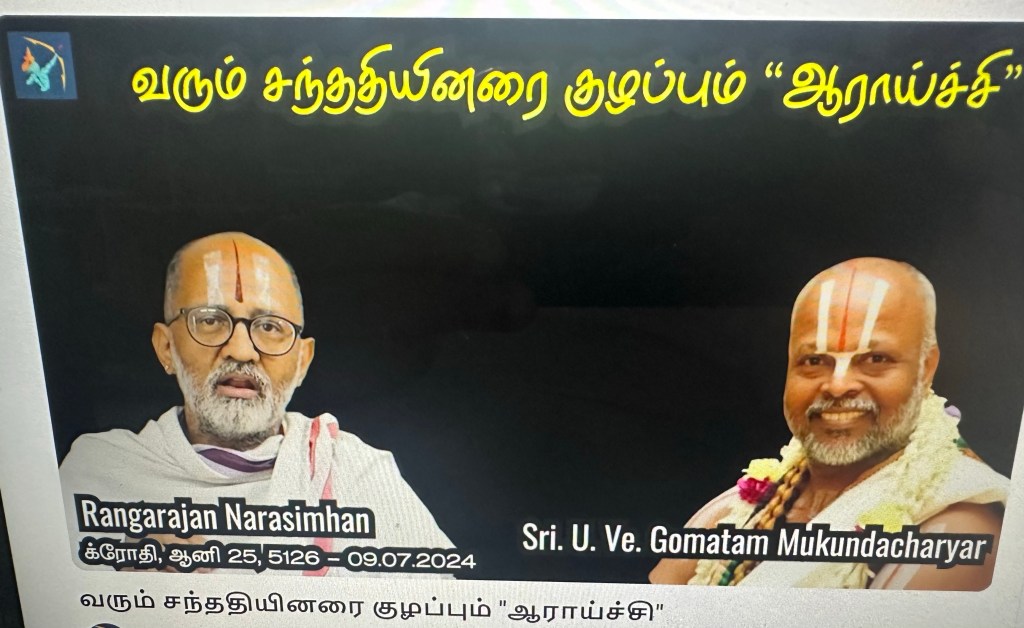
That brings us to the central question that unfortunately Sri Rangarajan Narasimhan of Sri Rangam failed or perhaps forgot to put to the galaxy of Sri Vaishnava “sampradaaya” pundits of the Ramayana who he interviewed on Youtube and TV channels. That fundamental question is: What exactly is “itihaasa“?
During the course of my writing my first published book in 2017 (“The Unusual Essays of an Unknown Sri Vaishnava” ( https://www.amazon.in/Unusual-Essays-Sri-Vaishnava-Sudarshan/dp/1482886278/ref=sr_1_2?s=books&ie=UTF8&qid=1477065680&sr=1-2&keywords=M.K.Sudarshan ), I had found myself asking the same nagging question while devoting chapters in it to the appreciation of the Ramayana.
Believe me, I did agonise over the same question as I grappled to comprehend it. I read many other books on it written by eminent scholars, both of the Sri Vaishnava ‘sampradaya‘ as well as in the formal academic world. Nowhere was I however able to find a clear definition for the Sanskrit word “itihaasa” except that which I found was loosely and inaccurately translated into English as “… that as it happened thus….”.
This sloppy translation of the Sanskrit term I found had gotten to be commonly applied in broadly characterising the Ramayana and Mahabharatha which furthermore, by strange non sequitur, together came to be known in the public imagination as History in the contemporary sense the world knows it today!
The more I read about the Ramayana and related Ramayana-literature and commentary, the more dissatisfied I became with the definition and conception of “itihaasa” as History.
In the year 2018, I came across two very influential books on Hindu Culture written by the well-known author living in America, Sri. Rajiv Malhotra. I read them both end to end — “Being Different” (2011) and “The Battle for Sanskrit” (2016). And in both of them I was able to at last find lucid, cogent and convincing explanations about what “itihaasa” really means in terms of Sanatana Dharma … but much more importantly… how it does not correspond at all to History as we all generally undertand it — i.e. as a specialised academic discipline that studies the distant-past to enable understanding it in terms of the present.
Below I am paraphrasing or else reproducing a few very relevant excerpts from the two Malhotra books. .
*************
- “Truth and not mere history is the concern of ‘itihaasa‘.
- The distincitive feature of itihaasa is that that truths it records or accounts for are not necessarily dependent upon history … The truths of the “itihaasa” are not contingent on a few specfic historical episodes. That is why “itihaasa” cannot be compared with the religious texts of the institutionalised Judeo-Christian or other Abrahamic religions of the world, and which are in bondage to history.
- Thus, “History-centrism is the key difference between Judeo-Christian and Dharma traditions”.
- “Dharma traditions deal with their past through “itihaasa“, a Sankskrit term sometimes translated as ‘myth’ or simply ‘narrative’. It is important to clarify the use of terms ‘history’ and ‘myth’ here. In the West, it is common to refer to stories such as those of Lord Krishna and Rama as ‘myths’. In popular parlance, the word ‘myth’ usually refers to that which is imaginary, fantastical, fictional, or even superstitioius, primitive or false. What is significant is that it is viewed, at least in the West, as the opposite of truth. European scholars studying Greco-Roman classics and pre-Christian Europe created this normative category and used it to describe the narratives or claims of people and places that were colonized or that existed outside the perimeter of Christianity. The term ‘myth’ conjures images of magical gods, goddesses, spirits and demons of the sort one would find in an Indiana Jones movie or fantasy. These may be considered interesting or exotic or even beautiful, but they are not reliable accounts of truth.
- “The Western view that ‘history’ and ‘myth’ are mutually exclusive took roots in India over 500 years of Islamic and European imperial rule. Indian academia became deeply infected thereafter by Judeo-Christian conditioning. Many generations of Indian scholars who went abroad to the Western universities to gain modern secular education, returned later to India with the same mind-set fixated on historicism. “Formal education and even family upbringing as in the West became fixated (in India too) on installing a unique historical identity”.
- Aping their counterparts in the Western world, thinkers, religious and academic intellectuals too, back in their jobs and careers in India, soon began affirming what eventually became prevailing conventional wisdom: viz.: the religious narratives of Sanatana Dharma culture are ‘myths’ because unlike as in the civilizations of the Judeo-Christian-Semitic faiths, Hindu religious texts as Ramayana and Mahabharatha et al lack the West’s unbroken continuity with the past and ability to extend successfully into the future.
- What religious historians and Indic scholars failed to understand properly was this:
- The Dharma civilisations too do have historical records, and Indians have a long tradition of historical memory — though the dharma is not contingent upon history. “In dharmic civilisations, accounts of the past are not made through either myth or history exclusively. Rather, these categories are replaced by ‘itihaasa‘, which combines ‘purakalpa‘ (past narrative) with words of advice regarding all aspects of life. “Itihaasa” encompasses both history and myth. It is the repository of tales passed down from one generation to the next. The Indian epics the Ramayana and Mahabharatha are outstanding examples….
- “Itihaasa” together with the narrative texts known as the Puranas, combine history and myth, and their multiple perspectives make them more open than history. Truth is not dependent on history, rather, history is a manifestation of it. The dharmic relation between history and myth was not appreciated anymore at all. Indian thinkers and academicians refused to believe that “itihaasa” was not at all comparable to the Western relation between truth and fiction.
- Sri Aurobindo, one of the greatest thinkers of the Sanatana Faith, was perhaps an exceptional intellectual who truly understood the nature of “itihaasa” and its “timeless quality“. In one of his writings he explained the ever-present nature of the Indian narratives in “itihaasa“, which he correctly observed should not be seen as events in the past in physical space-time : “The leela of the Gopis seems to be conceived as something which is always going on in a divine Gokulam and which projected itself in an earthly Brindavanam and can always be realized and its meaning made actual in the soul”. Yet Aurobindo was no “irrational” or credulous man. He was convinced of the historicity of Krishna, while making clear that nothing is contingent on that historicity.
- So, while the West demands that its own religious myths be historicized so that they may be claimed as true, Indian “itihaasa” do not carry that burden of history-centrism and so are under no pressure to present their myth as history. It does not matter today that this feature of the Ramayana is something which Western thinkers never understood in the past and do not understand it in the present day either. However, what is very sad and regrettable is that our academia, our own religious intellectuals and pundits like Dushyant Sridhar, Jayashree Saranathan et al have fallen into the same western rut of history-centric modes of thinking!
- Dharmic traditions see empirical reality as transient and in flux, blurring divisions across past, present and future. Scholar Troy Wilson Organ in his book suggests that one reason westerners have difficulty with dharmic philosophy is that the ‘static categories of Western essentialism” are inadequate for discussing the ‘dynamic character of Indian thought“. The Western mind seeks events fixed in space and time, i.e. history, whereas the dharma traditions are comfortable with itihaasa , the more flexible narratives of the past. (“The Hindu Quest for the Perfection of Man” (1970).
- “The Western view has generally assumed space-time is finite with a defined beginning and end contained in a Cartesian, deterministic grid. Such a world can be controlled intellectually, and conceptually. The dissolution of boundaries and neat partitions is considered anarchic. The West seeks absolutes which it can the control. This nuanced thinking has been so very well expressed indeed by a traditional Ramayana pundit, U.Ve. Sri. Gomatham Mukundachariar, one of the many whom Sri. Rangarajan Narasimhan of Sri Rangam interviewed on Youtube channel: https://www.youtube.com/watch?v=q4ivHYYn4wQ ….
- “As per dharmic thought, the interconnectedness within the cosmos has causation that is non-linear and not unidirectional. The cosmos is more complex and indeterminate and may even be said to transcend ordinary space-time.
- “In the Biblical doctrine of creation ex nihilo, the universe is created out of nothing and is the first cause and beginning of time. There is nothing equivalent in dharmic traditions. Time is without beginning. The universe is considered without beginning; prior to this universe, there was another, and before that, yet another in an infinite series of universes with no first cause. In the famous ‘Hymn of Creation’ (“naasadiya suktam” in the Rg Veda), the precise origin of the cosmos is left unknown. “Time does not come in uniform units and is textured. Different periods and moments have their distinctiveness…
- The precise story of Rama thus can never be reproduced in the strictly chronological order in which history demands. To treat an ‘itihaasa‘ in that fashion would be limiting its literally limitless boundaries to explore which a seemingly endless journey of discovery may be required. Each attempt in understanding the truth ingrained in the narratives of events in the Ramayana involves a combination, nay, a complex of reproduction, re-narration and re-perception. Which is exactly what Valmiki’s “itihaasa” is all about.
- The Ramayana is an itihaasa that is thus more than History… it is what I call “Metahistory“. And if the modern young mind (and Dushyant Sridhar’s audiences) can understand the vast difference there is between Physics and Metaphysics, surely it can grasp what is clearly implicit truth in Valmiki’s epic: The Ramayana is not a one-dimensional work. If we were to approach it as though it were History, and as bare chronicling of some distant past, that would be imposing limits to our own powers of imagination and constricting our creativity. It would be like strait-jacketing our own consciousness… imprisoning ourselves into the narrow cell of a spiritual idée fixe.
- The Ramayana must be studied with no preconceptions. One must let one’s mind soar into the skies while turning its pages and engrossing oneself in its thrilling narratives. As a poet said, to read works like the Ramayana, it is imperative for the human mind to allow for the “willing suspension of disbelief”. It does not however mean suspension of critical thinking.
****************
By incorporating the Rama-avatara dating theory of Dr. Jayashree Saranathan, it is not as if Sri.Dushyant Sridhar has through his book unveiled some revolutionary new and fresh perspective on the Ramayana. It is in fact a rather stale and very sterile debate that he and Sri.Rangarajan Narasimhan of Sri Rangam (his bete-noire in the current controversy) are engaged in. But in doing so, Dushyant & Saranathan are only needlessly rekindling, re-enacting and re-staging a pseudo-academic drama for which way back in 1984 an American scholar of Sanskrit studies at Harvard University, USA, wrote the script. His name is Prof. Sheldon Pollack. The only difference between Dushyant Sridhar and Sheldon Pollack is that while the former dates Rama-avatar around 7000 years BCE, the American places it just around the Buddhist times — 4th-5th century BCE!
Similar theories were also explained by another scholar, Prof. A.A.Manavalan in his book “A comparative study of Ramakathas“. https://www.amazon.in/Ramayana-Manavalan-Translators-Indra-Jagannathan/dp/9386473712
“In 1984, Prof.Sheldon Pollack (of Harvard University) began fashioning some of the building blocks for his study of Sanskrit texts by publishing an important work on Valmiki’s Ramayana (“The Rāmāyaṇa of Vālmīki” : an epic of ancient India (1990 Princeton University Press). He does not see the Ramayana reflecting historical events but as a myth potentially inspired by a Buddhist Jataka tale about a man named Rama…
Rajiv Malhotra writes in his book “The Battle for Sanskrit”:
He wrote: “… the Ramayana must represent the culmination of a long bardic tradition of heroic song, and although the monumental poet must have adopted certain motifs from folk literature as we find it represented, for example, in the Buddhist jaatakas, the poem is more easily considered as the first chapter in a new volume of Indian literary history than as the last of an old one.”
“Here Pollock appears to sideline the traditional view that the Ramayana is a reflection of actual events; he does not even discuss the issue of historical evidence. It is presented by him as a poem from a ‘long bardic tradition‘ constructed out of motifs drawn from ‘folk literature‘ that the clever Valmiki tied together into a heroic story.
“Pollock implies the Ramayana is a purely laukika (or mundane) text because it is not used in any way for performing Vedic yagnyas. — a criticial error in his assumption (being) that only fire rituals concern paramarthika (or adhyaatmikam), and everything else is strictly laukikam. This error is what leads him to think of itihaasa, including the Ramayana, as being laukika (or vyavahaarikam) with solely political purposes.
(My comment: Sheldon Pollock is utterly ignorant, of course, of the fact that the Ramayana shlokas do serve a ritual purpose in Hindu marriage customs — where fire-rituals are involved. The famous shloka “iyaM sItA mama sutA saha dharma charI tava | pratIcCha enAM bhadraM te pANiM gR^ihNIShva pANinA…” is in fact chanted at the solemn moment in the wedding rites when the father of the bride gives her hand away to the groom).
“To Hindus “(however)… the Ramayana is a “this-worldly” (vyavahaarika) text that provides a bridge to the paramarthika (or adhyaatmika) realm. The Ramayana was and is seen by its adherents as itihaasa, that is, as presenting the teachings of the Vedas in a manner accessible by most people who are inclined towards pleasure and play (preyas), rather than with introspective tendencies as are required by gnyana.
*************
The problem with researchers like Saranathan and Dushyant Sridhar is that while they, much like Western scholars like Prof. Sheldon Pollack, argue quite persuasively their case with “researched” facts and findings, they lose sight of the fundamental fact of what exactly itihaasa is and why it can never be regarded as simply History . The Ramayana is much more than History … it is “Metahistory” as I have pointed out above.
History and all the other weighty arguments and evidence put forth by Saranathan & Dushyant fall into the realm of “vyavahaarika” inquiry only. Whereas the itihaasa is not just about “vyavahaarika” but also so very much more about “adhyaatmikam”. (The two Sanskrit terms are untranslatable. Rough English equivalent could perhaps be “mundane” and “supra-mundane”). The two are inseparably intertwined and cannot be treated discretely in the manner of a historian’s clinical or academic methodology. The subject-matter of the Ramayana cannot be studied with reference to “vyavahaarika” alone without at the same time also studying its “adhyaatmika” aspects. The former leads to the other . It is in fact the precursor to the latter.
If Dushyant Sridhar cannot explain convincingly all these nuances of thought in his “upannyaasams” to his large audiences of young, new generation “asthikas“, and gently dissuade them from going about delving into the itihaasa in quest of superficial and trifling “rational factfindings“, then one can only say that he is wasting both his time and that of his fan following.
Sudarshan Madabushi