Curtis Yarvin is proposing a new political doctrine for America to embrace. It’s called neo-anti-brahminism … Please scroll down to read a piece on him and his works.
In my view, Yarvin is simply proposing the replacement of one oligarchy with another … i.e. a democracy where left-liberal neocons, globalists and Woke oligarchs — who he says have been lording over America and ruling the roost for far too long — must be displaced and banished by another set of Brahmins who in Yarvin’s own world are a special breed of oligarchs that will embrace Technocracy instead of Democracy.
In either case , it seems to me that America will have to kiss goodbye to the old philosophy it has been known to staunchly advocate to itself and to the rest of the world over which it has exercised hegemony for the last 100 years viz: “government of the people , by the people , for the people”.
By contrast, the system of Varnashrama Rule-based societal order (to which Yarvin refers in a left-handed, supercilious manner of speaking) in ancient India was truly democratic in that it was far less oligarchic although western historians are very fond of characterising it as feudalistic and oppressive …. I say so because the ruling classes in ancient India (whether monarchic or otherwise) were, in fact, bound too strictly by a code of Dharma, dharma sastras and/ or what in Latin is known as “mos majorum” that oppression or highhandedness in wielding power, the kings found, could never be a sustainable policy of the state.
America to me seems to be spiralling rapidly into intellectual and moral anarchy …. if guys like Curtis Yarvin are now moving from fringe status to mainstream limelight.
Sudarshan Madabushi
*********
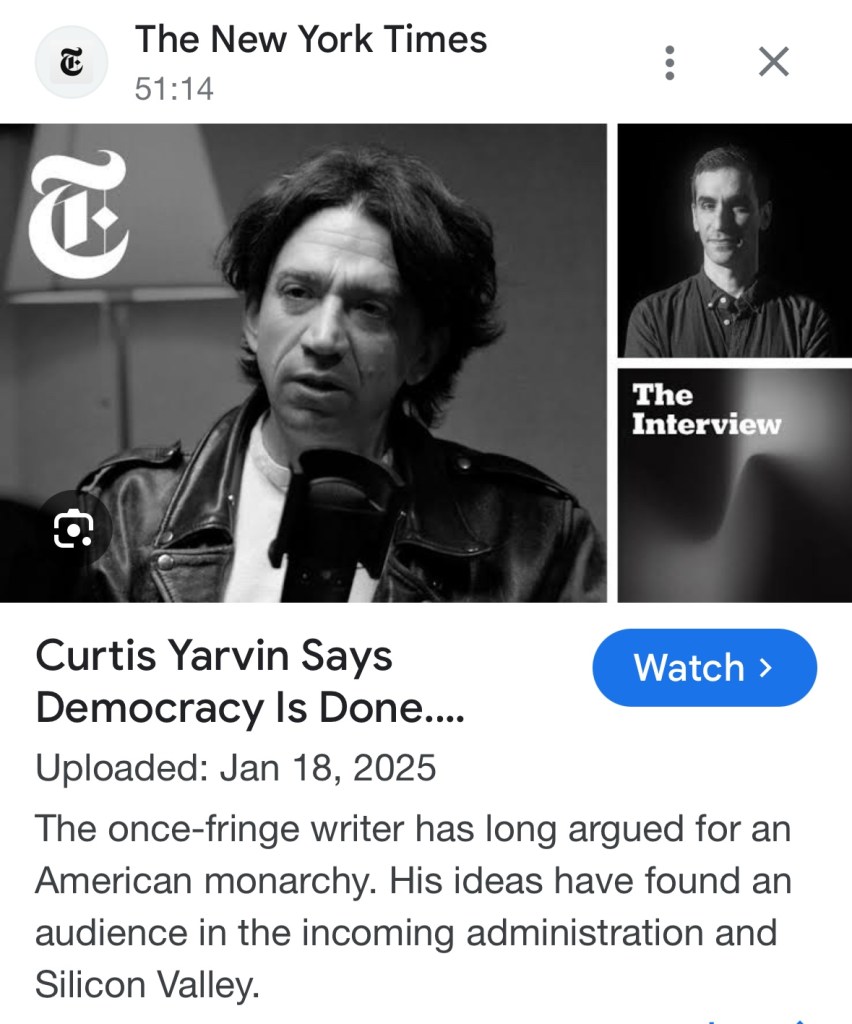
https://www.youtube.com/watch?v=NcSil8NeQq8 !!!
“Curtis Yarvin’s Anti-Brahminism: The End of American Democracy and the Rise of the Tech Billionaire Monarchy”
For years, Curtis Yarvin was a relatively obscure online theorist, a provocateur whose ideas seemed too extreme to be taken seriously. He argued that American democracy should be replaced by a CEO-style monarchy, that bureaucracy should be radically gutted, and that institutions like academia and the mainstream media should be dismantled. These ideas were easily dismissed as the musings of an eccentric blogger. But in 2025, it is clear that Yarvin’s influence is no longer confined to the internet’s fringe corners. His theories, once niche, are now finding an audience among some of the most powerful people in America. Figures like J.D. Vance, the vice president and venture capitalist Peter Thiel have referenced or engaged with his ideas. Mark Andreessen, another Silicon Valley heavyweight, has reportedly circulated Yarvin’s writings among key Republican operatives. Even President-elect Donald Trump’s inner circle appears to be borrowing from his playbook.
The mainstreaming of Yarvin’s ideas has led many to ask: Are we witnessing the end of American democracy as we know it? And if so, are tech billionaires poised to run governments like CEOs?
Deconstructing Democracy: The Yarvin Doctrine
Yarvin’s ideology, often referred to as ‘neoreaction’ or ‘NRx,’ is a fundamental rejection of liberal democracy. At its core, it suggests that the democratic system is inefficient, weak, and ultimately self-destructive. He proposes that a more effective system would be a form of monarchy—run not by hereditary kings, but by hyper-competent, visionary leaders who govern as corporate executives do. He frequently compares governance to company management, arguing that a streamlined, authoritarian model would produce better outcomes. Yarvin often points to historical figures like Franklin Delano Roosevelt, whom he describes as an example of a strongman who operated with near-dictatorial powers.
His theory suggests that modern governance should embrace this model openly rather than disguise it under democratic institutions.His critique of democracy hinges on the claim that it is incapable of making unpopular but necessary decisions, such as limiting immigration or dismantling entrenched bureaucracies.
He also posits that democracy is inherently aristocratic, with governance controlled by an intellectual elite he labels “Brahmins”—not in the Indian caste sense, but as a metaphor for the progressive intellectual class that dominates academia, media, and policymaking.
Anti-Brahminism: Yarvin’s War on the Elite
A central theme in Yarvin’s writing is his critique of what he calls the “Brahmin class.” In his 2008 blog post, An Open Letter to Open-Minded Progressives (https://www.unqualified-reservations.org/2008/04/open-letter-to-open-minded-progressives/), he describes “Brahmins as America’s true ruling class—not by financial wealth, but by intellectual and cultural dominance.
He argues that these elites dictate policy through NGOs, universities, and media institutions, perpetuating a left-wing ideology that is hostile to traditional values and conservative governance. Yarvin paints this Brahmin class as detached, self-serving, and dismissive of the so-called “Townies”—his term for the red-state, middle-class Americans who largely reject progressive academia’s worldview. He sees the Brahmins’ control of institutions as a fundamental problem that must be dismantled if America is to move toward his vision of a more centralized, monarchy-like system.
From Theory to Reality: The Silicon Valley Connection What was once an intellectual exercise in Yarvin’s blog posts has taken on a more tangible form in today’s political landscape. Tech leaders and venture capitalists have long been frustrated with government inefficiency, and some—such as Peter Thiel—are eager to experiment with alternative governance models. Thiel’s investments in seasteading (floating libertarian city-states) and his advocacy for “de-wokefication” efforts align with Yarvin’s disdain for the progressive institutions that shape modern governance.
Mark Andreessen, another influential tech figure, has reportedly circulated Yarvin’s writings among members of Trump’s transition team. His endorsement, alongside Thiel’s, raises concerns that key figures in the incoming administration may be willing to implement elements of Yarvin’s vision.
Is This the End of American Democracy?
Yarvin’s rise from the margins to the corridors of power is unsettling for many. His vision is unapologetically authoritarian, calling for the dismantling of democratic norms and the consolidation of power into the hands of an executive ruler. The fact that such ideas are now being taken seriously by influential political and business leaders suggests that the Overton Window—the range of ideas considered acceptable in public discourse—has dramatically shifted.
For decades, American democracy has been defined by its system of checks and balances, its institutional safeguards, and its commitment to pluralism. If Yarvin’s ideas take hold at the highest levels of government, those safeguards could be systematically eroded. Some argue that this shift is a necessary correction—that democracy, as currently structured, is failing to deliver for the American people. Others warn that this is a step toward authoritarian rule, where a small elite will govern without accountability.
What is undeniable is that Yarvin’s once-fringe ideology is now a subject of serious debate. Whether America resists or embraces this shift will determine the future of its political system—and the fate of democracy itself. And why is it a serious debate?… well there is now a Nytimes Podcast of Yarvin here below ⬇️