I don’t know about the position of other religious faiths on Euthanasia but I’m familiar a bit with the position of Hinduism.
Euthanasia in the Vedic faith is tantamount to “atma hatya” … the unnatural, adharmic and wilful destruction of the soul’s “svaatantraya” … spiritual sovereignty or autonomy.
The soul is sareeri… By dint of its past karmic past, it alone is said to have the right to exercises lordship over the body , the sareera. The atma knows when to shed its mortal coils , at a time and circumstance of its own choosing.
Thus, there is no room here for the human ego (ahamkaara, mamakaara) to take matter into its own hands and encourage the sareera to override the sareeri… That would be the denial of the fundamental tenet of our Vedic faith that the spirit shall always triumphs over matter, and that the atma is sovereign and sareera is its liege or subordinate.
Euthanasia may one day even in India become legally admissible. It all depends on what social mood and ethics swayed by medical science and political interests will come to prevail in our country. But it would, from a strictly Dharmic point of view, still be regarded as grossly sinful … a mahapaapa.
Of course , since modern Science has scant respect for Vedic notions such as the existence of atma , its karmic state and the reality of sareera-sareeri bhaava, Nobel Laureates championing euthanasia will always be looked up to as moral exemplars by many of us.
Sudarshan Madabushi
**************************************
On 17 Mar 2025, at 6:29 AM, Krishnamurthy <wrote:
I agree in a general sense.But the question remains how far we can stretch absolute freedom.
In a country that has banned abortions which is a fundamental right of the woman, is banned and up held by the SOCTUS We are talking about Euthanasia .
Both abortion and Euthanasia are not open and shut cases.They have huge religious ramifications upsetting faith and belief.In the case of Euthanasia there is this big medical angle too
Medical fraternity itself hugely divided in the West.
Some medical termination of life may be genuine others may be murder for gain .
What if an old 95 year old man is murdered by the doctor at the behest of his successors to his assets.So these things are not as simple as one would have us believe.
If old persons including me is forced to live on the crutches of medicines and suffering it’s my fate or just karmic .Yes it’s true that when we are in severe pain or medical condition we say
SETHHE POIDALAM POLA ERUKKU.
ANDAVA ENNAI SEEKARAM KOOPTUKODA.
YET THE SUFFERER DOES NOT COMMIT SUICIDE.
Even atheists hate euthanasia.
Man by nature wants to live as long as he can.With or without medicine.
In bed for enjoyment or suffering.
Regards
Sent from my iPad
On Mar 16, 2025, at 11:37 PM, Krishnamoorthy wrote:
Euthanasia / legally assisted death, if desired by one, should be available to all, even in the absence of terminal illness.
Most of the elderly population is living by prolonging their life by medical assistance, gulping several pills a day.
With the best days behind, stamina reduced considerably, life drags on aimlessly for many.
Freedom to opt to ‘go’, at a time of one’s own choice, is the ultimate freedom.
Dignity of life is incomplete without the dignity in death.
Anayasena maranam.
Regards
On Sat, Mar 15, 2025 at 9:11 PM R Veera wrote:
Daniel’s choice of going out of this world, at his age and state of declining health, is understandable.
Modern medicine prolongs life, but does not keep man’s internal organs in matching good health. I find that in many cases the elderly who are in physical suffering are not even able to express all their physical discomforts to others, with a humane thought of not discomforting others around them. Oh, God! why do this to the poor elderly!
Israeli-American Nobel Laureate Daniel Kahneman revealed to have died by assisted suicide
By ToI Staff 15 March 2025, 11:36 pm
6–7 minutes
Israeli-American Nobel Prize Laureate Daniel Kahneman, who died last year at 90, decided to end his life through assisted suicide in Switzerland, the Wall Street Journal reported on Friday.
Kahneman decided to end his life on his own terms while he was still in relatively good health, instead of letting his physical condition deteriorate, the newspaper said.
In farewell letters sent to his closest friend, the psychologist wrote that his decision was motivated by a long-held belief that the suffering typically associated with living to old age was unnecessary.
“I have believed since I was a teenager that the miseries and indignities of the last years of life are superfluous, and I am acting on that belief,” he wrote to them.
After making his decision, Kahneman spent his last days in Paris with his family. Afterward, he traveled to Switzerland, where his assisted suicide was carried out.
Get The Times of Israel’s Daily Edition by email and never miss our top stories
Barbara Tversky, Kahneman’s companion in his later years, wrote in an essay after his death that in his last days, the two “walked and walked and walked in idyllic weather…laughed and cried and dined with family and friends.”
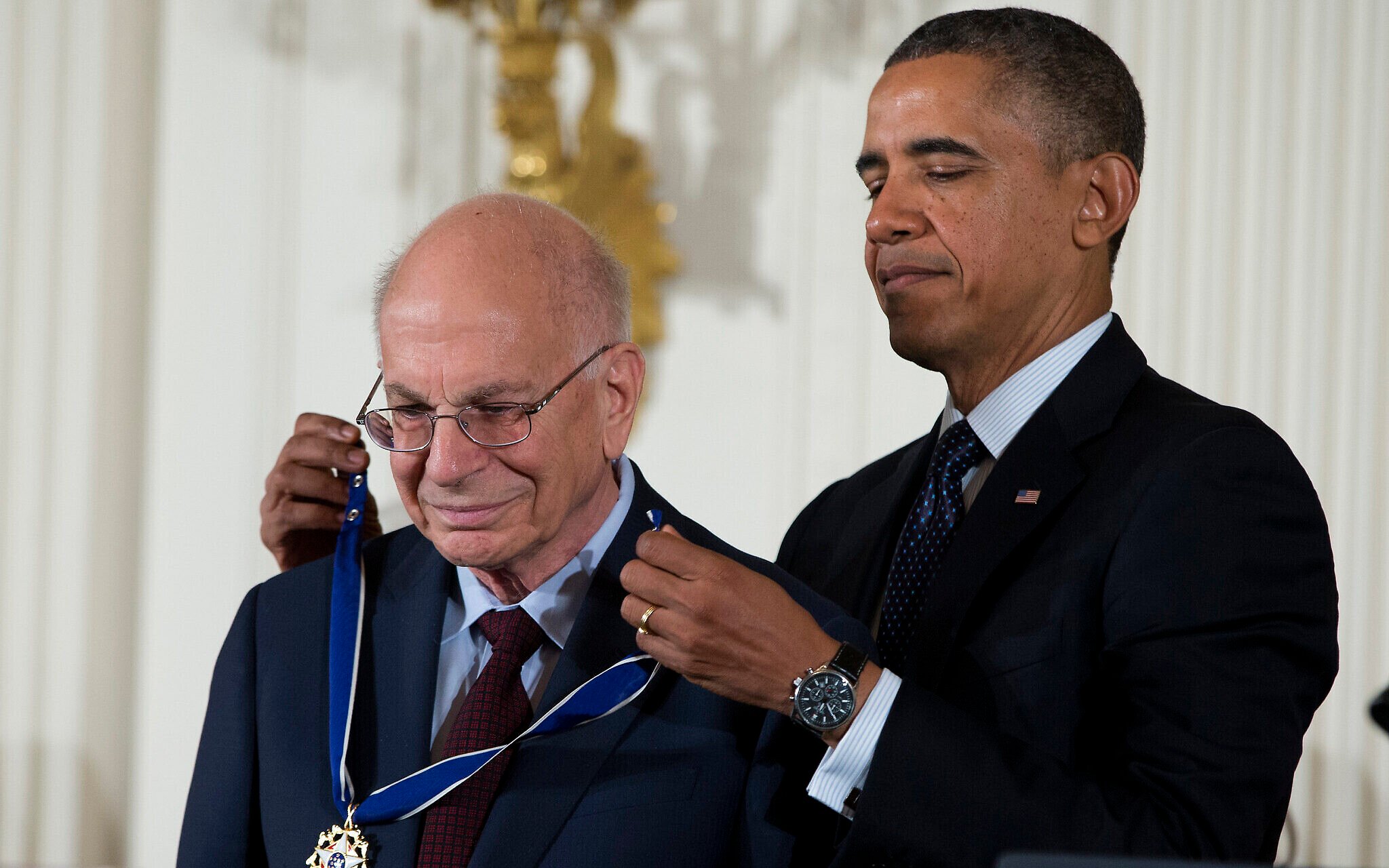
Then US president Barack Obama awards Daniel Kahneman with the Presidential Medal of Freedom, Nov. 20, 2013, during a ceremony in the East Room of the White House in Washington. (AP Photo/ Evan Vucci)
She said Kahneman “took his family to his childhood home in Neuilly-sur-Seine [outside Paris] and his playground across the river in…the Bois de Boulogne… He wrote in the mornings; afternoons and evenings were for us in Paris.”
Kahneman reportedly confided in a few close friends about his decision weeks before his death. Despite their persistent efforts to dissuade him, he remained resolute.
“It was a matter of some consternation to Danny’s friends and family that he seemed to be enjoying life so much at the end,” one friend told the Journal.
“‘Why stop now?’ we begged him. And though I still wish he had given us more time, it is the case that in following this carefully thought-out plan, Danny was able to create a happy ending to a 90-year life, in keeping with his peak-end rule. He could not have achieved this if he had let nature take its course.”
In his final letter, Kahneman wrote: “Not surprisingly, some of those who love me would have preferred for me to wait until it is obvious that my life is not worth extending. But I made my decision precisely because I wanted to avoid that state, so it had to appear premature. I am grateful to the few with whom I shared early, who all reluctantly came round to support me.”
His friends told the Journal that his decision was personal and did not serve as an endorsement of assisted suicides.
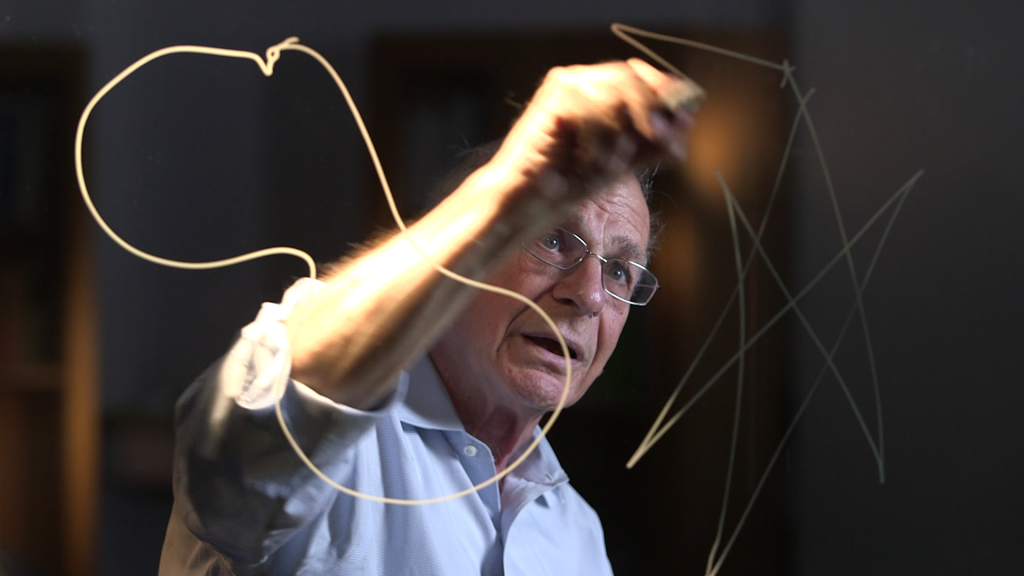
Nobel laureate Daniel Kahneman explains his theory in “The Nobelists.” (Courtesy Ruth Diskin Films)
“I am not embarrassed by my choice, but I am also not interested in making it a public statement,” Kahneman wrote in his letter, according to the Journal. “The family will avoid details about the cause of death to the extent possible, because no one wants it to be the focus of the obits. Please avoid talking about it for a few days.”
“Right to the end, he was a lot smarter than most of us,” Philip Tetlock, a psychologist at the University of Pennsylvania and friend of Kahneman, told the Journal.
“But I am no mind reader. My best guess is he felt he was falling apart, cognitively and physically. And he really wanted to enjoy life and expected life to become decreasingly enjoyable. I suspect he worked out a hedonic calculus of when the burdens of life would begin to outweigh the benefits—and he probably foresaw a very steep decline in his early 90s.
“I have never seen a better-planned death than the one Danny designed.”
The author of the article, Jason Zweig, who was a personal acquaintance of Kahneman, speculated that his decision was influenced by his witnessing the cognitive decline of his mother and wife, both of whom died before him.
Kahneman ended his letter to his friends by writing: “I discovered after making the decision that I am not afraid of not existing, and that I think of death as going to sleep and not waking up. The last period has truly not been hard, except for witnessing the pain I caused others. So if you were inclined to be sorry for me, don’t be.”
Kahneman was considered a pioneer in the field of behavioral economics, best known for upending the assumption of classical economics that human beings are essentially rational decision-makers.
In 2002, he won the Nobel Prize in Economics for his research integrating psychology and economics, which challenged the notion that people act rationally. Instead, he argued, people’s mental biases often lead them to make decisions that run counter to their own interests.