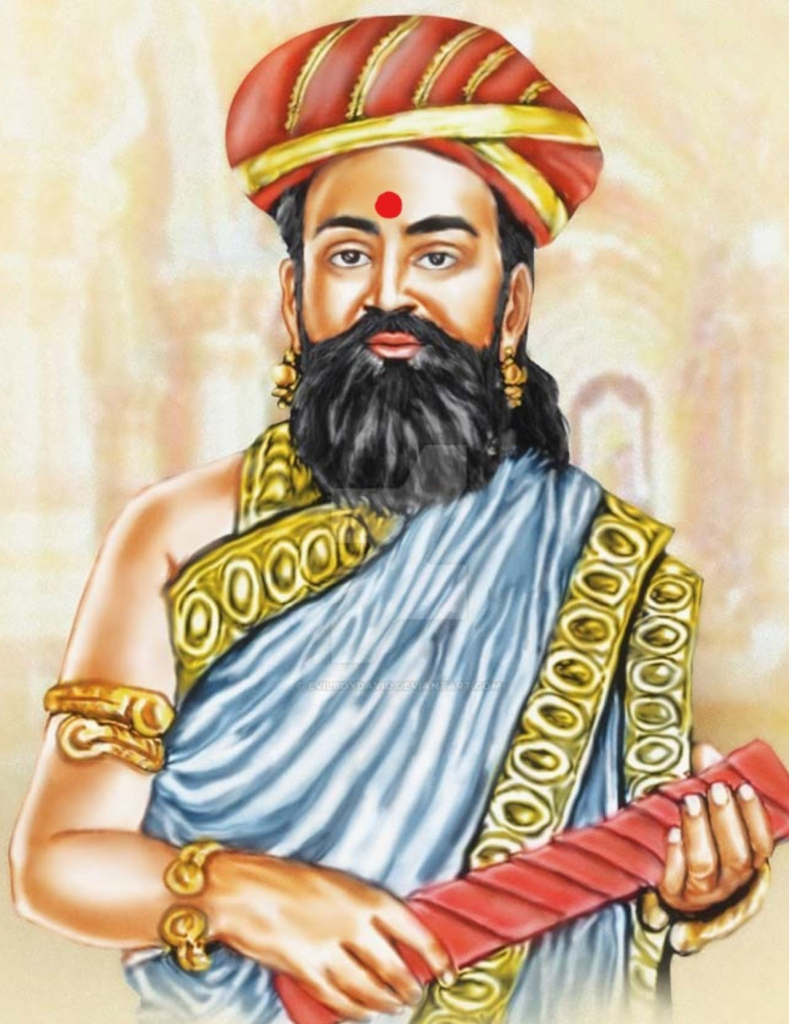
The well-known Sahitya Akademi, Sangitha Nataka Akademi, Padma Shri awardee, distinguished scholar, novelist, playwright and a doyen of classical Tamil literature, Sri. Indira Parthasarathy (aka “Eepa” in Tamil) was being very kind to me when he shared with me a very fine essay in English on Kamba Ramayana which he told me (in a Whatsapp message) that he had penned many years ago around the turn of this century.
Eepa: This I wrote a few years ago for Amartya Sen’s daughter’s magazine who requested me to send a piece on Tamil Ramayana. She edited a theme for her one particular issue The Indian Ramayanas . By accident I found it in my laptop after many years. Read it but you may have different views.
Me: I will definitely read it Sir. Anything to do with the Ramayana, I am always interested in the Ramayana .
After I had read Eepa’s fine, insightful essay, I was left with admiration for the breadth and depth of his erudition in Tamil classics and his deep understanding of Kamban’s Ramayana which was combined too with his great mastery of the Tamil Sangam literary masterpieces like the Silappadikaaram.
However, some parts of Eepa’s essay also left with me mixed feelings. Not everything he had penned was very clear to me. Some of the passages in the essay, in fact, I found a tad discomfiting since they seemed rather inconsistent with modern historical findings on the “many Indian Ramayanas” about which I had read elsewhere too…. Besides having read the English translation of Dr. H.V.Hande’s Kamba Ramayana, I had also read “Lectures on the Ramayana” by Rt. Hon’ble Srinivasa Sastry, A.K.Ramanujam’s “3000 Ramayanas“, Aubrey Menen’s Ramayana and many others of the same genre. Above all, I remembered I had also listened to so many public religious discourses of the outstanding Vedic exponent, U.Ve.Sri Mukkur Lakshminarasimhachariar wherein he had expatiated so beautifully on several passages from the Kamba Ramayana. What I had read and heard thus was a bit at odds with some passages in Eepa’s otherwise splendid essay.
So, I messaged him as follows:
Me: I’m reading your essay on Kamba Ramayanam. I’m no scholar in Tamil and I have no more than a nodding acquaintance with a handful of Kamban’s original verses…. But they are just enough for me to be able to appreciate that the poet was a genius and truly a Mahakavi in Tamil.
Sir, your essay at the outset strikes me as a very insightful tribute to Kamban’s Ramayana . The literary allusions you make are truly educative to a rank layman like me. However , there are a few minor averments you make in your essay which to my mind seem slightly jarring and, in fact, in my humble opinion, a little unnecessary in a literary appreciation of Kamban. Hope you will not mind me sharing my candid thoughts / views with you alongwith a few queries and observations.
Sir, first off, may I ask how long ago did you write this essay ? Would you rewrite the essay a bit here and there if you were asked to review it today ?
Eepa: Maybe I wrote it in the early beginning of this century. I don’t believe in rewriting any of my stories or articles because I will be untrue to myself .
Me: What was the reason that compelled you, Sir, to insert an implied comparison between Valmiki Ramayana and Kamba Ramayana ? Was it necessary ? Why ?
Eepa: No comparison between Kamban and Valmiki … but I only point out only deviations... i.e. how Kamban deviated from the original.
Me: Sir, after reading your essay I get a feeling that you probably harbour a trace of artistic distaste in treating Ramayana as a work of what you call “religious sectarianism”; and that you want to secularise the epic by regarding it as purely literary expression ? So, my question to you is: What is wrong if literature happens to be laced with elements of religious thought also ?
Eepa: Would you call Milton’s ‘Paradise Lost’ as a religious work? Was it not merely a literary work mainly to justify the ways of god to man? Kamban says he wrote his Ramayana only to celebrate the victory of god as man. மானுடம் வென்றதம்மா! ஆசையினால் அறையலுற்றேன் இராமன் கதையை. Surely, he meant it only as a literary work. I have nowhere called it a secular work — certainly not in the sense the word is used nowadays. But Kamban’s Ramayana is certainly, out and out, a literary work.
*************
And that was how began the long, prolix but for me very enlightening conversation on Kamba Ramayana between Eepa and I. But before I start reporting on our conversation, it is I think first very important to reproduce for the benefit of readers the scholarly essay that Eepa forwarded to me. For it is his essay that sets the context of all our ensuing conversations. So here we go… enjoy Eepa’s piece on Kamba Ramayana written a quarter of a century ago.
The Rama story as embellished by Kamban
by Indira Parthasarathy
The story of Rama, perhaps, began in the collective unconscious of the ancient tribes, who inhabited India in the distant past.. The story could have remained as an oral tradition for a long time that later found expression in a written form in the Buddha Jataka tales (5th century BCE). It was an essential part of the spiritual mythography of Buddhism. It was a simple and straightforward fable, wherein Rama represented one of the evolutionary stages of Gautama, the Buddha, before he attained Nirvana. There was only one twist in the story, the self- exile of Rama to the Himalayas to avoid the wrath of his step-mother. The Buddhist version scrupulously avoided war and violence befitting its saattvic tradition.
Valmiki, hailed as Atikavi (‘the first poet’), collected the various myths and legends of his time, obtained in the different parts of the Indian sub-continent and integrated them with the Rama story, bringing to bear upon the narration a thematic continuity, set in a vast canvass that spread over from Nepal in the north to SriLanka down under. Because of this inclusive setting, all the regions identified themselves with the epic, each in its own distinctive way, that when it got rendered in the language of the region, this impact of various cultural and linguistic diversities helped the story acquire a pan-Indian character. Ramayana became the intrinsic aspect of the Indian cultural psyche.
In the West, when they brought out Homer and Virgil in the European languages, the yardstick that was used to consider the quality of such works was their fidelity to the original in form and content. In the Indian context, our cultural tradition conceded a certain amount of literary freedom to those who rendered the original in their languages because those who were engaged in this stupendous task, were, invariably poets in their own right.
Ramayana exists in thirteen languages of the country and in innumerable folk versions. Each one offers us, a distinctive regional flavour, that happily integrates with the main theme. Kamban (12th century CE), who all that was the best in the Tamil literary tradition, (the Sangam classics belonging to the early centuries of the Christian era, Thirukural, the unparalleled literary manual for personal and social conduct, Cilappadikaram, the most elegant and sophisticated epic by a Chera prince called Ilango and most of all, the spontaneous devotional outpourings of the mystic poets of the bhakti period), chose to write the Rama story, not merely for ‘justifying the ways of God to man’ but out of ‘sheer love for narrating the story’ and ‘ poetic tribute and respect for Valmiki, the Atikavi’, as he did declare at the beginning of the epic. But Kamban did not translate the Valmiki’s Ramayana but trans-created it with masterly and subtle structural changes to suit his own literary views and concepts, without offending the sequential order of narration in the original.
Kamban was a conscious literary artist, who had this thing clear in his mind that what he proposed to write was a literary piece and not a religious work that was how Valmiki’s Ramayana came to be known, during the period of Kamban, though Valmiki might not have intended it so.. The commentators for the religious works, at the time of Kamban, profusely quoted from Valmiki to drive home their sectarian views, which could have, perhaps, unsettled Kamban that he decided his work should be uncompromisingly literary giving no leeway for religious hijacking.
Though Rama had begun to be worshipped as the incarnation of Vishnu by the time Kamban wrote Ramayana, he, in his invocation poems, did not refer to any sectarian deity, but saluted the One that went on creating, protecting and annihilating the Universe and which was an endless game by itself.. Throughout the epic at several places, he referred to this One guiding principle of the Universe, which, he categorized as the Supreme Reality.
A romantic as well as a philosophical description of a dramatic incident occurring in the Rama story, as described by Kamban, could sum up his view on religion. Rama, as he was on his way to the court of Janaka, the beautiful women of Mithila rushed to their balconies to catch a view of this handsome young man. Those, who looked at his shoulder continued to be looking at it, because it was so beautiful. Those, who looked at his feet could not take away their stare elsewhere. And the same story with those, who caught a glimpse of his sinewy hands. No one saw the complete fascinating figure of the Ayodhya prince. Kamban did not stop with this romantic imagery. He declared that like the sectarian views of different religions on God that failed to comprehend the Oneness of the Ultimate Principle, the women of Mithila saw only one physical aspect of Rama and not his whole figure.
It is often said by the critics of the Rama legend, that whereas, Valmiki treated Rama as a human-being, the later poets who retold the story raised him to divinity by making him an incarnation of Vishnu. It is true that at the time Kamban wrote his Ramayana, Rama was worshipped as an avatara of Vishnu, but to the credit of Kamban it must be said he treated Rama as one of the most loveable human characters, who befriended all, high and low, as his fellow brethren irrespective of their station in life.
Guha, the hunter, who helped Rama cross the river, was so friendly and affectionate towards him that Kamban’s Rama, treating him as his equal told him, “My brother Lakshmana is your younger brother, my wife Sita is your sister-in-law and all of us belong to the same fraternity’. In Valmiki’s Ramayana, one feels the comradeship between Rama and Guha as described by Kamban is somewhat missing. Rama’s love for Guha left such an impact on Sita, that, when she was imprisoned in Asokavana by Ravana, she recollected this incident in her nostalgic odyssey.
Kamban’s delineated even the minor characters with deft touches of psychological insights. He crafts Kumbakarna, the brother of Ravana, as a tragic hero torn between loyalty and justice, totally unlike the character as appearing in Valmiki’s Ramayana. Kumbakarna was an uncouth figure, a man-mountain, a glutton and a demon in Valmiki’s Ramayana. But with Kamban’s golden touch, he emerged to dizzy heights of glory, becoming as great as Bishma Pithamaha and Radheya(Karna) in Mahabharata. As one sees Kamban’s portrayal of Kumbakarna, he cannot but conclude that all these three characters(Kumbakarna , Bhishma and Radheya) were Destiny’s children, cursed, as they were, to fight for the wrong side.
Towards presenting Kumbakarna this way, Kamban deviated from the original and set up a scene in which Vibhishana met Kumbakarna in the battle-field to request him to join Rama, as he was also opposed to the abduction of Sita by Ravana.
Kamban achieved two objectives by presenting this scene One, Vibhishana had to be justified in his action for deserting his brother and joining his enemy and the other ,the character of Kumbakarna had to be glorified, as an heroic man of great integrity, full of love and compassion for his brothers.
Refusing to join the Rama camp, Kamban’s Kumbakarna replied : ‘No. What you have done is right by joining Rama. Because you were always a peace-loving man and against all illegal battles. You tried your best to convince Ravana to leave Sita and avoid war, but he exiled you and threatened to kill you if you did not leave the country. In your case, it is a question of ideology. Right versus Wrong. For such people, love for the kin or country does not matter. People who stand by justice transcend such narrow barriers. But, I had been participating in all the wars that our brother was engaged, whether they were for right or wrong causes. True, I protested against this unethical behaviour of our brother in abducting another man’s wife. But, having fought with him all along, I cannot desert him and especially now, when he is facing defeat. It would be selfishness on my part to do so. So leave me now to face my fate. From this.moment we are not brothers, we are enemies. I will not hesitate to vanquish Rama’s army.. Life is transitory but values are eternal.’
At the time, when Kamban’s Kumbarna lay dying, he said to Rama: ‘ I request you to promise me two things. The first is to aim an arrow to throw my body into the sea, as I do not want my enemies to see my much mutilated body. Secondly, I leave my dear brother Vibhishana in your trust, as I know, he would be the first target for Ravana, when he arrives at the battle-field to fight with you.’
Kumbarkana’s defence of Vibhishana raises an issue in the modern context.What is patriotism? Were all the good citizens of Germany, who left their country during Hitler’s rule, unpatriotic? Kamban’s Kumbakarna has the answer; ‘People who stand by justice transcend such narrow barriers’ as patriotism, nationalism etc one may add.
Kamban’s concept of fraternity cut across not only the caste regulations, as we saw earlier as in the case of Guha, but national borders as well. Kamban continued expanding this theme of fraternity by making Rama claim Sugriva, the monkey chief as his sixth brother and later, Vibishana, the asura prince and brother of his mortal enemy Ravana as his seventh brother. ‘Now that we are seven, your father in heaven Dasaratha would feel immensely happy”, Rama told Vibhishana. Kamban had a way with words, which is evident here by the way Rama addressed Vibhishana in an inclusive manner by his reference to Dasaratha as Visbishana’s father that was a master stroke which could have put the latter completely at ease with himself, overcoming a possible sense of guilt he might have had for deserting his brother, Ravana.
This valuable lesson of universal brotherhood was a favourite theme of Kamban that he stressed it at several places. He had this inspiration from one of the most famous Tamil poems in Sangam poetry, in which the poet sang,’ I belong to all the cities in the world and all are my kin.’
Kamban’s Rama did not feel humiliated or perturbed when Ravana disparagingly dismissed him as one belonging to the lowliest of the low, a human-being after all. He, in fact, had a sense of pride in being a man and his ultimate triumph over the asura who was blessed with the boons given to him by the mighty gods in heaven, was hailed by the poet, as the victory of Man over divinity. God, in his descent as a human-being in this very earth had more relevance and significance for the alvars, the Tamil bhakti poets (7thcentury CE to 9th century CE) than in his being an abstraction in the form of a deity in the distant heavens. In their view, man had immense potential in him, which, when properly tapped and exploited could help him attain godhood. Kamban showcased the blueprint of such a man in the form of Rama, who, like any one of us, met with lots of emotional problems and existential dilemmas before overcoming all of them to achieve success at the end. Kamban’s characters, whether they were heroes or villains were not either totally white or totally black.
Rama had his own blemishes like his killing Vali, when the latter least expected it. Kamban’s Vali told his wife,Thara, before he accepted the challenge of his brother to fight with him, when she reminded him that Sugriva had Rama’s support, ‘Do you think that such an exalted soul as Rama, who did not hesitate to give his kingdom to his brother would descend so low as to commit an heinous crime?’
But the irony was, he did kill Vali stealthily. He could not defend himself, when Vali, surprised and shocked, expressed his disappointment in no uncertain terms. Kamban very subtly had drawn this picture of a guilty Rama with artistic maturity..
Kamban’s Ravana was not a hard-hearted, brutal villain merely given to lust and violence. He was a magnificent warrior whose tragedy was that he fell in love with Sita even before he met her. His sister Surpanaka described her beauty in such a picturesque manner, that he saw Sita’s illusion even while she was talking. He asked her whether the one he was seeing before his mind’s eye was Sita but she replied it was Rama, because when she was describing Sita, she had Rama in her mind with whom she had fallen in love!
It is one of the most beautiful romantic passages in Kamban’s Ramayana. Since
this incident was going to seal the fate of Ravana, Kamban dramatized the whole scene in an exquisite manner. For the sake of love, he was prepared to lose a kingdom. When his son Indrajit told him to give up Sita, as at that time the war was almost lost, Ravana replied,’ I have chosen my enemy not in the hope that you and your uncles and my mighty army are going to support me, but I have done it on my own mental strength, energized by a feeling of allconsuming love. So long as Rama’s name will remain that he fought to the end to get back his wife, my name will also be there that I did not yield unto the last.’
This reminds us of Milton’s Satan, who thundered, ‘What though the field be lost? All is not lost, the unconquerable will, and study of revenge, immortal hate, and courage never to submit or yield.’
Kamban lost no opportunity in emphasizing over and again that Ravana’s love for Sita was not just physical infatuation but a pure, unadulterated tender feeling of the mind and even before keeping her a prisoner in Asokavana, he had kept her a prisoner in his heart! So when Rama’s arrow pierced Ravana’s chest at the end, Kamban said, it scouted for the feeling of love he had for Sita in his heart of hearts and took it away, making an exit through his back! Kamban beautifully captured the great fall of the mighty Ravana and contrasted it with his once glorious past, when he lifted the Kailash mountain, the abode of Shiva and what a fall was there and all for the sake of love!
Kamban lived during the period of Imperial cholas but, considering that he dedicated his epic, in a way, to an ordinary, simple philanthropist, by mentioning his name ten times in the course of his narration, one may be tempted to conclude that he did not enjoy royal patronage as many other inferior poets of his period and apocryphal stories about the master poet are not wanting, to strengthen this view.
–END-
***********
The matter however did not end there… not for me, certainly.
Eepa’s essay triggered inside my mind a whole lot of thoughts, impressions and questions on many of its averments. I began posing to Eepa a series of queries and observations and requested him to shed light and clarify on many aspects of the Kamba Ramayana with reference to specific episodes therein. Eepa was so patient and so kind in answering all my queries. And that’s how it turned out to be a very enjoyable, free-wheeling, free-thinking and free-dealing back-and forth conversation between ourselves.
So educative was the conversation for me that, at the end of it, I thought it would be a good idea to also record our talk in a series of blogs so that it may be of great interest to all Eepa literary fans, Kamban fans and students of the Ramayana as well. I took Eepa’s permission too to go ahead with the idea.
The conversation is what will get reported in the ensuing three separate daily blogposts.
Sudarshan Madabushi
Nice article. A small correction though. Rama on meeting Guha, introduced lakshmana as “ your brother is now my brother”.
Kamba rammayana verse is, “ உம்பி எம்பி “
I forwarded your comment to Sri Eepa and this was his reply FYI : “That’s right. Agreed. Rama is as he describes Hanuman ‘சொல்லின் செல்வன்’”