
Who hasn’t come across these immortal lines of Adi Sankara in his famous Sanskrit hymn, “Bhajjha Govindam“?
पुनरपि जननं पुनरपि मरणं,पुनरपि जननी जठरे शयनम्।
इह संसारे बहुदुस्तारे,कृपयाऽपारे पाहि मुरारे ॥२१॥
“punarapi jananam punarapi maranam punarapi janani jathare sayanam,
iha samsare bahudusare krpaya’pare pahi murare” – 21
Being born again, dying again, and again lying in the mother’s womb to be reborn; this samsaara is extremely difficult to cross over. Save me, O destroyer of Mura, through your infinite compassion.
Also, who hasn’t come across the below oft-repeated explanations in English translation of the above? :
— Samsara is nothing but a repeated process of birth and death. Why does this cycle go on? It is because what I am pursuing or seeking is not fulfilled in the journey of this lifetime. Naturally, then, when I die, there are unfulfilled desires in my heart, and those unfulfilled desires make me take another birth in a suitable environment so that I can fulfill my desires.
— If, again, the desires (“kaama“) are not fulfilled, the journey is not concluded in that embodiment and I give it up only to acquire yet another new embodiment. This is the reason we talk of the process of repeated births and deaths. It is because a man is born incomplete and he dies incomplete as well. The journey goes on till a total fulfilment is gained.
***********
Wherefrom do “unfulfilled desires of the heart“ or Kaama arise? What causes Kaama? The short Vedantic answer is: Karma!
The deepest desires in life are caused by Karma. Kaama and Karma feed into and feed off each other.
That begs the question: What is Karma? And there is also the oft-heard corrollary question: “Why did I take my first birth before it all started and how did the karmic ball get rolling in the first place… of “punarapi janam, punarapi maranam”? In the very beginning of Time, I had no previous birth nor did I have any previous karma nor did I have any kaama either. Then why was I born for the first time? No scripture has explained this riddle.”
All very profound questions indeed!
**********
In Vedanta philosophy , the Atma (soul) is eternally existent entity… all through infinite time … There’s no beginning or end to it. It is immortal . There is no such thing as “first time birth” nor anything like a “no previous karma” state. And it is also inaccurate to say “No scripture has explained this riddle.” The Bhagavath-Gita has provided ample explanations for what is termed “riddles”. If we diligently and humbly study the Gita — with the help and guidance of a qualified Acharya — the riddles will seem less like riddles and more like brightly lighted pointers on the pathway to truth.
Karma is but the net aggregate of all actionable choices fuelled by desire (kaama) that were made by a soul during its endlessly cyclic cosmic peregrinations.
Some of those choices are made through exercising clear wisdom which itself is born of virtuous desire …. Many other choices are they which, on the other hand, are made through ignorance — what in Vedanta is called Avidya or “a-viveka”: the incapacity to discriminate between those desires to be necessarily cultivated in life and those never to pursue. (The poetess Andaal referred to precisely these “undesirable desires in life”, in her famous Tamil hymn “Tiruppaavai” with that single profound phrase: எற்றைக்கும் ஏழேழ் பிறவிக்கும் உன்தன்னோடு, உற்றோமே ஆவோம்; உனக்கே நா மாட்செய்வோம்; மற்றைநம் காமங்கள் மாற்றேலோ).
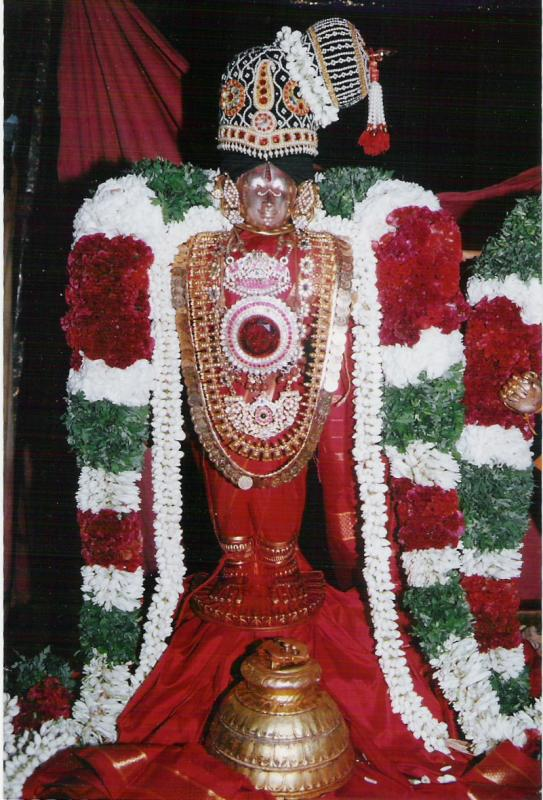
From exercising virtuous choice is born “punnya karma phalan”, Wisdom or Vivekam. For the individual Atma, this impels it forward to a virtuous cycle of Vivekam — more wise choices. On the other hand, choices made through Avidya i.e. the choice of un-virtuous, unnatural a-viveka desires, they result in “paapa karma phalan“. One act of un- wisdom inevitably leads to a ceaseless series of others in several lifetimes… and this is exactly what Sankara meant when he described it as “punarapi jananam, punarapi maranam...”.
**********
Karma — all the choices arising from kaama that were made in lifetimes before — have consequences or “phalan“. They are inescapable .
What is meant by consequences ?
Consequences are essentially nothing but “life experiences imbibed and lessons learnt”. Such lessons are all learnt and experienced as opposites : viz. joy and sorrow (sukha/dukkha), pain and pleasure, health and disease, hope and despair . The most ineluctable Consequence (“karma phalan‘) of all, however, is the experience of bodily death and re-birth.
To live through all such consequences by experiencing both sets of “phalan” is how the individual Atma evolves spiritually. As the Atma goes forward on its evolutionary journey, it learns, re-learns and un-learns lessons and truths derived from many karmic experiences it gains through endless lifetimes.
Karmic consequences are all experienced as karmic lessons in each lifetime only from within or inside a bodily form. The atma of its own karmic volition thus chooses its bodily-forms (“sareera“) and uses each one of them as classroom where a great syllabus of spiritual self-education and evolution is imparted to it.
*********
However, the capacity to learn (and re-learn and un-learn) lessons from karmic experiences to thereby gain vivekam, greatly varies from soul to soul. This capacity depends upon the bodily form (‘sareera‘) that the Atma finds itself possessing. (One may perhaps imagine this to be the “spiritual horsepower capacity” of each sareera form).
Some lessons of life the Atma (“cit“) can imbibe only through bodily-forms of insentient entities (“acit“) ; some others only through lower bodily forms like plant, insects, land or maritime animals; some lessons and experiences are so special and rare that they can be acquired only through the “sareera” of human beings.
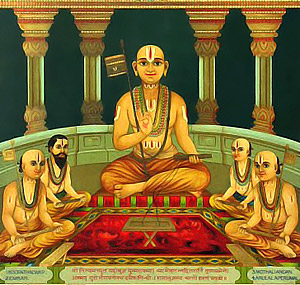
Yet again , even amongst humans, there are great differences in the innate “spiritual horsepower” of consciousness which in Sri Ramanuja’s metaphysics is known as “dharma-bhutha-gnyaana”. The capacity to learn lessons from and acquire wisdom is not the same or equal amongst all Atma-s. Why? Because such capacity too is actually a consequence! That is, it is a karmic legacy the Atma had bequeathed by itself to itself through a myriad kaama-driven choices made in countless previous janma-s.
**********
A few analogies might help the understanding of the above very subtle and fine Vedantic concepts:
— Patience or fortitude are great qualities of virtue. How can they be learnt, gained and experienced in life? They could be learnt through the bodily-form of, let’s say, a hillock or a mountain. It stands there in one spot for ages and is able to weather all vagaries of the seasons and vast time-eras. The mountain is “a-cit“, an insentient being. It is evolving through the experiences of patience and fortitude.
— Likewise, the great lesson of unselfish charitableness can be learnt through the bodily-forms of the plant kingdom like herbs, grain-crops, trees and forests etc. The tree provides cool shade to one all in the world. It’s pure unselfish charitability. The plant kingdom indeed gives back so much in return to the world while taking so little from it. The plant kingdom too is possessed of Atma and it is evolving spiritually through experiences of pure, unselfish charity in life.
— Likewise, the great lessons and experiences of how to be grateful or loyal can be learnt even from the animal kingdom.., say, through the bodily-form of dogs. The animal-kingdom too thus is possessed of Atma that is evolving spiritually through its very own experiences of great learnings in life.
— Finally, there is also the great lesson of human compassion. It can be imbibed only when the Atma has evolved from inside the sareera of an outstandingly saintly person…
And so on and so forth, but the long and short of it all is this:
We are all atma-s learning life-lessons and experiences through karmic choices. All atma-s are trying to evolve through kaama ie. the desires of the Viveki…. that singular desire that Sri Andal spoke about in her Tiruppaavai.
**********
If the Atma is to evolve forth in its cosmic journey, it necessarily has to learn all its lessons and experiences only through its sareera, the bodily form. Such learning, and the sum of all such experiences constitutes spiritual wisdom (gnyaana) in Vedanta philosophy.
If during one lifetime such wisdom is insufficiently learnt — or the experiences gained are half-baked or incomplete (avidya) — then the Atma must return again and again to the mortal world to assume another suitable sareera in order to complete its spiritual self-education. This process is what is described in Sankara’s Bhajja Govindam as ….. “punarapi jananam, punarapi maranam “.
— Concluded —
Sudarshan Madabushi