THE HINDU- Monday, July 21, 2025: Opinion: Recently, a political controversy erupted in Tamil Nadu on the issue of diverting temple funds for building colleges.
Scroll down below to read an Op-Ed (Propaganda) that was published by The Hindu yesterday .
This Op-Ed piece is a classic example of the kind of casuistry that the Dravidian intellectual or ideolgue of the ruling dispensation in Tamil Nadu State has truly mastered while engaging with the Hindu Right on the question of how much legitimate licence (pushing the envelope) does the Secular State enjoy under law in intervening and regulating the affairs of Hindu Temples and religious institutions especially the use of “surplus temple funds” for financing public welfare projects.
The casuistry is two-fold:
(A) peddling specious historical narrative through the good old trick of “suppressio veri” and “suggestio falsi”.
(B) obfuscating the substantive issue at hand with pious rhetoric and political motherhood statements and apple pie.
************
With regard to (A), here is an illustrative passage from the Op-Ed to underscore my point on the Dravidianist intellectual peddling specious, distorted and one-sided historical narrative … in other words, “suggestio falsi”:
“Over the last century, the Self-Respect Movement, which emerged from the Madras Presidency, viewed the regulation of temples and oversight of their resources as a critical feature of anti-caste reforms. Without this, there would have been no temple entry legislation in 1936 and 1947.
Now, how tenable or credible is this historical narrative? Does it not suggest that the Hindu Temple Entry Act in Tamil Nadu would never have seen the light of day but for the the Self-Respect Movement of the Dravidianists?
The Self-Respect Movement in Tamil Nadu was no doubt crucial — and the most radical and persistent local engine perhaps for temple reform — but it was most certainly never the sole cause. Temple entry legislation in Tamil Nadu was the product of overlapping social, political, and legal efforts: viz. Congress leaders, the Justice Party, Dalit and Nadar activists, as well as parallel movements in neighboring Kerala, all of which contributed to breaking caste barriers in temple access.
— The Indian National Congress, for instance, passed resolutions as early as 1920 in support of temple entry for Dalits and took an active stand against caste discrimination. In the 1930s, Congress leaders like T.S.S. Rajan and A. Vaidyanatha Iyer spearheaded campaigns for temple entry, most notably the historic 1939 Meenakshi Temple entry, which preceded the passage of the later enabling legislation.
— Key movements like the Vaikom Satyagraha (1924–25) and the Guruvayur Satyagraha in Kerala (1931–32) mobilized thousands and set compelling precedents for temple entry rights. These movements were sometimes led or strongly supported by national leaders such as Mahatma Gandhi and B.R. Ambedkar, both of whom actively advocated for temple reform in the South.
— Leaders from various communities and castes—Dalit, Nadar, and others (even Brahmin in fact —collaborated to demand access and equality. The 1939 Temple Entry Authorization and Indemnity Act, passed by Congress Premier C. Rajagopalachari, responded to a cumulative wave of agitations, demonstrations, and legislative efforts involving multiple stakeholders.
Thus, claiming as this Op-Ed does that the Temple Entry law would never have seen the light of day “without the Self-Respect Movement” overstates its exclusivity and underplays the complex, collective struggle behind these historic changes.
Then there is another variety of “suggestio falsi” and here is an example to quote: “Tamil Nadu and Kerala are among the few States where governments have appointed priests from backward classes after a prolonged legal struggle.”
An arrant non-sequitur like this one appearing right out of nowhere in the narrative seems to suggest indeed that because the appointment of backward classes as temple priests in Hindu temples was a such a big, notable victory won for the Dravidian Self Respect movement, that victory by itself more than justifies the State today appropriating temple funds and resources! It as though it is a matter of not only sovereign right but as best practice in good governance and public policy too!
*************
Next, is the instance of casuistry (B). This is done in two clever-by-half ways.
Firstly, pious rhetoric and political motherhood statements and apple-pie are used to deflect attention away from the central and substantive issue at hand viz. usurping temple funds by the State under a British colonial-era statue whose intentions were clearly imperialistic and malfide in the first place.
The rhetoric is very clever because it invokes both distant and near history, and which are wholly irrelevant and misleading respectively.
Distant History:
Take a moment to please read the nonsense below:
“Endowments to temples have a long and rich history. Temples received lavish donations from the sovereign rulers from as far back as in 970 AD, when the Chola empire was at its peak. Historian Anirudh Kanisetti writes that Sembiyan Mahadevi, a Chola queen, made strategic donations of land and kind to temples. The practice continued during the Vijayanagara kingdom.
So what, for God’s sake?! The Op-Ed brings in Chola and Vijayanagar history needlessly into the narrative leaving one to wonder what on earth those two great dynasties had to do with this current issue! Today, we are talking about the Ruler (Govt.) usurping temple wealth. The Chola and Vijayanagar Emperors did the very exact opposite — their grant of wealth to temples over a period of 200 years in history was munificent!
Sembiyan Mahadevi was a 10th-century queen and empress of the Chola Empire, married to Gandaraditya Chola and mother of Uttama Chola. She held power as queen consort (949–957 CE) and later as queen dowager, and is remembered as one of the most influential royal women in medieval South Indian history.
Her most enduring legacy is as a major benefactor of Hindu temples and Saivism in Tamil country:
• Over six decades, she commissioned, constructed, and renovated numerous temples across the Chola heartland and beyond, including the Kailasanathaswami temple at Sembiyan Mahadevi Pattinam.
• She provided generous endowments—donating land, jewels, and wealth—and funded perpetual lamps and regular rituals in major Shiva temples.
• Her patronage extended to both urban and rural regions, often placing gifts strategically to establish royal authority, win popular support, and promote religious unity.
Sembiyan Mahadevi also set artistic standards—the temples and bronzes associated with her era are marked by exquisite Chola craftsmanship and inscriptions.
So, history clearly tells us that what motivated the Chola queen in building and donating to temples was really not politics at all. It was partly aesthetic motive and partly religious motive. More importantly her main objective was to win popular support and promote religious unity in the Chola Kingdom. The contrast with what the Dravidianist ideology seeks today to do with temple funds is so stark and so diametrically opposed indeed to what Sembiyan Mahadevi intended to do with Hindu temples.
As for the Vijayanagar Kingdom, again the Op-Ed cites gibberish, utterly inapposite parallels with the present day situation. This is what it says: “Temples were not just places of worship; they were socio-cultural hubs and were also used for educational purposes. This is confirmed by the inscriptions on temple walls and the spacious mandapams (pillared halls) which were used to hold educational or cultural events. So the original intent argument would also support the theory of utilising temple resources for educational purposes“.
What the above statement badly seems to miss and not fully appreciate is the fact that the official religion of the Vijayanagar Dynasty was Hinduism.
The Kings were wedded to the cause of propagating Hindu Dharma and, yes, they did leverage the power and the influence of temples and priesthood to expand the sway of Sanatana Dharma faith right across their empire. Therefore, if the munificent endowments they made to temples were made for the purpose of “holding educational or cultural events”, as the Op-Ed states, it was most certainly dedicated to the primary if not sole cause of the Hindu religion…. And it most certainly was not for state objectives of “Secularism” and “Rationalism” that we know toda the Tamil Nadu State embraces.
************
Then, there is near History. The Op-Ed invokes British Colonial History, to buttress its argument for and on behalf of the State and make its point but only ends up only botching it up. Read this self-incriminating passage:
“Through colonial rule, the British East India Company and the Crown viewed sovereign involvement in the management of temple affairs as necessary for reasons of revenue and maintenance of local control”.
The proverbial cat is out of the bag! The above statement is profoundly Freudian slip! It reveals completely what is at the heart of the Dravidianist ideolgical case put forward for being able to access the wealth, resources and “surplus funds” of the Hindu temple! It is could not have been more clearly articulated: “sovereign involvement in the management of temple affairs as necessary for reasons of revenue and maintenance of local control”. Underline the phrase “for reasons of revenue and maintenance of local control”! This is exactly what the Dravidian intellectual is championing for and on behalf of his masters in the government.
*************
However, by the far the most insidious of casuistry engaged in by the Dravidianist intellectual or ideologue today is the way he/she deftly sidesteps the most substantive and central issue which is not really about the use of temple resources and funds by the State but its gross and unlawful usurpation and misuse.
The meat of the debate is conveniently forgotten and what is bandied about in the columns of The Hindu is meant only to pull wool over the general public’s eye with nonsensical propaganda, diversionary tactics and intellectual-sounding bunkum laced with toxic political agendum.
What is the real and substantive issue here? It is not about use of temple funds but about its usurpation, misappropriation and misuse ever since the HR&CE Act of 1959 was enacted in Tamil Nadu. While the Op-Ed eloquently explains how state regulation and anti-caste reforms enabled by movements like the Self-Respect Movement contributed to increased access and democratization of Hindu temples in Tamil Nadu, it is resoundingly silent on how those very same reforms have also sparked never-ending rancour and debate about the misuse and misappropriation of temple resources under state management. The people are divided by religion today in Tamil Nadu and not united in the Sembian Mahadevian sense.
Allegations and Evidence of Misuse
• Frequent Allegations: There have been numerous reports, legal cases, and civil society complaints alleging widespread misappropriation, underutilization, and diversion of temple funds and assets by both appointed trustees and the state’s Hindu Religious and Charitable Endowments (HR&CE) Department.
• Judicial Inquiries: Courts have periodically intervened, seeking explanations for specific instances of swindling, calling for audits, and, in recent cases, halting large-scale government projects funded by temple money due to lack of transparency and accountability.
• Audit Backlogs: Tens of thousands of audit objections regarding temple finances and land encroachments remain unresolved, highlighting both administrative laxity and persistent risks of financial impropriety.
• Diversion of Funds: Critics point to temple funds being diverted for non-religious and secular state activities, including the construction of colleges and other state institutions, which, while technically allowed under current law, is argued by many to ignore the designated intents of temple revenue and property.
Then there are forever political battles surrounding temples.
Political and Legal Context
• Ongoing Controversy: Political parties and Hindu groups argue state control often leads to political interference, with temple resources serving government agendas rather than the religion or the devotees for whom funds are intended.
• Mismanagement of Lands: Large tracts of temple lands have reportedly been lost, encroached upon, or leased under dubious terms, causing substantial loss of revenue and impeding the functioning and restoration of temples.
• Calls for Reform: Legal petitions and activist campaigns regularly seek to “free the temples” from state control, demanding return of management to devotees and religious bodies, or at least greater transparency and auditing standards.
Amidst all the din and bustle here, does the State act at its own whims and fancies with impunity? Yes!
• Lack of Accountability: While legal mechanisms exist, effective administrative accountability has often been lacking, with delays and inaction following audit reports and court directions. Accusations of impunity arise especially when audits reveal major irregularities without follow-up action on the part of responsible officials or trustees.
• Recent Interventions: Judicial bodies have increasingly begun to scrutinize and restrain questionable government actions—such as halting major construction projects or demanding restitution of misused funds—but these often come after years of alleged misuse.
So what are we to conclude after reading The Hindu Op-Ed of these Dravidianist intellectuals? Well, there is substantial evidence—documented in court proceedings, audit reports, activist petitions, and media investigations—that the state management of Hindu temples in Tamil Nadu has enabled significant misappropriation and misuse of temple resources. Although judicial and civil society oversight have checked some abuses, issues of transparency, accountability, and impunity remain serious ongoing concerns. Let us hope the High Court of Madras takes notice of the ground reality and render justice accordingly.
Sudarshan Madabushi
***************
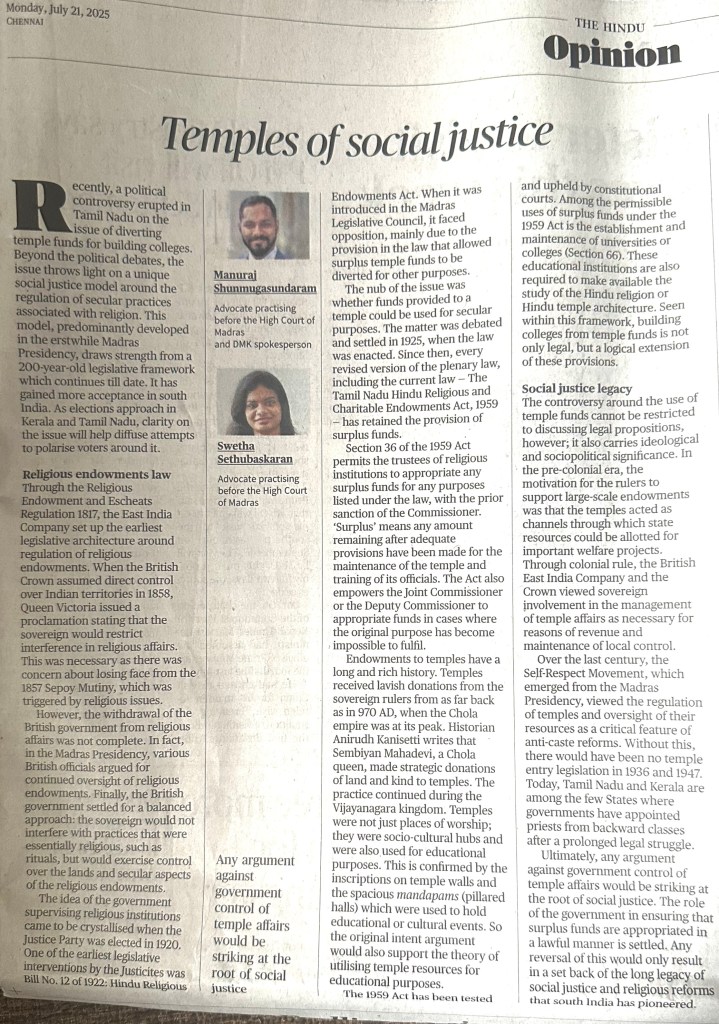
Recently, a political controversy erupted in Tamil Nadu on the issue of diverting temple funds for building colleges.
Beyond the political debates, the issue throws light on a unique social justice model around the regulation of secular practices associated with religion. This model, predominantly developed in the erstwhile Madras Presidency, draws strength from a 200-year-old legislative framework which continues till date. It has gained more acceptance in south India. As elections approach in Kerala and Tamil Nadu, clarity on the issue will help diffuse attempts to polarise voters around it.
Religious endowments law
Through the Religious, Endowment and Escheats Regulation 1817, the East India Company set up the earliest legislative architecture around regulation of religious endowments. When the British Crown assumed direct control over Indian territories in 1858, Queen Victoria issued a proclamation stating that the sovereign would restrict interference in religious affairs. This was necessary as there was concern about losing face from the 1857 Sepoy Mutiny, which was triggered by religious issues.
However, the withdrawal of the British government from religious affairs was not complete. In fact, in the Madras Presidency, various British officials argued for continued oversight of religious endowments. Finally, the British government settled for a balanced approach: the sovereign would not interfere with practices that were essentially religious, such as rituals, but would exercise control over the lands and secular aspects of the religious endowments.
The idea of the government supervising religious institutions came to be crystallised when the Justice Party was elected in 1920. One of the earliest legislative interventions by the Justicites was Bill No. 12 of 1922: Hindu Religious Temples of social justice. Any argument against government control of temple affairs would be striking at the root of social justice Endowments Act. When it was introduced in the Madras Legislative Council, it faced opposition, mainly due to the provision in the law that allowed surplus temple funds to be diverted for other purposes.
The nub of the issue was whether funds provided to a temple could be used for secular purposes. The matter was debated and settled in 1925, when the law was enacted. Since then, every revised version of the plenary law, including the current law – The Tamil Nadu Hindu Religious and Charitable Endowments Act, 1959 – has retained the provision of surplus funds.
Section 36 of the 1959 Act permits the trustees of religious institutions to appropriate any surplus funds for any purposes listed under the law, with the prior sanction of the Commissioner.
‘Surplus’ means any amount remaining after adequate provisions have been made for the maintenance of the temple and training of its officials. The Act also empowers the Joint Commissioner or the Deputy Commissioner to appropriate funds in cases where the original purpose has become impossible to fulfil.
Endowments to temples have a long and rich history. Temples received lavish donations from the sovereign rulers from as far back as in 970 AD, when the Chola empire was at its peak. Historian Anirudh Kanisetti writes that Sembiyan Mahadevi, a Chola queen, made strategic donations of land and kind to temples. The practice continued during the Vijayanagara kingdom. Temples were not just places of worship; they were socio-cultural hubs and were also used for educational purposes. This is confirmed by the inscriptions on temple walls and the spacious mandapams (pillared halls) which were used to hold educational or cultural events. So the original intent argument would also support the theory of utilising temple resources for educational purposes
The 1959 Act has been tested and upheld by constitutional courts. Among the permissible uses of surplus funds under the 1959 Act is the establishment and maintenance of universities or colleges (Section 66). These educational institutions are also required to make available the study of the Hindu religion or Hindu temple architecture. Seen within this framework, building colleges from temple funds is not only legal, but a logical extension of these provisions.
Social justice legacy
The controversy around the use of temple funds cannot be restricted to discussing legal propositions, however; it also carries ideological and sociopolitical significance. In the pre-colonial era, the motivation for the rulers to support large-scale endowments was that the temples acted as channels through which state resources could be allotted for important welfare projects.
Through colonial rule, the British East India Company and the Crown viewed sovereign involvement in the management of temple affairs as necessary for reasons of revenue and maintenance of local control.
Over the last century, the Self-Respect Movement, which emerged from the Madras Presidency, viewed the regulation of temples and oversight of their resources as a critical feature of anti-caste reforms. Without this, there would have been no temple entry legislation in 1936 and 1947.
Today, Tamil Nadu and Kerala are among the few States where governments have appointed priests from backward classes after a prolonged legal struggle.
Ultimately, any argument against government control of temple affairs would be striking at the root of social justice. The role of the government in ensuring that surplus funds are appropriated in a lawful manner is settled. Any reversal of this would only result in a set back of the long legacy of social justice and religious reforms that south India has pioneered.