For the last couple of years it’s been my privilege and personal delight to be corresponding via WhatsApp messages with the well-known writer, novelist, playwright and scholar, Sri. Indira Parthasarathy (pen name “Eepa”) almost daily while we casually discuss a whole range of subjects of mutual interest — mostly Tamil and English literature but occasionally also current affairs, politics and celebrities in the art world. Eepas’s responses to my messages (and daily blogposts on this webpage of mine) are often sharp, wise, wry , witty, pungent and very insightful. They make me smile but they also arouse lot of thoughts in me.
At 96 years of age, Eepa’s memory is still prodigious. His mind today works as vigorously as it did during his long and illustrious literary career in the past that saw him produce scores of novels , plays, essays and short stories both in Tamil and English language, winning him both the Sahitya and Sangita Nataka Awards and a Padma Shree to boot.
It is not always that I share with Eepa WhatsApp forwards or messages about only literature, art or politics. On occasions, we also exchange some silly jokes and trivia simply out of sense of enjoying pure fun. At 96, Eepa still enjoys telling and hearing a good joke.
So, yesterday a silly joke I sent Eepa was this one:
A 90-year old toothless geezer of an old man is sitting in a public park on a bench when a lady passing by asks him out of plain curiosity:
“Sir, what do you do for a living?”.
Pat comes the old man’s reply with a bemused twinkle in his eyes:
“Well, in the morning I start off by doing nothing, in the afternoon I finish what I began in the morning and in the evening I retire to take rest from all the hectic activity!”.
While sending the joke to Eepa I also added my own caption to it: “Sir, I just turned 69 a couple of days ago and I’ve decided to take inspiration from this old senior! Bless him !” To further heighten the comical effect of my comment, I added also a very telling and delightful Tamil idiomatic expression that I knew Eepa would be familiar with and be able to savour too. That delightful phrase was “சோம்பரை உகத்தி போலும்….”.
It is difficult to translate this Tamil idiom into English accurately since the sense in which it is used might get easily spoiled. The the nearest equivalent might be something like this: “fie on the lazy bone!” (where the word சோம்பரை denotes indolence).
Eepa quickly responded to my message and to the forwarded joke with a mild note of good-humoured protest by referring to himself:
“It is not சோம்பல்! What else one can do at 96!”
And I retorted:
“Sir , please we mustn’t misunderstand the casual, harmless joke … It just so happens that the Tamil idiomatic phrase is what at once popped into my mind on reading the joke and I’m sure you will recall it too: it’s from the paasuram of Tondaradipodi Azhwar:
மேம்பொருள் போகவிட்டு
மெய்ம்மையை மிகஉணர்ந்து
ஆம்பரிசு அறிந்து கொண்டு
ஐம்புலன் அகத்து அடக்கி
காம்பறத் தலை சிரைத்து
உன் கடைத்தலை இருந்து வாழும்
சோம்பரை உகத்தி போலும்
சூழ்புனல் அரங்கத் தானே.
— Verse 38 “Tirumaalai”
Here, Tondaradipodi Azhwar is describing a devotee who appears to have renounced worldly pleasures, mastered the senses, and is living at the feet of the Lord. Yet, if such a devotee is idle or spiritually lazy (சோம்பரை), even God (Arangan) would despise such laziness. The phrase “சோம்பரை உகத்தி போலும்” literally means “even You (the Lord) would despise the lazy (devotee).” This underlines the high value placed not just on external renunciation or ritual, but on active, heartfelt devotional effort.
However, the essential meaning of Thondaradippodi Azhwar’s phrase “சோம்பரை உகத்தி போலும்” is a little ambivalengt and it often gets interpreted by Sri Vaishnava theological pundits in two entirely different ways: one represents the Vadakalai standpoint and the other represents the Tenkalai view. Now, which meaning holds greater validity and appeal to a devotee will depend naturally upon which traditional commentary (“vyaakhyaanam”) of the Sri Vaishnava sectarian guru-lineage that the reader, Vadakalai or Tenkalai, might belong to … and there are several traditional gurus in both sects who have written copiously on the Tirumaalai.
Here is how a Vadakalai will tend to translate the above “paasuram”:
“Giving up the pursuit of worldly riches,
Experiencing the highest truth,
Knowing the true state of existence,
Withdrawing the five senses within,
Bowing the head in humility,
Living at your sacred feet—
Even those who do so, if they be lazy, are despised
by You, O Lord of Arangam (Srirangam, surrounded by pristine waters).”
In direct opposition to the above way of explaining how the Azhwar intended to be understood, here is the Tenkalai rendering:
“This verse praises genuine devotees who fully surrender to the Lord, live solely for Him, and finds spiritual fulfillment beyond worldly pursuits. It emphasizes that for such devotees, close presence and service to God alone is more than enough, and that this humble, self-controlled devotion is all what the Lord values above all.”
********
Without getting lost in a discussion on the dense semantics of Sri Vaishnava “vyaakhyaanam” or splitting hair on theology, Eepa and I changed gears in our WhatsApp palaver.
Staying however still wholly within the very same context of சோம்பரை உகத்தி போலும், Eepa went off suddenly in another entirely different direction of discourse! This was his thoughtful message to me:
“Instead of actively being engaged in true meditation for realizing God by controlling the five senses, why should one instead go and do all such things like shaving off ones head and doing all sorts of other things that appear pious but are really only play-acting the pious — i.e. doing nothing really at all but only believing that one is totally devoted to God?”
Eepa followed up that thought of his immediately by recalling a briiliant and apt Kural of Thiruvalluvar:
மழித்தலும் நீட்டலும் வேண்டா உலகம்
பழித்தது ஒழித்து விடின். (௨௱௮௰ – 280)
“One need not shave the head or grow long hair, if one simply avoids what the world disapproves of.”
Eepa’s sudden and brilliant quip had me momentarily stumped by the sheer force of its distinct strain of Existentialism philosophy. For an instant, my own mind began filling with a few old quotes of Jean-Paul Sartre (the most prolific thinker on Existentialism) that long ago, as a young man in university, I had once read about on the existentialist condition of Man:
“Three o’clock is always too late or too early for anything you want to do”. (Nausea (1938)
“I hate victims who respect their executioners”. (Les Séquestrés d’Altona (1960)
Sartre suggests that certain moments, like three o’clock, fall in a kind of liminal, frustrating zone where it is neither the right time to start nor finish anything meaningful. It reflects the existential feeling of alienation and temporal disjunction—the struggle to find the suitable moment to act in a life that often seems out of sync or lacking in inherent meaning.
By the second statement quoted above, Sartre means that victims who show respect or submission towards their oppressors (whether they are traditions, ideologies, religions, customs or institutions) — i.e. those who metaphorically or literally “execute” them—are failing to assert their freedom and dignity. Sartre, grounded in existentialism, emphasizes that individuals are fundamentally free and responsible for their choices; to “respect” one’s executioners is to surrender that freedom and fall into “bad faith” (self-deception).
Eepa I realised had thus just raised a question of profound spiritual concern: why do some people, instead of sincerely practicing inner meditation and controlling the senses to realize God, merely perform outward rituals like shaving the head or external displays of devotion towards the end of their life? …. And the Kural line “மழித்தலும் நீட்டலும் வேண்டா உலகம் ஒழித்து விடின்” that he quoted could be interpreted here as a reflection on authenticity versus empty prolongation of living.
Tiruvalluvar’s epigram suggests that merely extending life though outward show of piety and devotion without true inner transformation is futile. In many spiritual traditions, genuine realization requires inner discipline—controlling the senses, meditation, and sincere devotion. External rituals without inner change might be due to societal customs, fear of death, or seeking social respect, rather than true spiritual realization.So, the essence of it all is only this: rather than bargaining with external rites or delaying true spiritual awakening, one should focus on genuine inner realization— and just as the Kural implies, there is no point in extending what is destined to end without meaningful essence.
********
With the medley of such thoughts buzzing inside my head, I again messaged Eepa:
“Sir, you make a very valid point .. and yes , it’s a question that many people too ask themselves. In fact, I did too … many a time in the past .
“I once politely posed the same question to “Vaikuntavaasi”, U.Ve. Sri Mukkur Lakshminarasimha Chariar , the famous “upannyaasakar” (who, by the way, I look upon as my unacknowledged spiritual mentor) .
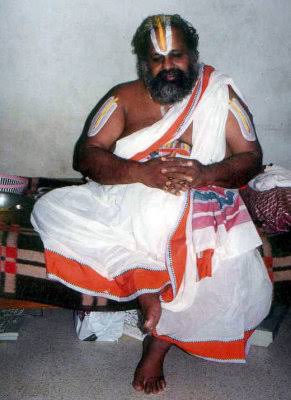
He did not give me a direct response but in a rather roundabout way, provided me one that was very thought provoking : it made me understand that sometimes what you call “play acting” , “role play” or imitation … does serve a spiritual purpose albeit in a limited way:
“Why did Ravana, who came to Panchavati “parnashaala” of Rama and Sita to abduct her, don the disguise of an ochre-robed holy mendicant or sannyaasi? That disguise or role got so easily exposed later, didn’t it?
“On the other hand , if Ravana had disguised himself as Sri Rama himself … and had play acted too like him … wouldn’t he have been more successful in befooling Sita and more easily been able to abduct her without drawing undue attention or alarm ?
“The reason why Ravana — the commentators of the Ramayana have said this — chose not to dress up or playact or disguise donning Sri Rama was this : if he indeed had done so , it was possible that merely imitating Rama, even in outward look and deportment, would’ve had the effect of transforming Ravana’s villainous nature and evil intent into something noble. The mere presence of Rama possessed such intense spiritual power that if one were to even merely attempt emulating or “play acting” Rama in any physical , behavioural or moral way , then one would, even without one’s own volition, consciousness or effort , begin to reflect Rama’s saattvic “Guna”, qualities and nature .
“Ravana feared thus that if he donned Rama’s role, then he might falter and not be able to carry out successfully the nefarious mission to abduct Sita .
You must now go and think about this”.
********
I continued next messaging Eepa:
“Sir, therefore, I believe there is much weight to be found that supports the above Ramayana commentary even in modern psychology theory and science .
Imitation of someone else’s behaviour… what you call “play acting” … can often lead to one’s own behaviour undergoing subtle but clear transformation happening within oneself . The central psychological theory explaining why imitation of someone’s behavior—sometimes described as “play acting”—can lead to genuine changes in one’s own behavior is Social Learning Theory.
This theory was introduced by psychologist Albert Bandura and emphasizes that people do not merely mimic others; they also internalize observed behaviors through a process known as observational learning or modeling.
Core Components of Social Learning Theory:•
Observation: Individuals watch the behaviors of others (referred to as models). •
Imitation: Observed behaviors are copied, either consciously or unconsciously. •
Modeling: The behaviors adopted become part of the person’s own repertoire, possibly affecting personality, attitudes, or habits. •
Reinforcement and Motivation: People are more likely to internalize behaviors if they see them rewarded in others or if imitation serves a social purpose.
Psychological Mechanisms and Effects•
Mimicry and Imitation: Humans automatically and often subconsciously imitate other people, a process that activates the “mirror neuron system” in the brain. This not only facilitates learning but strengthens social bonds.
• Identity Transformation: Through frequent and intense imitation or role-playing (as actors do), individuals may experience changes in self-processing. There is evidence that this “suppression of self” leads to genuine shifts in affect, cognition, and even personality traits.
Pretend Play and Acting: Beginning in childhood with pretend play, taking on roles and “acting” is fundamental to developing cognitive, emotional, and social skills. In adulthood, similar play-acting can yield subtle but lasting behavioral shifts, as the boundaries between role and self may blur with repetition and emotional investment.
• Mimicry: Spontaneous copying of others’ gestures, expressions, or mannerisms, often at an unconscious level.
• Role-playing/Method Acting:Consciously taking on roles or personas, as in theater, which can create emotional and behavioral changes in the one performing.
Vicarious Learning: Gaining new behaviors through observing the experiences and outcomes of others’ actions, even without direct participation.
Modern psychology does not label this as a disorder or “condition,” but views imitation and behavioral transformation through the lens of Social Learning Theory, mimicry, and role-playing. When someone imitates others—especially with conscious engagement or emotional investment—the behavior can become integrated into their own identity, leading to real shifts in how they think, feel, and act over time.
*********
I continued messaging:
“Sir, the key word in the above passage is — “over time”.
“Even if we think that someone is “shaving off his head” and only putting on a show of piety or Bhakthi in one’s sunset years in life … but does not show any signs of having controlled his senses or is in genuine pursuit of the divine … still we must give such a person the benefit of doubt because it is quite possible that he may be a Ravana at heart but he is perhaps role acting the part of a Rama Bhakth and thus “over time” , his inward personality might get transformed from being Ravanesque to Rama-like .
That Sir, I think, is the great power indeed of what even modern psychology theory like Albert Bandura’s too is suggesting: that “observation, imitation, mimicry and modeling” can bring change to bear upon human behaviour. Nonetheless, sir , as I already conceded to you, your original observations drawn from the Kural you quoted are quite right and they offer indeed so much food for thought.
*********
And thus on that very thoughtful and engaging note, the daily exchange of WhatsApp correspondence yesterday between Eepa and I ended .
Sudarshan Madabushi