Even with the benefit of 20:20 historical hindsight that we enjoy today, and as it was in his own time without it, Srinivasa Sastry could never easily be stereotyped. He was rather unique in that it could not be said with any certainty whether he was outright an Orthodox or Performative Brahmin “Sanatanist” or otherwise a shrill “anti-Sanatanist Liberal” whose heart bled for secular reforms to Hinduism.
Two separate incidents in Sastri’s life do support the above assessment of the man. In one he seemed to lean towards Brahmin Orthodoxy but, of course, only in the most liberal and enlightened sense; and in the other incident, he openly played the part of an anti-Sanatanist liberal-reformer. The two events were:
(A) Temple Entry law for Dalits into the Guruvayur Temple in Kerala (which was a continuation of the famous1924-25 Vaikom Sathyagraha movement in Kerala for Untouchables to gain entry and worship inside Temples)
(B) The Sarada Act that related to Hindu customary law relating to woman’s rights. (The Child Marriage Restraint Act, 1929, passed on 28 September 1929, in the Imperial Legislative Council of India, fixed the minimum age of marriage for girls at 14 years and boys at 18 years. In 1949, after India’s independence, it was amended to fix the age of marriage at 15 for girls, and in 1978 at 18 for girls and 21 for boys. It is popularly known as the Sarda Act, after its sponsor Harbilas Sarda).
***********
GURUVAYUR TEMPLE ENTRY FOR UNTOUCHABLES
The Guruvayur Temple Satyagraha was a major campaign in Kerala for Dalit temple entry, led by K. Kelappan who was supported by leaders like Mannathu Padmanabhan and A. K. Gopalan (Communist Party of India). The struggle included a hunger strike, mass mobilization, and a demand for the right of lower caste Hindus (then called “untouchables”) to enter the temple.
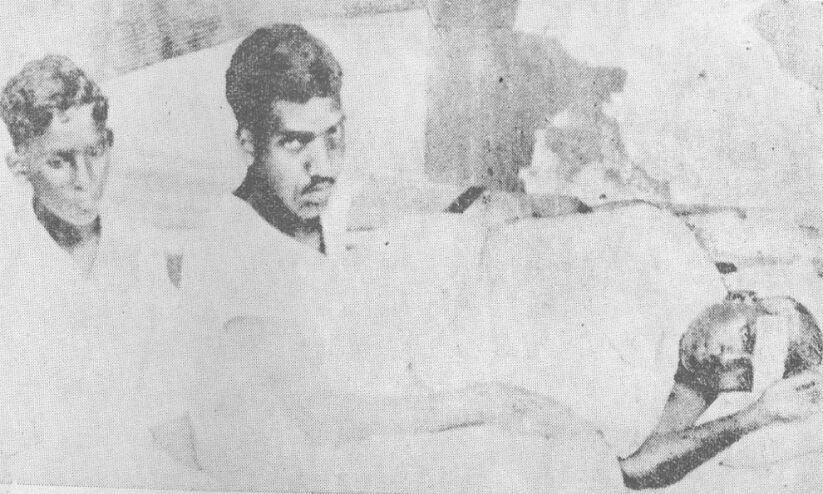
Gandhi took personal interest in the Guruvayur agitation. When K. Kelappan (imitating Mahatma Gandhi’s own political tactics) began a fast-unto-death to press the cause, Gandhi intervened—writing to ask him to break the fast, fearing harm or violence. The satyagraha was suspended at Gandhi’s request and the issue then gained all-India attention. The Satyagraha itself did not immediately succeed in opening the Guruvayur temple, but it triggered significant social reform debates. It was only later in 1936, that the Temple Entry Proclamation in Travancore allowed lower castes access to many Kerala temples, marking an important step toward ending ritual exclusion.
Srinivasa Sastri did not play a significant or direct front-line role in the Guruvayur Satyagraha of 1931–32, though he was aware of the issue and Gandhi, in fact, reached out to him for advice.
YERAVADA CENTRAL PRISON: 8th November 1932
Dear Friend and brother,
You will have seen that Guruvayur is being made the centre of attack by the self-styled Sanatanists. Not much time to lose.
I do not know how far your health will let you organise the battle on behalf of the reformers. To the extent it is possible, I wonld like you to put your great Sanskrit learning at the disposal of the cause.
I am sure you have been thinking of the thing yourself. But I could not restrain myself from sending you a line when I am writing to many friends about the impending storm.
It gives me great joy that I am able to take some work out of the Servants (of India) here.
I do hope you are better.
With love, Yours
M. K. GANDHI
Then on November 10, 1932, Gandhiji, referring to Kelappan, issued however a statement urging that the Guruvayur sathyagraha be called off for the time being, but in which he also said that he himself would gladly later join Kelappan!
“I would be in honour bound to fast with him if on or before the first of January next that temple is not opened to the Untouchahles, and if it becomes necessary for Sri. Kelappan to resume it”.
**********
Sending a copy of the above letters he had received from Gandhi to another friend, Sastri wrote:
“In reply I have written two letters (to Gandhi), clearly stating my dissent from his views and my disapproval of his threatened fast. Of course I favour the temple-entry of the untouchables”.
And writing to another friend, Sastri also wailed:
“What a predicament I am in! To wish his (Gandhi’s) cause success but utterly discountenance his method and his hurry.”
Sastri, a staunch constitutionalist and a steadfast moderate, and never an overzealous Hindu reformer, was sympathetic to the cause of temple entry for Dalits. However, he typically advocated negotiation, education, and legal reform rather than direct action or satyagraha. Privately, he corresponded about his misgiving to Gandhi:
“Patience, good-will, and consideration for sincerely-held beliefs are essential in matters of faith. Social change, especially concerning places held sacred, comes best through understanding and education, not through pressure—however righteous the cause.”
Sastri evidently had pointed out to Gandhi that ancient temples like Guruvayur had been administered for centuries strictly in accordance with time and custom honoured Hindu Agama Sastras which were the sole authoritative basis of faith upon which temple norms were established and rituals had always been conducted. To interfere with such Agamas with the intention to overturn them in a spirit of revolutionary or republican fervour would only do more harm than good to the social fabric of the peoples of India.
Gandhi, was obviously receptive to the spirit in which Sastri’s two letters to him had been written. And so, referencing Sastri’s advice, the Mahatma wrote to a few friends about it:
“Shri Sastri’s counsel has always been to avoid any method that would cause bitterness. I have valued his friendships and his faith in the power of reason … His voice carries great moral weight in South India.”
Thereafter, once the Sathyagraha and Kelappan’s fast had been called off, Gandhi further wrote to Srinivasa Sastri, perhaps, after having carefully read through both correspondence and all the accompanying material on Temple Agama Sastras that the latter had made available to him. Gandhi acknowledged the wisdom in Sastri’s advice to tread slowly and cautiously on matters related to the faith of the Hindu people in their Temples but refused to accept the overarching authority of the Agama Sastras.
YERAVADA CENTRAL PRISON: 24th November 1932
Dear Brother
I had your precious letters. Your criticism soothes. Your silence makes me nervous. Time only deepens my love for you.
Our differences appear to me to be superficial. Deep down I feel and touch the meeting ground, and that is precious.
I do wish I never spoke of God or the Inner Voice or Conscience. But, like Raamnam, however much it may be abused, it has got to be repeated when it is relevant, and almost becomes imperative. Truth will receive a deep cut if, for fear of being misunderstood or even being called a fraud, I did not say boldly what I felt to be true.
I carefully read the typed notes you sent me. The reasoning failed to make any appeal to me. The implications of the Agamas are stretched too far by the writer.
I hope you are keeping well.
With love, Yours
M.K.GANDHI
**********
Eighty five long odd years (!) have passed after the above Sastri-Gandhi correspondence took place. But it is sad irony that even to this day the Hindus of India continue find themselves deeply embroiled and entangled in scores of seemingly irreconciliable and rancorous legal battles in the State High Courts and in the Supreme Court of India too over what limits are there and to what permissible extent, exactly, they must be set to restrain the Constitutional powers a Democratic, Secular Government can invoke and exercise in its interference into religious affairs of Hindu temples by even overturning ancient Agama Sastras.
Truly, Srinivasa Sastra — the oxymoronic orthodox liberal-hearted Brahmin from Mylapore — had possessed such remarkable foresight and wisdom that he did not have to shirk from counselling even the tallest, most dominant political leader in the country of that time, the great Mahatma Gandhi. Sastri did not mince words in warning him that rabble-rousing and rallying Hindu Reformists and Secularists with clarion calls of Sathyagraha, Ahimsa and fasts-unto-death, all would only foment unwarranted revolution inside the ancient temples of India. Such revolutions would only divide the nation, never unite it.
************
(to be continued)
Sudarshan Madabushi