On February 19, 1945, the anniversary of the death of Gopala Krishna Gokhale, Sastri spoke for about forty-five minutes at a public-meeting and suddenly lost consciousness. When he regained it after a while, he was advised by his doctors to give up all arduous work including public speaking.
Nevertheless, on March 6. 1945, he gave a press interview on the subject of reform of The Hindu Code, which was under public discussion then across the country. The question was did the legislature have the right to deliberate and decide upon issues that religious in nature and ought to be left only to the Hindu religious orthodoxy leaders.
Sastri argued saying in his view the legislature, as then constituted, was competent for the purpose and that some of the suggested reforms were unobjectionable and even necessary. He made his position clear: while the objections raised by the Hindu orthodoxy should he heard with respect and their pleas also must be met as far as possible, the reforms, in their essentials, should not be sacrificed. He was also confident, Sastri said, that Hindu religious orthodoxy had a remarkable capacity to adjust itself to the reforms after enactment, though their capacity to see the need for them during the lead up to the enactment would suggest inflexibility. Sastri, ever the Brahmin Liberal-Humanist he was, by that statement showed that he possessed not only a very acute but also accurate understanding of the Hindu psyche and its religious leaders; they would baulk at the reformative moves in the beginning but in the end, he felt, they in their wisdom, would come around to accepting and accommodting reforms if found to be reasonable and in the larger good of the country.
in his biography, Kodanda Rao writes, that “even the mild exertions involved in giving that interview by Sastri however, took toll on his health. He had a severe heart attack which lasted some three hours. He could not sleep and had to be administered sedatives”.
***********
In the biographical notes of D.V.Gundappa is to be found an endearing anecdote on the end that was nearing Srinivasa Sastri.
One day as he lay weak in his sick bed at “Swaagatham“, his home on V.M.Street, Mylapore, Sastri expressed a desire to listen to Tyagaraja’s kriti “Paahi Raamachandra Raghava…” in the Carnatic raagam of Yadukula Kaambhodhi rendered by one of Sastri’s favourite musicians, Sri Musiri Subramania Iyer. The song was played for him, at his frail bidding, on a 78-rpm gramaphone disc. Sastri closed his eyes and was utterly engrossed in listening to the poignant lyrics of the song wherein Saint Thyagaraja beseeches Sri Rama to save him:
“O Lord rAma candra! O Lord rAghava! O Consort of sItA! O Lotus Eyed! O Lord rAma – worthy of praise by those highly reputed! O Lord worshipped by Emperors! O Ruler of this tyAgarAja!
There is none to protect for me and nowhere is a God better than You, so please protect me. As You are my refuge, please come, protect me quickly.
Is it possible that, no matter how much I entreat You, You would not have even a little mercy towards me? I entreated You to relieve my troubles because I considered You to be the Lord, my most beloved. Please save me quickly because what is the use of life bereft of Your grace?
Does my appeal seem to You to be a plaything? Otherwise, what could be the nature of my fate? You test me but am I worthy of Your tests? There is no time to delay any further, because I will not go begging for Your Grace at any sundry place (when I have come to you directly)!“
After song ended on the gramaphone, Sastri opened his eyes, moist with tears, and whispered softly… “Can it be played again for me please?… I want to listen to the song once more....”.
This story has been recorded and is widely cited as a testament to Sastri’s devotion to classical music and the personal spiritual resonance of Bhakti he found in Tyagaraja’s inspiring compositions.
***********
Early in January, 1946, with his cardiac condition worsening, Sastri was advised to get admitted into the Madras General Hospital. Mahatma Gandhi, who was on a visit to Madras, called on him in the Hospital on January 22 and was permitted to be with him for a few minutes.
The meeting was most moving, according to the biographical accounts.
Sastri, who was reclining in bed, sat bolt upright and moved towards the edge of the bed and extended his hands towards the Mahatma and said in a voice choked with emotion:
“I want to come near enough to hug you, little brother.’
In soothing tones, the Mahatma begged Sastri not to excite himself and helped him to recline in bed as Sastri held the Mahatma’s hands in both his own. With great effort, Sastri expressed his disappointment then with Gandhi’s no-show at the Simla Peace Conference that the British Government had organized in the aftermath of World War-2. The Conference was convened by the Viceroy, Lord Wavell, at the Viceregal Lodge in June-July 1945. Its primary aim was to facilitate Indian self-government after World War II, as Britain was preparing to leave India. Lord Wavell proposed a new Executive Council for India with a majority of Indian members (except the Viceroy and the Commander-in-Chief) and representation for major communities, including Hindus, Muslims, and other minorities. All portfolios except Defence would be controlled by Indians.
Gandhi hoever had refused to participate in the Simla Peace Conference because its Agenda failed to meet the main Congress demands for genuine transfer of power and full independence. The other major sticking point was over the appointment of Muslim representatives—Congress insisted it had the right to nominate Muslims delegates, but the Muslim League was adamant about having the sole right to appoint Muslim representatives. When this deadlock wasn’t resolved, Congress viewed the whole process as British-Muslim design to divide Indian unity and was unwilling to participate unless these issues were addressed on their terms. More broadly, Gandhi had grown wary of British offers after failed previous protracted negotiations (like the “Cripps Mission“, for example), seeing them all as inadequate gestures that wouldn’t lead directly to real independence or unity.
So, Sastri lying in a hospital bed virtually awaiting the hour of death, told Gandhi:
“I have wanted to say one thing to you. Another opportunity for peace has been lost. They are sitting there at the Peace Conference Table. But who is there to speak for humanity except you? I am afraid India has failed to do her duty”. Even if they do not ask you, you must go as the apostle of truth and non-violence and be on the spot. Your mere presence will have a tremendous effect. You must not stand on ceremony.”
Mahatma gently reminded him that he did not come to discuss politics with him in the hospital. Sastri then jokingly retorted: “I see, you think I am not good for it.”
After exchanging further pleasantries, the Mahatma left, knowing that Sastri’s end, sadly, was very imminent.
**************
The above meeting between Sastri and Mahatma Gandhi is testimony to their lifelong friendship and obvious love for each other as kindred souls. But then in many other less obvious ways the meeting not only forebode Sastri’s death but also the death of Brahmin Liberalism in the Independent India of the future.
In the grindingly long history of the Indian freedom struggle, Sastri had come to be known as an exemplar of the “vita contemplativa” as well as the “vita activa“… As (explained already in Part-16), it meant for Sastri a life lived adhering steadfastly to the fundamental tenets of Sanatana Dharma… He had famously averred that “the Hindu civilization rooted in Sanātana Dharma, has constantly been enriched by brahma and safeguarded by kṣāttra. For Sastri, that essentially meant for him, again, the “contemplative way of life” focused on intellectual and spiritual reflection i.e. the way of true “braahmanic living”, combining itself closely with the “active way of life” i.e. engagement with the world through moral virtues, social and economic duties, military work, and practical actions … For Sastri, the two “vita-s” were more or less entirely reflected in 19th-20th century ideas of “classical liberalism”. And such blending of “brahma” and “kṣāttra” in his own life became definitive Brahmin Liberalism.
It was truly the Brahmin-Liberal in Srinivasa Sastri that made his dying heart melt with Brahminical Bhakti feelings while listening to a Thyagaraja kriti and at the very same time, also vigorously engage Gandhi in a debate over the political strategy and tactics adopted by him in the final stages of the great battle for India’s freedom that was nearing its end in the year 1946.
In the democratic-secular political discourse and social fabric of India as we all know it today, the Brahmin-Liberal is an outright oxymoron…. i.e. you can either be a Brahmin or a Liberal, but you cannot be both because the “vita brahmin” and “vita liberal” are believed to be as mutually exclusive as “vita contemplativa” and “vita activa” are as described in Greek philosophy. In the ideological construct of the Dravidian South, especially in Tamil Nadu of which Sastri was a native, the Brahmin is today regarded as an extremist-protagonist of Sanatana Dharma while the Dravidian-Liberal is his extremist-antagonist.
Srinivasa Sastri’s life though was anything but that of an extremist in any sense of the word anyone could ever imagine… He simply defied the myth which latter-day vicious political propaganda has perpetuated — that a true Brahmin can never be a true Liberal …. and that Dravidian Secular culture and Sanatana Dharma — well, “never the twain shall meet“. Sastri’s imminent death thus would signify, and sadly too, a fin de siècle moment for Brahmin Liberalism too. From his death-bed never would he have given in to maudlin lamentations. We cannot imagine Sastri saying to his friend and compatriot, Mahatma Gandhi, and saying “Après nous, le déluge, mon ami” (“after you and I pass on, dear friend, the deluge shall come…) … In all likelihood, silently while preparing for his own end, Sastri might, however, have brooded: “Après moi la décadence morale”…. With the death of “Classical Liberalism”, a general moral decadence in the new era of a free India?
***********
The biographies continue to narrate the last days of Sastri right to the end.
The Mahatma, with several friends, called on Sastri again on January 30.
Sastri hailed his friend as the greatest man living and a blessing to him in a hundred ways. The Mahatma protested. Whereupon Sastri quoted a sloka from the “Ramayana” which said that he who did not see Rama or whom Rama did not see was despised by every one in the world. He (Sastri) spoke of his trance the previous day when he had written a beautiful essay on the episode when Sita persuaded Hanuman to spare from his wrath the minions of Ravana who merely carried the orders of their master in humiliating her (during her days in captivity in Lanka); they were not guilty themselves. It was forgiveness, said Sita, that made life worth living. Forgiveness was divine and was the noblest of virtues. None was so free from error that he did not need to be forgiven. She regretted that there were not two or three people who dared to tell the truth to Ravana, the King of Ceylon, and save him from wrongdoing.
Turning to the Mahatma, Sastri said: “That is the duty we owe to friends and we fail to discharge. I have done that for you one or twice, and as for you, you do it and sometimes publicly, much to the consternation of everybody. But it is the noblest office of friendship.“
***********
The Mahatma paid a third visit to Sastri though he had only three hours in Madras and had several engagements to fulfil. It was a Monday, when the Mahatma observed silence. Therefore, while Sastri talked, the Mahatma replied on paper. Deeply inoved, Sastri said:
“Brother, you have done me an exceptional honour, especially by paying this visit when you were in a great hurry. You are nearer and dearer to me than my own brothers, sons and other members of the family. We have come together by some inner affinity. No external reason can explain our friendship. Gokhale was but the occasion of it.”
He became breathless with emotion. The Mahatma waved Sastri a fond farewell and went away.
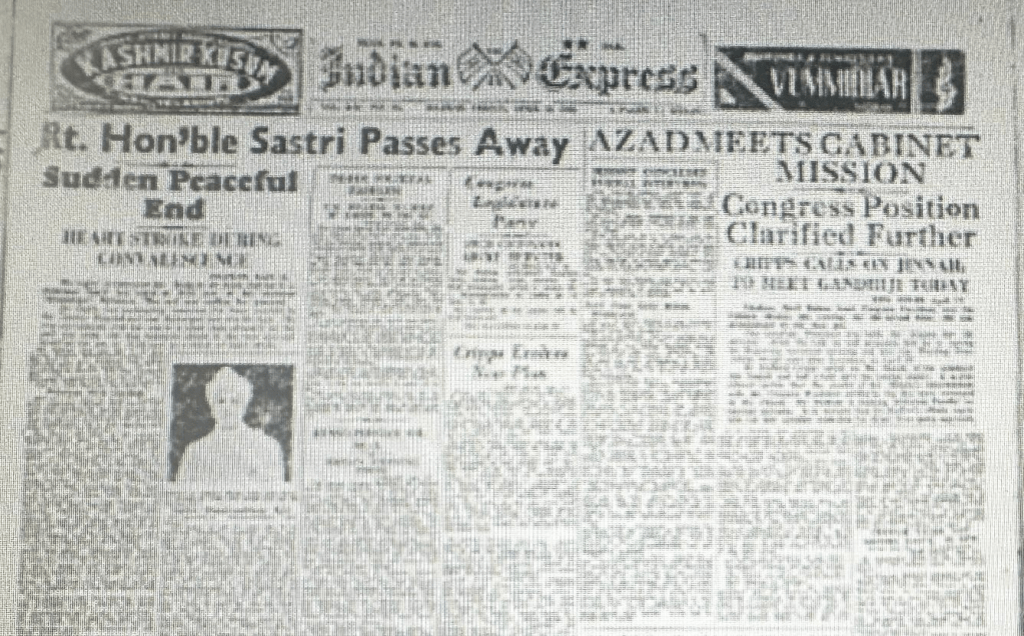
Sastri’s health steadily and gradually grew worse. He passed away at 10.35 p.m. on April 17. 1946. He was conscious till about fifteen minutes before the end and was speaking to the members of his family. He then lost consciousness and did not regain it.
The news appeared in the morning papers on the 18th, and a stream of relatives, friends and admirers called at his house “Svaagatam” to pay their last respects. His mortal remains were cremated according to orthodox Brahminical rites.

**************
The ““Après moi la décadence morale” prediction seemed to come almost true on the very day Srinivasa Sastri passed away.
It was rather strange, inexplicable why no official mourning or condolence messages were issued by British Commonwealth leaders at the time of Srinivasa Sastri’s death in 1946 was forthcoming. Although he was internationally respected through his work as India’s Agent-General in South Africa, his participation in the League of Nations, and diplomatic engagements in Britain and the Dominions, the published obituaries and tributes that were reported in the newspapers following Sastri’s death did not focus on Sastri’s death as much as they did on Mahatma Gandhi’s much later in the year 1948. There is no record of formal messages from Commonwealth or any other foreign government heads.
The mourning and tributes after Sastri’s death that became public were primarily from leading Indian statesmen, reformers, and public intellectuals, most notably Gandhi and contemporaries in the liberal nationalist tradition. The news-report below is a revealing list of who were true Sastri admirers.
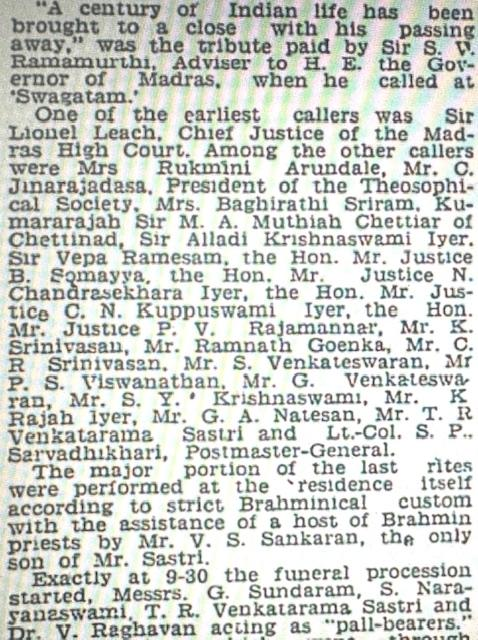
The reason why neither the British Government nor the British Commonwealth leaders of the world sent in condolence messages on Sastri’s death is most likely because they knew that Sastri had always been and still was the “eternal outsider” of Indian politics and especially the Indian National Congress with whom momentous negotiations for India’s Independence were still underway then and poised at a very critical stage. The British officials knew well that many of the top leaders of the INC — save Gandhi — nurtured barely cordial collegial relations with Sastri and thus did not wish to irritate or in any way embarass leaders like Nehru, Rjajaji or Patel by sending in condolences expressing encomiums for Sastri who, in many different ways, had often chosen to oppose their own programs and ideas in mainstream politics.
While none of these three leaders is known to have spoken of Sastri with personal spite, politically he had been often a source of embarrassment for them: an eminent Indian statesman that Sastri certainly was and whose rhetorical gifts and international stature were quite legendary, could not however still erase the fact that he had taken positions which the post‑Quit India Congress wanted to leave behind. So their public silence in death very likely mirrored their silence in political life toward him over the previous decade — a calculated distancing, not an accident. Gandhi’s openness in honouring Sastri stands out precisely because it showed he could acknowledge deep political disagreements without withholding public respect.
Available public records and major biographical sources today do not show evidence that Jawaharlal Nehru, C. Rajagopalachari (Rajaji), or Vallabhbhai Patel made notable public condolence statements specifically reported or widely cited at the time of Sastri’s passing. Their individual official condolence messages—if they were published—are not prominent in standard accounts or referenced in major archives. Similarly, there are no readily accessible records or major press coverage of an official message of condolence issued by the Indian National Congress upon Sastri’s death. The egregious absence of well‑documented, widely reported condolence messages from Jthese leaders of the INC does create a striking and disappointing impression on our minds today. All three leaders had known Sastri personally for decades, Rajaji in particular enjoyed an ongoing personal acquaintance with him in Madras. Yet none of them went on public record to condole the death of Sastri. And that lapse on their part can today certainly be read as a lapse in statesmanlike generosity — at least in the symbolic and historical sense.
Publicly acknowledging the passing of a figure like Sastri would have been both an act of personal respect and a recognition of his contribution to India’s public life. It’s possible these leaders may have expressed condolences privately, in closed meetings, or via less‑publicised statements that were never picked up by national newspapers and thus never entered the durable historical record. The political climate of early 1946 was certainy extremely intense — negotiations with the British, the Cabinet Mission’s arrival, and the approach of independence and partition all dominated the leaders’ time and public messaging. Sastri by then was far from the political mainstream, which may have made his passing less of a media priority and also for the INC and other national leaders. That said, from a moral perspective, however, the lack of visible tribute does inevitably appear ungenerous and hence appears to have been the inauguration of the era of “la décadence morale” in India.
Many of the obituaries for deceased leaders of the great stature of Srinivasa Sastri, especially if received from leaders like Nehru and Rajaji, tended to be reprinted decades later in collected works, biographies, or in the Collected Works of Gandhi/Nehru/Rajaji. The fact that no well-documented evidence of such condolences exists in these sources — while Gandhi’s note alone is well preserved — strongly suggests one of two possibilities: The lapse had either slipped through somehow historical records. Or, these Congress leaders simply did not issue public messages at all — perhaps out of political calculation, given Sastri’s known opposition to Quit India and his wartime cooperation with the British. If anything was however said by them at all, it was done in a very minor, perfunctory way, maybe in a local setting, without press release or AICC-INC resolution, so it never entered the durable public record. It simply “slipped through”. Given the norms of the time and the way obituaries for major figures were covered, the second scenario — i.e. deliberate public silence or near-silence — seems more plausible than the “slipped through history” argument.
What makes the absence of condolences from Nehru, Patel and Rajaji rather morally reprehensible is probably that it reflects a conscious choice rather than an archival accident. It fits with the broader reality that by 1946 Sastri was very much outside the Congress mainstream, and the top leadership was focused on partition negotiations and the Cabinet Mission, not on paying tribute to a man whose politics they regarded as outdated or even unhelpful. By 1946, for Jawaharlal Nehru, Rajaji, and Vallabhbhai Patel, the Rt. Honb’le V. S. Srinivasa Sastri represented a political tradition they had not only outgrown but, in some respects, wished to keep at arm’s length.
************
On the death of Srinivasa Sastri in April 1946, Mahatma Gandhi publicly conveyed his condolences with a heartfelt tribute in the pages of Harijan, stating on historical record:
“Death has removed not only from us but from the world one of India’s best sons.”
******* CONCLUDED *******
Sudarshan Madabushi