
At the above book-launch event, many in the audience as they trooped into the plush Chennai International Centre (CIC) auditorium were mystified if not aghast when they first saw the title that my book carried :
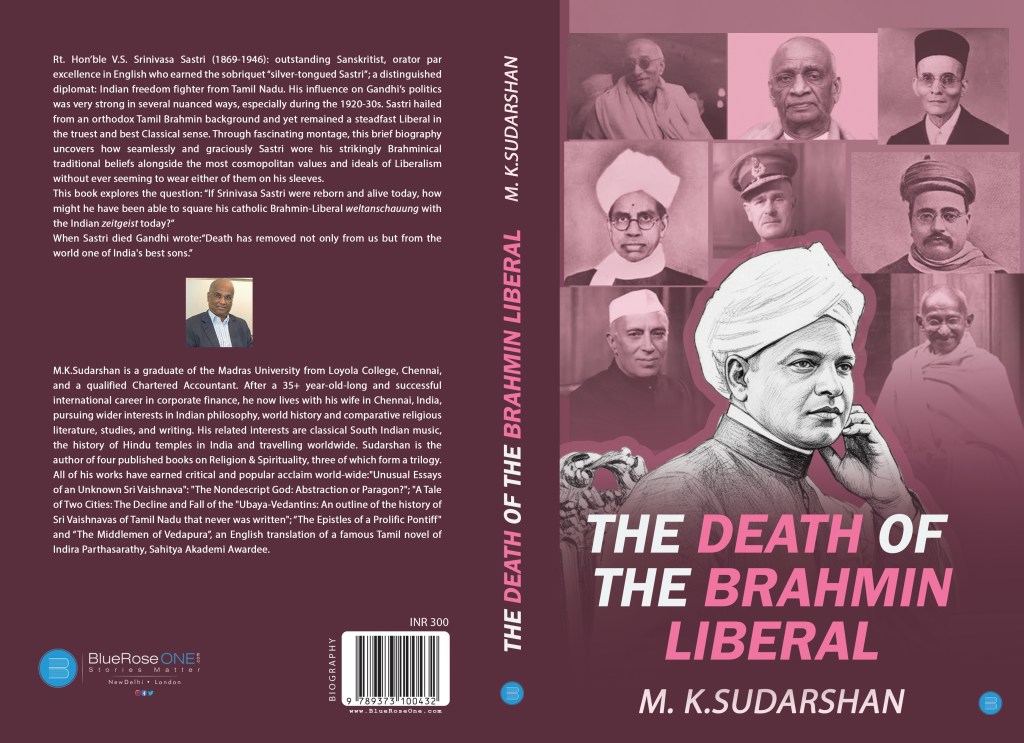
Death? Brahmin? Liberal? And the Rt. Hon’ble Srinivasa Sastri?!
Right at the very beginning of the event, Mr. Chandramouli, the CEO of CIC , made formal introductions of the distinguished guest-panellists on stage —- T.S.Krishnamurthy (former Chief Election Commissioner of India) S.R. Madhu (Author and Journalist) and P.S. Raman (Advocate-General of Tamil Nadu State).
When it came to introducing me , the book’s Author, he felt compelled perhaps to try and put at ease the audience’s misgivings about the title of the book. Under the circumstance, Chandramouli obviously did some quick thinking on his feet and demonstrated remarkable presence of mind for an MC. He pulled out from the “Author’s Preface” in the opening pages of the book a relevant passage wherein I had offered my readers an explanation about why I had chosen a title as grim as “Death of the Brahmin-Liberal”. Here below is that passage :
The word “death” in a book’s title can and does make a reader perhaps squirm and shift uncomfortably in the chair. I am very aware the unnerving effect my book’s title might have on readers’ minds. However, I choose to persist with the title chosen because I am convinced it serves the central purpose of the book viz.: to describe the death of decency and decorum, idealism and Dharmic values in politics and public life today in our country. When a tiger has already gone extinct as a species in our beautiful wildlife forestlands, what does it matter whether we call the extinction “Death”or “The Last of the Tiger”?
As I ascended the stage to join the three distinguished panellists, I got the distinct feeling that Chandramouli’s introduction of me, far from putting the gathering at ease, had made things only a little bit worse: the audience’s misgivings were now not only over the book-title but also about its author.
******
Sri. T. S. Krishnamurthy, when asked to commence his opening remarks in the book-discussions made it clear at the very outset that he did not quite relish the book’s title at all … Someting did he say to this effect: “I wish Sudarshan had chosen a wholesomely worded title for the book that reflected the essence of a great man like Sastri… something like “unsung patriot” instead of “liberal” … or, “moral” instead of “the Brahmin”…
Immediately I began feeling my heart to sink a bit … The book’s title was coming under intense scrutiny even before its content! … “My book launch event”, I thought, “was off to a fine, flying and inauspicious start, indeed”!
S R Madhu, the moderator, sensing perhaps my slight trepidation, then tried steering the discussion off in another direction by hastening to the next questions and themes in the panel discussions. The panellists then moved on briskly thereafter to talk about about other aspects and features of the book … and about Srinivasa Sastri … over the course of the following hour and a quarter.
Inwardly, at last, I heaved a sigh of relief!
*****
At the very end of the last 10 minutes of the program when the floor was thrown open to audience questions, a gentleman asked me if I could define exactly the term “Brahmin-Liberal” since it had different connotations to different people. Since the event was already nearing its end , I was very relieved that I was not obliged to offer him any kind of elaborate explanation. People were already getting to ready to exit and go home. So, I gave an abrupt , cryptic answer and left it to the gentleman to figure it out for himself:
“Sir, very pertinent question …. Let me say to you that today in our society we have this strange narrative : if you are a Brahmin, you can’t be a liberal . And if a liberal you won’t be a Brahmin. Srinivasa Sastri defied such a narrative since he was a perfect blend of both”.
The program concluded and the audience dispersed …. Many of them, I saw from their faces, seemed to be still a little bemused if not nonplussed by the title of the book. Nonetheless, I was happy that about 50 and more of them went out to buy a copy of my book to take home, read it and de-mystify all by themselves the book’s title that seemed to rankle so many that evening … “Thank God”, I said to myself silently .
*****
The next morning , I sat at home savouring my first cup of coffee for the day.
Opening my email inbox, the first message I got was from a very friendly reader of my book who had purchased, he told me, his copy from the online Amazon bookstore. He too began by querying me about the title of my book. “Oh, no! Not again!”, I cried to myself .
This was the question he posed to me : “Here the book title is “….the Liberal”??! After reading the book I thought “…a Liberal” would’ve been more appropriate.”
Now, the title of the book was being put to the rigours of a grammatical test! Parsing the title of my book seemed to me then had all of a sudden become a pastime for readers. They bought the book out of kindness towards me, but they had to frown at its title.
Parsing a book’s title, I told myself then, was after all only an exercise in English grammar; Srinivasa Sastri himself had been famed for his scrupulous attention to correct grammar… In my book, I had devoted one whole chapter narrating the incident when Sastri in the manner of a school master had taught proper grammar, as to a student, the great Karamchand Gandhi on how not to write sloppy English editorials for the “Harijan” magazine that the Mahatma himself edited. And it was also said that Sastri all his life had kept a textbook of English grammar by his bedside.
Challenged thus on grammatical correctness by the emailed question posed by a reader to me, I felt I should respond in what I believed might have been the Sastri way: answer tricky questions on grammar with a sedulous lesson in grammar. So, imitating the typical Sastri style, I explained to the reader why, in my book’s title, I had chosen the definite article “The” instead of the general/unspecific article “A”.
“Dear Sir, very good question you raise indeed… But as a writer I look at things a little differently … Let me explain.
“Sastri to me in his lifetime represented the best values of both classical liberalism and Brahminical way of life . Today, when I look around me in society, at the Tamilian Brahmin community, I perceive only a marked decline in its old value system. The community calls itself liberal … but then its a very pretentious sort of liberalism.
“So, in comparison to the Brahmins of today who call themselves as Liberal-minded but, in reality, are neither fully one nor the other …. and neither here nor there… Sastri, by contrast, in his time, always remained the perfect and steadfast blend of both value-systems . And it is precisely that facet of his which I have portrayed in my book .
“So, in my book Sastri was indeed THE Brahmin-Liberal … not A Brahmin-Liberal“.
The friendly reader followed up with another question:
“Do you mean to say, like, that Sastri is the ultimate “Brahmin-Liberal” – a role model for others to follow? Maybe he was then… But how do you define men of “Liberal” values who lived during Sastri’s time? Would they too have been like the “Wokes” of today? i.e. Hindus who are willing to run down Hinduism just to look good to others of their type or to non-Hindus ? So-called “Hindus” today we see are willing to overlook and condone all the havoc created by other Religions across the world”.
I replied:
“No, I would’nt use the term “ultimate” …. But yes, definitely, I would say that Sastri was the most exemplar of Brahmin-Liberals of his times. I say that because the definition and tenets of classical liberalism that Sastri himself embraced in life were those that his guru Gopalakrishna Gokhale’s guru Ranade had given. Here is the verbatim definition below which were known then as “The Tablets of Indian Liberalism” inscribed by Ranade:
“The spirit of liberalism implies freedom from race and creed prejudices and steady devotion to all that seeks justice between man and man, giving to the rulers the loyalty that is due to the law they are bound to administer, but securing at the same time to the people the equality which is their right under the law.
At the very heart of Liberalism as Gokhale and Ranade had conceived it was the ideal of Moderation which was in turn defined as that which “implied the conditions of never vainly aspiring after the impossible or after the remote, but striving cach day to take the next step in the order of natural growth by doing work that lies nearest to our hands in a spirit of compromise and fairness.”
Sastri was a true exemplar indeed of both Liberalism and Moderation as described above. Which was in fact why Gandhi himself acknowledged Sastri to be the best disciple of Gokhale when he said: “I have called Gokhale my political Guru. Therefore, Sastriar is a fellow disciple. And what a disciple and yet an amiable usurper!!! I was to have the honour of being Gokhale’s successor but I found in Sastriar a worthy usurper to whom I made a willing surrender…. I had and have no gifts which Gokhale had and Sastriar has in luxurious abundance.”
********
Another friendly reader — from Bangalore this time — sent me a query via a Whatsapp message. It echoed in fact the very same feelings that Sri. T.S.Krishnamurthy and that gentleman in the audience had expressed too, just as I describe them above. This was the question:
“If you had to drop “brahmin” from the title of your book “The Death of the Brahmin-Liberal”, what would you have replaced it with?”
(continued in Part-2)
Sudarshan Madabushi