
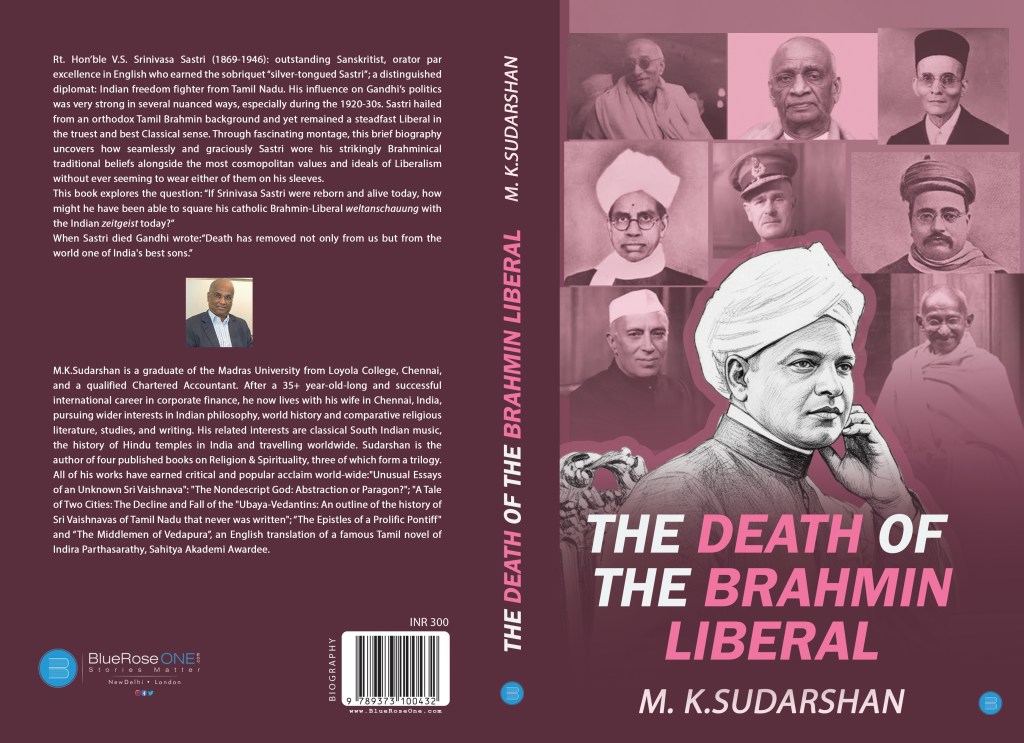
Another friendly reader — from Bangalore this time — sent me a query via a Whatsapp message. It echoed in fact the very same feelings that Sri. T.S.Krishnamurthy and that gentleman in the audience had expressed too, as I described them above. This was the question and it was a very serious one:
“Sudarshan, let me ask you an academic question. If you had to drop “brahmin” from the title of your book “The Death of the Brahmin-Liberal”, what would you have replaced it with?”
This was a hypothetical question but then a very serious, loaded and leading one with which I had also grappled when I had finished writing the manuscript of the book and was searching for an apt title to give it. So, I hesitated to give a direct answer for the simple reason that I had refrained from providing one in the Preface written in my book. I had deliberately chosen not to bring up this theme in any of the chapters of my book.
The reason why I chose reticence on the matter was that I believed the question of Caste and Identity politics in Indian society — that prevailed even in the pre-Independence era — was regarded by Sastri himself to be beneath him and of no great consequence. He had always risen above it and distanced himself from all forms of parochialism and sub-national provincialism that were pursued and practised by other narrow-minded, mean-spirited politicians of his times. Therefore, I too avoided going anywhere near describing in my book how Sastri personally had had to face the caste-identity animosity of peers (in what is today Tamil Nadu state but the then Madras Presidency).
However, there was once incident in Sastri’s life which I read in his biography that revealed the full extent of the casteist attacks he had had to ensure and weather in his political career. I did not include the narration of it in my book. However, it was reading about that very incident that had filled me with shock and dismay and which became the main reason why I resolved that I would persist with inclusion of the term “Brahmin-Liberal” in the title to my book, no matter what readers and the general public might have to say about it in criticism.
What I had been loath to include in my book, I felt that I might now include in my reply to my Bangalore correspondent who had posed the friendly question to me: “If you had to drop “brahmin” from the title of your book “The Death of the Brahmin-Liberal”, what would you have replaced it with?”
*********
“You raise a very pointed but extremely touchy question. But I’m not going to give you a direct answer myself . I shall reproduce below for you an extract from the biography of Sastri. It will tell you how Sastri himself was the target of Brahmin resentment if not outright animosity in his time; and how it was up to a Pillai gentleman who was his admirer who rose to defend Sastri.
After you have read the anecdote … I believe I wouldn’t have to explain to you at all why I wouldn’t replace a single word from the title of my book.
*******
My friend, I believe you certainly are already aware that Sastri played a pivotal role in the enactment of what in 1919 was the Montagu-Chelmsford Indian Reforms initiative that was taken by the British Government of India.
The Montagu-Chelmsford Report then officially became the Government of India Act 1919. It was a British law that introduced reforms to increase Indian participation in governance, based on the reform recommendations the Montagu-Chelmsford Report contained. Its key features included establishing a dual government system at the provincial level called dyarchy, separating central and provincial budgets, and creating a bicameral legislature at the center. The Act was a response to growing Indian nationalism and aimed to grant limited self-governance while maintaining British authority.
Now, the publication of the Montagu (aka Montford) Report… was soon followed by the appointment by the British Govt of two committees to make detailed recommendations regarding the matter of “franchise” and “division of powers”. Sastri was appointed to the Franchise Committee, under the Chairmanship of Lord Southborough.
Sastri’s inclusion in the Committee infuriated the non-Brahmin organisations in Madras, who accused him of preferring a Brahmin oligarchy to Indian Democracy.
Sastri was born a Brahmin; he could not help it. But he never said that he favoured Brahmin oligarchy to Indian democracy. All that he had really said at the time was that he did not favour adult franchise at that period of time in the history of India where masses of people were still in poverty, illiterate and uneducated in matters of citizenship rights and duties and lacked familiarity with electoral and legistlative processes. That stand of Sastri was twisted by his non-Brahmin critics to mean something very different. They demanded that Sastri should be unseated and some non-Brahmin members to be instead included in the Committee. As their demand was “not fully met”, they all boycotted the Committee.
The chief contention of the non-Brahmins group was that, though they constituted the large majority of voters and their ratio to Brahmins was something like eight to one, they were not sure of adequate representation in the Councils because of the caste superiority of the Brahmins in Hindu society. They, therefore, demanded a separate communal electorate for non-Brahmins.
While the non-Brahmins attacked Sastri because he was a Brahmin, The Hindu newspaper and the nationalist press attacked him equally fiercely only because he was regarded as a Moderate and largely supported the Montagu Reforms which Nehru and his Congress radical nationalists stoutly opposed.
Mr. P. Kesava Pillai, himself a Congressman and a non-Brahmin, was moved to protest against all the nasty attacks that the Congress and casteist parties in Madras launched against Sastri and which were further broadcast nationwide by The Hindu. In the course of his letter published in the “Indian Patriot”, Pillai said:
“Mr. Sastri is a level-headed and cultured man who has acquired wisdom enough to treat undignified and indecent personal attacks with indifference and pity, and has self-respect, patriotism, optimism, common sense and sound information of the constitutional systems in the civilised world to do signal service for his country in the Committee.
“Few Brahmins are as free from Brahmin prejudices as Mr. Sastri. And it is a thousand pities that such a public man, who has made sacrifices in life, is attacked, traduced. slandered and calumniated in and out of season by comparatively small men.
By all means let Dr. Nair ( Justice Party founder whose prime over was “EVR Periyar”) get in (the committee) and plead for communal representation as he considers best ; but to ask for Mr. Sastri’s removal (from the Committee) as a thing agreeable to non-Brahmins in general is a gross perversion of truth. Mr. Sastri’s removal will be disastrous to the Congress cause, say whatever “The Hindu” may. And even the progressive and self-respecting non-Brahmains will be better served by him than by Dr. Nair, or any of his school or following”.
The net result of the agitation was that Sastri was not unseated and Nair was not seated, and the non-Brahmin representatives boycotted the Committee.
The Southborough Committee, however, went on to recommen reservation of seats for non-Brahmins on a common electoral rolls. Sastri’s personal view was that communal electorates were undesirable and should be granted only in special cases, but with built-in correctives, such as a time-limit and the option for individuals to prefer the common to the communal electorate, or change over from the latter to the former. He held to this view consistently and uged it repeatedly.
Finally, it was another British committee-member who recognized what deep and vicious caste dynamics were at play in the whole affair, and made a remarkable observation:
“In this matter, too, Mr. Gokhale’s mantle seems to have fallen on his (Sastri’s) shoulders and he has worn that majestic garment with an ease that would have delighted his master. India has cause to feel proud of Mr. Sastri, and it is a matter for astonishment and sorrow that such malicious attacks of hate have been made upon him, not only in Madras where his enemies, by their very ferocity, render tribute to his great capacity and qualities, but also in Bombay, where, I hear one of the oldest members of his party speaks of him as a ‘black sheep.’ May there be many more such, might well be the prayer of patriotic Indians.”
*******
It is now, finally, that I think I wish to pose my own question to M/s Chandramouli, T.S.Krishnamurthy and also to my book’s three other anonymous readers/audience-members:
It was only after I had fully read the above historical incident in Sastri’s biography, that I decided I would not replace the word “Brahmin” from the title of my book, come what may…. And would you still fault me now for sticking to my guns?
Sudarshan Madabushi
Your very convincing arguments, strongly supported by Mr Pillai’s logical observations , justify your decision to retain the word “Brahmin” in the title of tour book.It is shocking to know how this hatred against Brahmins is deep- rooted and was in evidence even during the pre- independence period, thanks to the Justice Party. Brahmins , as a race, are more sinned against than sinned.
I am afraid I have not been properly understood.
1.What I objected to was the use of the word “the” before Brahmin.
It gave an impression that the only Brahmin Liberal at a time when S/Shri Vaidyanatha Iyer (Madurai),Subrahmanya Bharati,Subramanya Siva,Vanchinathan Rajaji, Bengali Brahmin liberals and a whole lot of others who came out of conservative thoughts in the national freedom movement.
Secondly it gives an impression that he was a hero in Tamilnadu by confining him to regional leader.
In my opinion you are not doing justice to his national stature.
2.I had never expressed any comment on the word Brahmin while expressing my views in the public deliberately. My view was and is that his national stature is enhanced if the title was “The unhonoured & The unsung Indian liberal patriot”
@
Very grateful to you Sir for your clarification which reveals the broad sweep of your own perception and appreciation of Sastri’s personal qualities . The matter should now, of course, rest. Sudarshan