
What does the Greek derived Biblical word Soteriology mean?
It is the branch of theology that studies “salvation”: i.e. what the human problem is, what it means to be saved or liberated, and by what means and conditions that liberation is effected.
Generally, in religious studies across the board, soteriology covers doctrines about (a) deliverance from a dire existential condition (sin, ignorance, bondage, suffering) and (b) attainment of a final positive state (heaven, nirvāṇa, mokṣa, etc.).
It asks questions about (i) the nature of the saving state, (ii) the role of divine agency (iii) and the human response, and (iv) the processes or paths (grace, faith, works, knowledge, ritual) by which that state is reached.
In Sanskrit, there is no single technical noun exactly parallel to the term “soteriology,” but the closest functional equivalents would be:
- Mokṣa-śāstra (मोक्षशास्त्र) / mokṣa-vidyā (मोक्षविद्या) – teaching or science of liberation.
- Mokṣa-tattva-vicāra (मोक्षतत्त्वविचार)– inquiry into the principle/doctrine of liberation.
- Within Vedānta specifically, discussions of mokṣa-sādhana (मोक्षसाधन, means to liberation) and mokṣa-svarūpa (मोक्षस्वरूप, nature of liberation) together practically constitute “soteriology.”
Tamil also does not have a single fixed coinage, but in usage the following expressions are functionally parallel to soteriology:
- vīdu-t-tattuva viḷakkam (வீட்டுத் தத்துவ விளக்கம்) / vīdu-nilai viḷakkam (வீடு நிலை விளக்கம்) – doctrinal exposition of “vīdu” (mokṣa) and its state.
- vīdu-peruvadu eṉṟa neri (வீடு பெருவது என்ற நெறி) – the path/means by which liberation is obtained (i.e., mokṣa-sādhana).
************
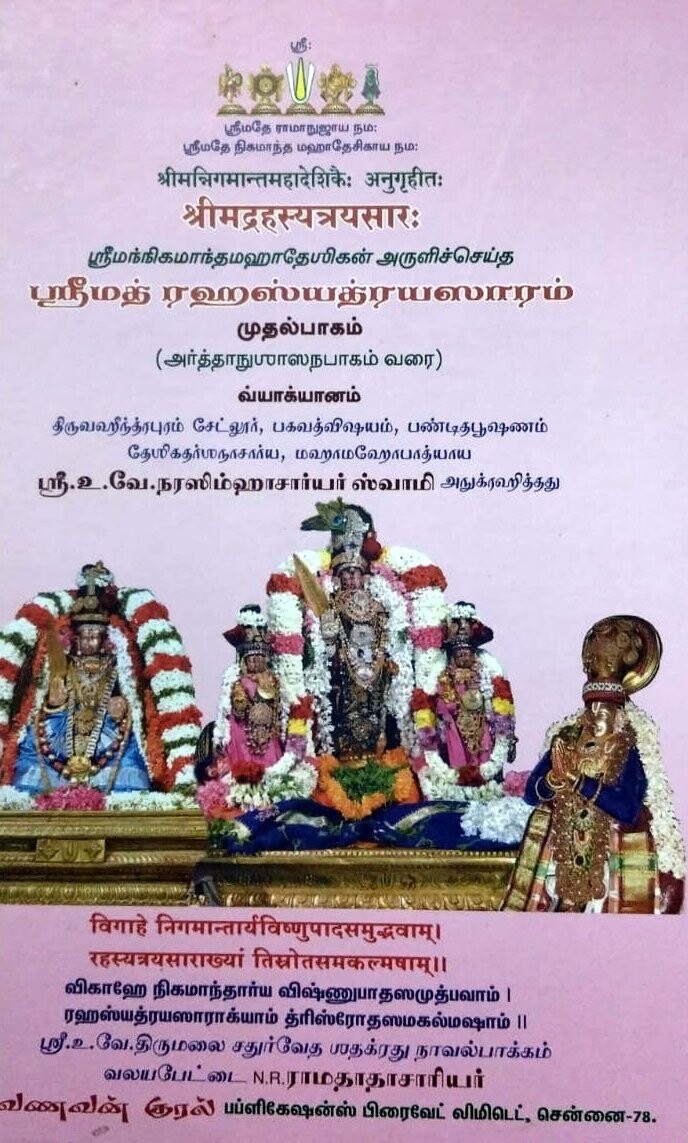
In Visishtadvaita Vedanta aka “sri ramanuja darsana“, the most comprehensive and seminal work of soteriology is the Manipravala treatise, “Sri Rahasya Traya Saara” (“The Essence of the Esoteric Three“). It is a 32-Chapter treatise in which Swami Vedanta Desika distilled the very core of Sri Vaishnava doctrines on “”मोक्षशास्त्र” into one comprehensive tome for the benefit of all earnest and genuine seekers of Liberation.
Every chapter in Vedanta Desika’s famous work, “Sri Rahasyatraya Saram” (RTS) is so very profound that even the devoutest student, even while attending “kaalakshepam” sessions (study-circle) to study it humbly under the expert guidance of an erudite “sadhAcharya” — and especially if the former is not fully acquainted with the traditional vocabulary (“paribhaashai“) of Sanskrit and Manipravala “vyaakhyaana” (hermeneutics) style –, can find himself/herself floundering about in trying to grasp and grapple with some of the fine Vedantic concepts or subtle explanations of philosophical nuance espounded in it. The RTS is a “rahasya grantha” that deals with esotericism of salvation … which is a subject of study not recommended for all and sundry but only for those “sishyas” or students whose intellectual aptitute and spiritual attitude the guru is convinced makes him fit and ready to receive the knowledge imparted by the sacred text.
It is precisely for that reason, that in Sri Vaishnava “sampradaya” studies, a student-sishya is advised not to ever venture undertaking the study of the RTS by his own effort and without the gentle and learned aid of a qualified “acharya” or “guru” steeped in the Visishtadvaita school of thought. It would be foolhardy for anyone to ignore such advice and rush into uncharted, unnavigable and that perilous sea of study into matters soteriological.
“Arthapanchakaadhikāra” is the 4th Chapter in Rahasyatraya Sāram. It is one such profound chapter. It would normally take a quite a while for ordinary students of RTS — even if they were to learn it in the traditional “guru-sishya kaalakshepam” mode — to grasp the doctrine and internalize it fully. This chapter or “adhikaara” lays out and systematizes five indispensable objects of knowledge for a mumukṣu, the “seeker of salvation”.
The five “artha-s” are: (a) the nature of the Supreme (paramātma-svarūpa); (b) the nature of the self (jīvātma-svarūpa); (c) the means (upāya-svarūpa); (d) the end (puruṣārtha / phala-svarūpa); and (e) the impediments (virodhi-svarūpa), and shows how the esoteric “three” (trayi) “rahasyas” of “Tirumantram, Dvaya Mantram and Charama Shloka” encapsulate all five.
Swami Desikan presents “artha-pañcaka” as the minimum doctrinal package every seeker of mokṣa must correctly apprehend, framing it as the operative paradigm of Śrīvaiṣṇava soteriology.
Within Śrīvaiṣṇava teaching, these five “things to be known” are indeed presented as the basic framework within which a mumukṣu is meant open his eyes to see a larger noumenal Reality beyond the sensory self and world i.e. “Who is the Lord?”, “Who am I?”, “What is the means?”, “What is the goal?”, and “What obstructs it?”.Swami Desikan and later authors treat this framework as the operative model for spiritual development and for structuring a life of śaraṇāgati (absolute surrender) and kainkarya (servitude to Bhagavan).
Thus, we may say that “artha-panchaka” is somewhat akin to an “operative paradigm” to understand Sri Vaishnava soteriology. To say so would not be too far from the way the insiders of the “sampradaya” also would describe it in their own “paribhashai“. The doctrine functions also as a sort of normative “tool‑kit” for self‑understanding; but the tool-kit must never be mistaken to be any kind of formal intellectual pre‑requisite in the sense of scholastic mastery needed for mokṣa. From the standpoint of lived practice and experience, Artha‑pañcaka does work precisely only as a self‑introspective tool-kit or grid: in other words, it is something that a seeker keeps at the back of his/her mind always while repeatedly asking, “Do I see Nārāyaṇan and myself rightly? Have I really adopted the right upāya? Am I genuinely aiming at nitya‑kainkarya? What specific virodhi‑s are distorting my life?”
It is through this important doctrine of “artha-panchaka” that Śrīvaiṣṇava theology encourages every serious mumukṣu to internalize “the five” as an ongoing pattern of examination, while still affirming that what finally saves is however only the Lord’s Grace responding to śaraṇāgati, and not the sophistication of one’s conceptual apparatus.
The “Ramanuja darsana” is also very careful not to turn this “arthapanchaka” into imperative tenet or a demand for elaborate doctrinal comprehension as precondition for Grace: explicit Śrīvaiṣṇava manuals state that even one lacking scriptural learning can perform prapatti (the rite of surrender) and attain mokṣa, provided there is present in him/her total awareness of spiritual helplessness (“aakinchinyam“) and exclusively seeks Bhagavān as the one and only saviour (“ananya gati“). Such “heart-felt awareness” … i.e. in Tamil, “மனமார்ந்த உணர்வு” … presupposed can thus be very minimal and implicit (e.g., “He alone is my refuge, I belong to Him”), even if the same reality is later understood then by the seeker to be systematized for teaching/learning purposes as “Artha‑pañcaka” in works such as the Rahasyatraya Sāram.
************
Very briefly, what are the 5 “things to be known” as “artha-panchaka” — the spiritual “grid or framework of soulful introspection”?
- Paramātma-svarūpa: The Supreme to be attained is Śrīman Nārāyaṇa, inseparably united with Śrī, possessing all auspicious qualities, and standing as inner controller of all sentient and insentient entities (śarīra-śarīri-bhāva). This Lord alone is both upāya and upeya (the means and the end), the sole saviour and the sole object of eternal service (to His Will), and the three rahasyas (embedded in the “tirumantra”, “dvaya-mantra” and “charama-shloka”) are said to disclose precisely this para-tattva (Supreme Truth).
2. Jīvātma-svarūpa: The individual self is of the nature of knowledge and bliss, distinct from the body and matter, atomic in size yet capable of dharma-bhūta-jñāna (consciousness) expansion, and eternally dependent (“sesha-bhutha, dasa-bhutha”) on Divine Will. Desika stresses the śeṣa–śeṣi relation as primary: the jīva’s essential identity is as servant of the Lord, and ignorance of this dependence underliessaṃsāric bondage mapped under the ontological realities of “tattva-traya” (cit, acit and Isvara), the triad of Matter, Soul and Supersoul.
3. Upāya-svarūpa: Among the means to the end, bhakti-yoga and prapatti are admitted, but prapatti (surrender) is taught as the direct and universally accessible upāya, presupposing the abandonment or subordination of all alternative claims to independent effort. Desika links this to the rahasyas by showing how the Tirumantra reveals the dependence, Dvaya articulates surrender with Śrī’s mediation, and Carama-śloka confirms the Lord’s exclusive responsibility for protection.
4. Phala / Puruṣārtha-svarūpaThe fruit or End is not mere escape from saṃsāra but eternal, unobstructed service (nitya-kainkarya) to Śrīman Nārāyaṇa and His Will as He resides in His nitya-vibhūti (the etenal realm) in the company of nityas and muktas (immortals and the liberated souls). This state entails the cessation of karma, the non-return to saṃsāra, and the full manifestation of the jīva’s intrinsic nature as Bhagavat-śeṣa, which is already signalled in the Dvaya’s expression of goal-orientation.
5. Virodhi-svarūpa: Desika finally catalogues the various “virodhis” that obstruct correct grasp or effective pursuit of the first four artha-s, such as ego (“ahankaara“) and possessiveness (“mamakaara“), taste for lesser fruits, attachment to other deities as if they were the ultimate, and faith in rival or mixed upāya-s. These virodhi-s may delay the enjoyment of promised mokṣa, though they do not destroy it once mokṣārtha-prapatti has been properly performed, thus giving a nuanced account of post-prapatti moral and spiritual failure.
**********
(to be concluded)
Sudarshan Madabushi