
Recently, some friends of mine on a WhatsApp group were engaged in chatter while discussing comparative Jain community population versus Ayyangar community size. Although , the Jains represent a religious minority while Ayyangars represent a Hindu sect , the lively discussion continued nevertheless.
My views stated during the discussions were as follows :
Ayyangars are like Parsis not Jains ….Our community is going rapidly extinct because there’s not much pride left in the Sri Vaishnava identity, sampradaya and heritage.
The Demographics shown below ⬇️ clearly show the trend line projections of the above fact.
India’s Jain population is estimated at around 5.2 million as of 2026. The Ayyangar (also known as Iyengar) community, a Sri Vaishnava Brahmin subgroup primarily in Tamil Nadu, lacks recent official census figures but is roughly estimated at 600,000 based on older data.
Jain Population
The 2011 census recorded 4.45 million Jains in India, or 0.37-0.4% of the total population. Projections for 2026 suggest growth to about 5.2 million, concentrated in states like Maharashtra, Rajasthan, Gujarat, and Karnataka.
Ayyangar (Iyengar) Population
Iyengars form one of the two main Tamil Brahmin groups alongside Iyers, with no precise national census data available. An approximate 2004 estimate places their size at 600,000, mainly in Tamil Nadu’s Cauvery Delta and cities like Chennai and Nagercoil.
Tamil Brahmins overall (Iyers and Iyengars) number around 1,400,000 in Tamil Nadu per some profiles, with Iyengars as a subset.
Ayyangars IMHO are demographically and culturally in decline .
***** *******
Many of my friends were very skeptical of my estimate of 600,000 being the Ayyangar population because admittedly it was based on 2004 non-Census survey estimates. They all countered me saying that in the absence of Census Data … missing since 2011… nothing could be said about the Ayyangar population size and my account of 600,000 was just gross underestimation.
Since , no one knows when the next countrywide Census survey is going to be held, I decided to do a bit of “back-of-the-envelop” statistical calculations to arrive at the best possible estimate of the current population size of Ayyangars with the aid of AI tools.
Below ⬇️ are my findings:
India’s Ayyangar (Iyengar) population, starting from a 2004 estimate of 600,000, would grow to approximately 928,000 today at a 2.0% annual replacement rate over 22 years.
An alternative estimate, using Tamil Nadu’s 2026 population of 77.3 million and assuming Brahmins at 2.5% (about 1.93 million total), yields roughly 966,000 Iyengars if they split evenly with Iyers.[censusofindia +2]
Growth Calculation
Using the compound growth formula P = P_0 \times (1 + r)^t , where P_0 = 600,000 , r = 0.02 , and t = 22 : P \approx 928,000
This aligns closely with the Brahmin-based projection, as Tamil Nadu’s 2004 population was around 65 million, implying the initial 600,000 was about 0.92%—reasonable for Iyengars as a Brahmin subset.
Key Assumptions
• Annual growth rate of 2.0% (midpoint of 1.9-2.1% replacement fertility).
• Brahmin share steady at 2.5% of Tamil Nadu’s population, consistent with common estimates.
• Iyengars ~50% of Tamil Brahmins (Iyers and Iyengars as main subgroups).
The estimate split between Iyers and Ayyangars however as we know empirically was never equal .
It was more like 65:35 or maybe 75:25 in favour of the Iyers.
So , what then would be the resultant estimate of Ayyangar population today ?
Adjusting for a historical Iyer-Iyengar split of 65:35 or 75:25 in favor of Iyers, the Ayyangar population today is estimated at 676,000 to 483,000 using the Brahmin total in Tamil Nadu.
From 600,000 in 2004 at 2% annual growth: 600,000 \times (1.02)^{22} \approx 928,000 .
Direct projection from the 2004 base this yields 928,000, suggesting a blended range of 700,000-800,000.
Split-Based Estimates
Using Tamil Nadu’s projected 2026 population of 77.3 million and 2.5% Brahmins (1.93 million total):
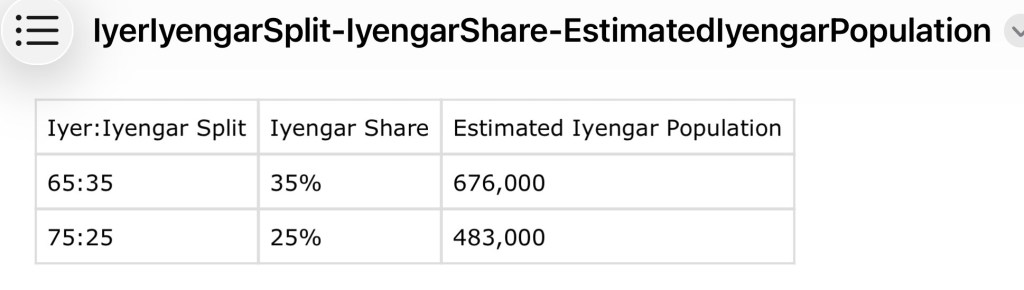
Averaging the direct and split methods gives ~802,000 (65:35) or ~705,000 (75:25).
***** *******
What about the estimate population size of Vadakalai sub-sect ?
Applying further an estimate ratio of the Tenkakai : Vadakalai sub-sect ratio of 70:30, it can be concluded that estimated population of Vadakalai could be +/- circa. 200,000 to 275,000.
So, my original assertion made to my friends — that Ayyangars are demographically and culturally a community in decline — was not far off the mark, was it?
The Ayyangar (Iyengar) community does face demographic decline, driven by low fertility rates, high emigration, and aging populations in traditional strongholds like Tamil Nadu’s temple towns and Brahmin agraharas.
Key Decline Factors
• Migration: Significant exodus to urban centers, metros, and abroad (US, UK) for education and jobs, leaving villages with abandoned homes.
• Fertility below replacement: Like other Tamil Brahmins, Iyengars exhibit rates under 1.9-2.1 children per woman, accelerating shrinkage despite stable or growing state population.
• Cultural shifts: Urbanization erodes traditional practices, with fewer youth marrying within the community or sustaining rituals, compounded by inter-caste unions.
Evidence from Context
This aligns with my prior estimates: a 2004 base of 600,000 projecting to 700k-900k in 2026 ignores outflows, suggesting actual numbers closer to 400k-600k today after net decline. Brahmin neighborhoods near Thanjavur temples are now 30-90% vacant or elderly-occupied.
Sudarshan Madabushi
The Iyer Brahmin community reflects the enduring nature of tradition in a rapidly changing society. Through their commitment to learning, spirituality, and cultural preservation, they have maintained a unique identity within India’s diverse social fabric.
https://www.indianetzone.com/ayyar_brahmin_brahmin_caste