
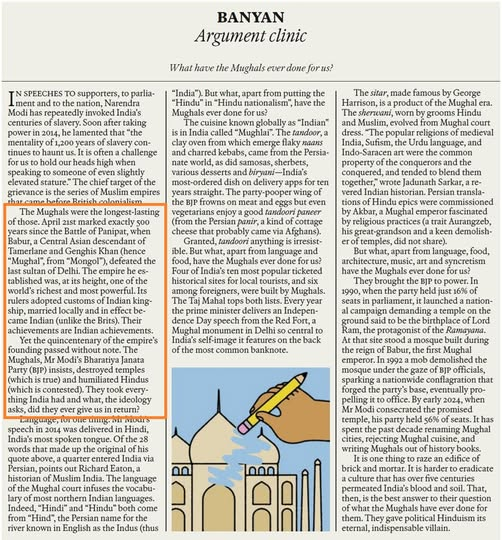
As usual, the UK Economist peddles once again in its columns a perversely colonialist perspective on Indian History. Will some learned Indian historian please impart to these washed up editors of this fossilised imperialistic relic of British journalism, fresh lessons in understanding the nuances of Indian History and Culture?
The Economist suggests that there are several compelling reasons why India ought to mark, remember and commemorate the Quincentenary of the founding of the Mughal Empire in our country : the Op-Ed then goes on to sing praises of how old Mughal gastronomy, music, sartorial style, architecture and other cultural finery are today manifested in Indian lifestyles…
The Economist thus subtly seeks to shame the Indian people and State for its mean-spirit … for not todat acknowledging debt to its Mughal past and historical legacy. What the Op-Ed fails however to understand is that all the reasons trotted out by the Economist cannot cancel out one historically unforgivable and egregiously heinous one. It overrides all others and is the main reason why Indians today feel no obligation at all to express even token pride or to look back upon with even an iota of pride or nostalgia upon the Mughal Dynasty … or to view it even as a part of Indian history without grave misgivings.
That main and overriding reason is this below which The Economist cannot or will not appreciate:
The waning Mughal empire that had enslaved India for over 400 years, in the course of its slow decline, instead of liberating the Indian peoples began however paving the way for them to be enslaved, tyrannised and exploited again for another 250 long years by the British colonialists. It was truly the unkindest cut of all that the Mughal Empire could have delivered upon India ….
If the Mughals had genuinely regarded India, as the Op-Ed implies, to be their own home and adopted native soil and soul, they would have surely made common cause with the Marathas, the Rajputs and the South Indian kingdoms in their campaigns of war to drive out the British from this land. They never did any such thing … Once Bengal and the Doab was lost to the British, the so-called “1856 Indian Sepoy Mutiny” happened and there was clearly told the story of how the Mughal Empire served India verily on a platter to the British Colonialists.
What did the Mughals really do for India? Well, History reveals that they in their terminal reign only hastened and facilitated the eventual British takeover of India thus extending rule and enslavement of we Indians for yet another quarter of a century.
While the East India Company sought expanding rights throughout the mid-17th century, Emperor Shah Jahan issued significant farmans (imperial orders) granting specific trading privileges in 1633, 1634, and notably in 1650 (often confirmed in 1654), which reduced custom duties and broadened the Company’s trading rights in Bengal and other parts of the empire. The company continued to gain more substantial, consolidated rights from later emperors, particularly under Farrukhsiyar in 1717.
Key points related to Shah Jahan’s concessions that paved the way for handing over India from Mughal enslavement to British enslavement:
- 1633-1634: Shah Jahan granted orders allowing the English to trade in Bengal.
- 1650/1654: A major farman from Shah Jahan, often confirmed later, allowed duty-free trade in Bengal, expanding on previous limited permissions.
- Note on Authority: While Emperor Jahangir granted the first major, empire-wide trading, and factory-building rights (1613-1617), Shah Jahan refined and extended these rights to specifically enhance trade in the Bengal region that eventually led to the British colonising nearly all of India.
Despite all the wonderful gifts of cultural life that The Economist Op-Ed enumerates as being exquisite blessings conferred upon India by the Mughals, today we Indians can and will neither forgive nor forget that it was the Mughals who indeed enabled and supported the continued enslavement of India under British Rule long after their own was dead and buried.
The Quincentennary of the beginning of Mughal Rule in India is not a matter about pride for Indians but about national shame and regret.
Sudarshan Madabushi