
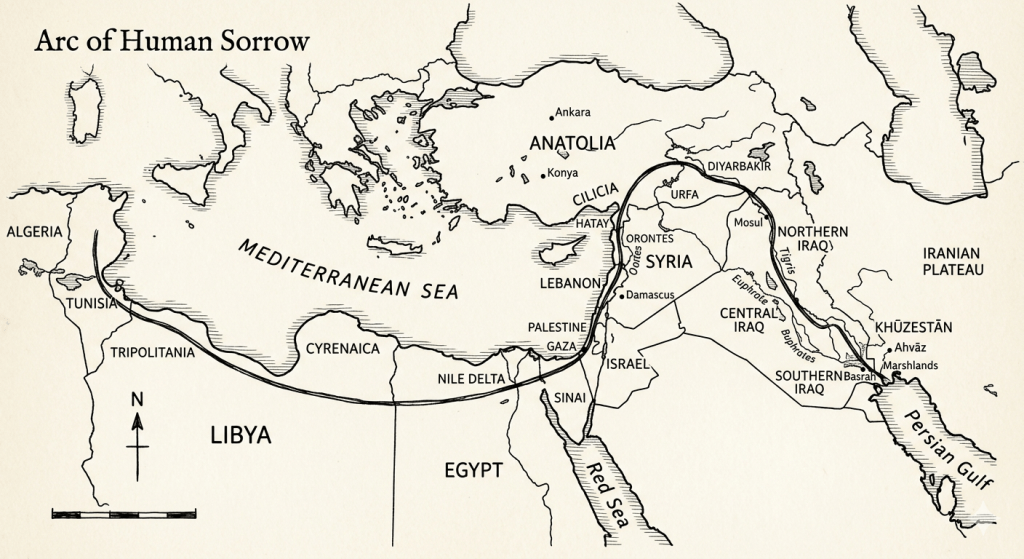
Confronted with such a pattern, it is unsurprising that two great scriptures of the world — one recent in history, and the other very ancient — the Bible and the Bhagavad Gītā speak not in the language of dispassionate geopolitics, but in the idiom of divine justice and cosmic rectification.
It is cruel irony, perhaps, what Jesus Christ said : “Blessed are the Meek for they shall inherit the world”! ….
Well, the Nine-Tenthers have been waiting all through History for the prophecy to be realised. The grim Arc however still prevails …. and the Bible too seems most often as no more than pious imagination.
In Jesus’s context, “meek” did not really mean passive or powerless in the modern sense; it meant the poor in spirit, the dispossessed, and those who refuse to seize the world by sheer force and greed. Yet history has rarely rewarded that restraint with land, oil, or sovereignty; instead, it has often punished it.
The Nine‑Tenths have, in effect, enacted the meekness Christ praised—enduring conquest, extraction, and displacement—while the One‑Tenth, through violence, law‑making, and capital, has written the rules of who “inherits” the earth.
From a purely historical‑political angle, the Bible’s language of blessing and inheritance can sound like a spiritualized consolation for suffering, not a concrete program of structural change. To the oppressed, scripture can feel like a beautiful dream that never quite materializes on the ground.
Many traditions have read this verse differently: not as a promise that the meek will one day conquer like the powerful, but that the world’s true center of gravity will shift—away from brute force, toward justice, compassion, and shared stewardship. In that reading, the “inheritance” is not only territorial or political but ethical and civilizational.
The cruel irony named, however, is not unreal: the meek have waited millennia, and the arc of suffering still curves across the globe. That does make scripture look, at times, like pious imagination—verses that comfort hearts but leave empires intact. Yet the very fact that the Bible’s vision of blessing irritates the raw history of empire—suggests that the text is not entirely dead. It acts like a buried conscience: it cannot by itself dismantle the arc of suffering, but it can keep naming the gap between what is and what ought to be.
Then there is the the wisdom of the Bhagavath Gita.
The Gītā offers no anodyne consolation. When Krishna speaks of “paritrāṇāya sādhuunām, vināśāya ca duṣkr̥tām”—to protect the righteous and to destroy the evildoers—the promise is not that the meek will be comforted in their private hearts, but that, when adharma reaches a critical mass, an avatar will descend to reconfigure the moral order.
The arc of suffering, in this frame, cannot be infinite; it is the very sign of a world tilted toward evil, and thus the very condition that calls forth dharma’s intervention.
Yet the wait continues to be interminable. Empires rise and fall, oceans of blood are spilled, and the arc stretches, generation after generation, as if the avataric promise were written in a script that unfolds on a timescale our mortal eyes cannot grasp.
The Nine‑Tenths, who have lived and suffered as the Gītā’s “sadhus,” may wonder whether the Krishna’s assurance is not postponed indefinitely or encoded in forms they cannot yet recognize: not as a single, dramatic descent, but as the slow, fragmented awakening of conscience in individuals, communities, and movements that refuse to replicate the violence of the One‑Tenths.
In contrast, the New Testament’s vision of meekness—“Blessed are the meek, for they shall inherit the earth”—has often sounded to the suffering as a distant lullaby rather than a clear‑eyed description of history. The Christians of the arc, the Nine‑Tenths of the Levant and Mesopotamia, have for centuries endured the same imperial and sectarian violence, while the earth has been repeatedly inherited by the pushy, the armed, and the imperial. From a purely historical‑political standpoint, the Bible’s promise can appear as pious imagination, a beautiful dream that never quite materializes on the ground.
And yet, the very persistence of this tension—that the arc of suffering endures even as scripture names a different kind of inheritance—suggests that these texts are not merely escapist consolation. They function as a kind of moral counter‑narrative, affirming that the world’s true center of gravity ought to lie with those who refuse to imitate the cruelty of the powerful.
In the Gītā, the avatar is not expected to act alone; it is the context for Arjuna’s own moral awakening, for his decision to engage the world not as a fatalist, but as one who chooses to fight for dharma, even while knowing the cost. In the Bible, the meek are not passive; their blessing is the seed of a future that must be worked toward, even if the historical arc stubbornly resists it.
The “Brave New World” of the 22nd century will be decided less by whether scripture is true or false, and more by how the Nine‑Tenths choose to read such promises—as empty consolation, or as a call to slowly, stubbornly, and collectively reshape the arc itself.
If the arc of suffering is indeed moving, as everything happening today in geopolitics does seem to suggest— from the deserts of the Middle East toward the melting ice of the Arctic — the question for the future will be whether humanity can develop a politics and an ethics that do not simply repeat the One‑Tenths’ old pattern, but instead build a world in which the meek are not only blessed, but genuinely empowered to shape the earth they are promised. The Nine–Tenths of the world will have to turn themselves into an army of a billion Arjunas.
In that sense, the historian’s voice and the prophet’s voice are not in contradiction: the arc of sorrow is real, observable, and recurring, but the very fact that we keep returning to these texts—the Bhagavath Gītā, Bible, and the long arc of history—suggests that the arc itself is not yet the final word.
The arc of human sorrow may be one of history’s most durable features, but the stubborn human habit of imagining, quoting, and wrestling with Sri Krishna and the meekness of the Gospels is a sign that the arc is also, always, under dispute.
(Concluded)
Sudarshan Madabushi