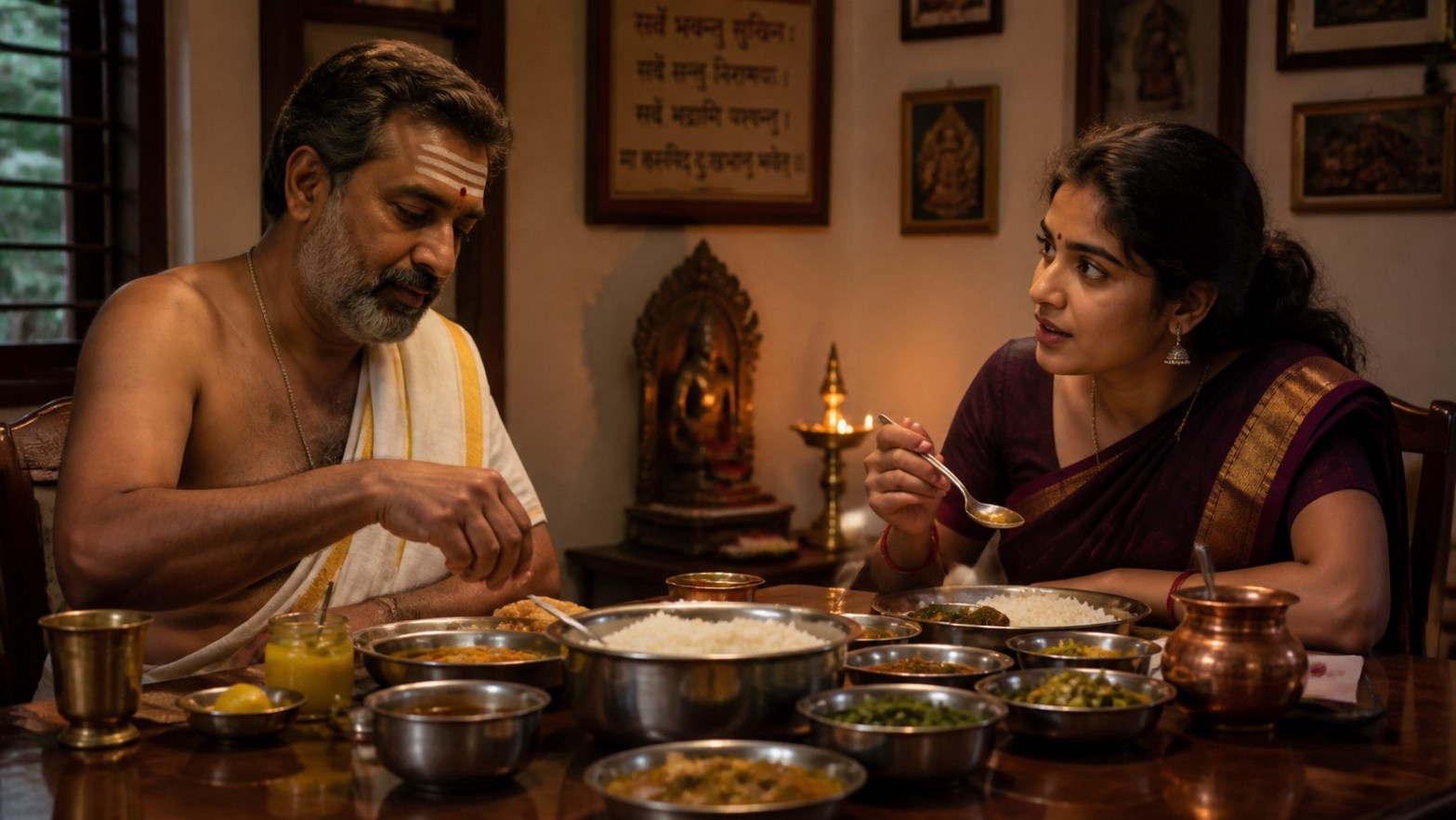
The meal was spread before them on stainless steel plate, an ordinary Brahmin home meal made solemn by habit: rice, sambar, a dab of ghee, some vegetables, and the faint scent of steamed grain rising from the plates.

The father sat down with the quiet composure of long familiarity, and with the same measured movement he had used for years, he performed his ritual over the food. Across from him, his daughter watched him with the kind of attention that comes not from defiance alone but from thought.
“Appa,” she said, after a pause, “I have often noticed that the meal begins differently for men and women in our homes. You sprinkle water, recite the ‘Pariseshana mantra’, and begin in the way prescribed for Brahmin men. But for Brahmin women, you say it is custom that it is enough if they sit down and mentally utter the name of Govinda three times. People say that serves the same purpose. Why this difference?”
He did not answer at once. The fan moved overhead, and in that pause the room seemed to gather the weight of old habits, of domestic rhythm, of a thousand meals passed in the same way.
“Because,” he said finally, “tradition is rarely content to give one reason when it can give three. One is ritual discipline. One is social memory. One is the comfort of inherited arrangement.”
She gave a faint smile. “That sounds like a scholar’s way of saying the matter is old and complicated.”
“It is old and complicated,” he replied. “The male rite belongs to a world in which the man was trained as the visible bearer of Vedic observance. The sprinkling of water, the mantra, the consecration of food, the first offering to the 5 pranas — praana, apaana, vyaana, udaana, samaana— all this formed part of his ritual identity as one who had undergone “upanayana samskaara”… a rite of passage women that for ages has been held women no longer needed to undergo. The woman, in many households, was not excluded from sanctity; she was simply given another mode of entering it.”
She looked down at her plate. “By silently saying Govinda?”
“Yes,” he said. “That is how many families have understood it. The name of Govinda, uttered inwardly, is not treated as less powerful simply because it is quiet. In fact, some would say that the inward name has a gravity of its own. It is not the volume of the mantra that matters, but the sincerity of remembrance.”
She stirred the rice on her plate with her spoon, thoughtful now rather than combative.
“But then why is one form public and formal, while the other is private and almost incidental? The man performs a visible rite; the woman is asked to do it mentally, as though her sanctity should remain unobtrusive.”
He nodded slowly. “There is the heart of your objection. The custom may say that both reach the same end, but it does not distribute visibility equally. One mode is ceremonially foregrounded, the other domesticated. And that difference is not trivial.”
The daughter looked up. “So even if the intention is benign, the structure still carries asymmetry.”
“Yes,” he said. “That is the mark of many inherited arrangements. They do not always deny value to women outright; they often grant it in a quieter register. The question is whether quietness is reverence, or whether it has become a polite form of marginalisation.”
For a moment neither spoke. Outside, a stray vehicle passed, and the sound softened as it moved away. Inside, the meal remained untouched except for the steam dissolving into air.
“In a modern feminine reading,” she said at last, “this feels like gendered partitioning of ritual power. The man gets the full visible act. The woman gets the inward substitute.”
He folded his hands briefly before taking in the first morsel of food from his plate.
“That is a fair reading. It may be defended as tradition, but it cannot be denied as unequal in form. Yet one must also recognize that many women accepted the inward Govinda not as a second-best concession, but as a different path of remembrance. For them, the name itself was the ritual.”
She was silent for a while, then smiled with a mixture of irony and affection.
“So the tradition protects itself by saying the hidden thing is as good as the public thing.”
“Sometimes that is true,” he said.
“Sometimes it is only what custom says to preserve its own peace. But the devotional heart has always had a way of escaping rigid form. The Lord is not bound by whether the invocation is spoken aloud or inwardly. The problem is not with Govinda’s name. The problem is with the hierarchy built around who must say it how.”
She looked at him steadily now. “Then can we say that the ritual language is different, but the yearning is the same?”
“We can say that,” he replied. “And if we are honest, we must also say that equality asks a further question: why should the yearning be given less ceremonial dignity in one case than in the other? That is where modern conscience presses tradition to explain itself.”
The room had grown warmer with the meal, with the smell of ghee, curry leaves, and rice. The tumbler of water stood like a small witness between them.
“Perhaps,” she said, “the true issue is not whether women need purification. It is whether their way of purifying should be considered complete only when it resembles men’s.”
He looked at her with quiet approval.
“Indeed,” he said. “That is the question. And it is not small. For once a tradition begins to think that one sex must perform holiness visibly while the other may be satisfied with silence, it must ask whether it is preserving dharma — or merely preserving custom-built habit.”
He then ate quickly from his plate, and proceeded silently to finish the meal, and his voice then softened.
“Still, the old homes were not built without feeling. There is affection in these customs, even when there is asymmetry. There is memory, tenderness, and the wish to place the act of eating itself under divine recall. But tenderness alone cannot settle the issue. One must also look at justice.”
She too gave a small nod, and with that the conversation settled into the room like sweet-smelling incense smoke settling into cloth.
The meal continued, but it had changed. It was no longer only a meal. It had become a quiet generational argument between inheritance and conscience, between inward devotion and visible authority, between the old assurance of custom and the modern demand that sanctity not be distributed by gender alone.
And over the table, above the steam and the silence, the name of Govinda seemed to linger — spoken in some homes aloud, in others only inwardly, but everywhere meant to gather the heart before the first mouthful.
Sudarshan Madabushi