
-Part I–
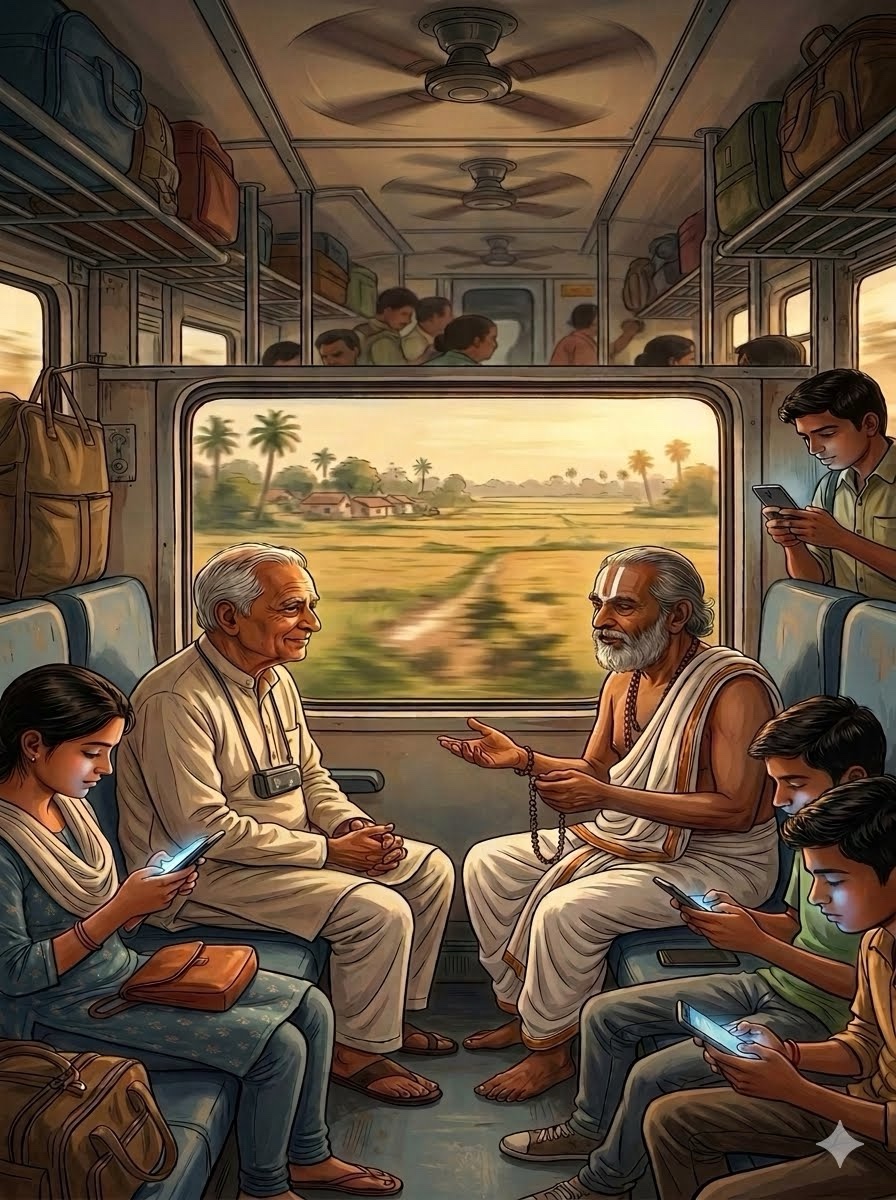
The train was already moving past the suburbs when Krishna looked up from the window and sighed.
“Look at them,” he said softly. “All these young people seated so close to one another, and yet each seems miles away. No one speaks. Their eyes are lowered, their thumbs are busy, and their faces are lit by tiny screens.”
The Unknown Sri Vaishnava smiled faintly. “They are not alone, Krishna. They are with everyone and with no one.”
Krishna nodded. “A strange age. In my youth, one needed courage to make a friend. One had to offer time, attention, and some part of one’s soul. Now friendship is made with a tap. It is so easy to add, follow, connect, and so difficult to know whether one has met another human being at all.”
The old Vaishnava leaned back, listening to the rattle of the carriage. “Aristotle would have frowned at this. He is remembered for saying, ‘What is a friend? A single soul dwelling in two bodies.’ The line is often quoted as if friendship were a mystical fusion, but Aristotle’s own deeper view is sterner: true friendship is grounded in virtue and the wish for the other’s good.”
Krishna smiled. “Then he did not romanticize friendship; he purified it.”
“Exactly,” said the Unknown Sri Vaishnava. “He made it morally demanding.”
At the far end of the compartment, a group of young passengers laughed at something on one phone, then returned at once to silence.
Krishna observed them for a moment longer. “And Sartre?”
The elder answered, “Sartre’s famous line is, ‘L’enfer, c’est les autres.’ In English, ‘Hell is other people.’ He did not mean that every human being is a demon. He meant that the gaze of the other can become a prison, a judgment, a trap.”
Krishna nodded. “So the young prefer screens because screens look back less harshly.”
“Perhaps,” said the Unknown Sri Vaishnava. “The screen offers contact without full exposure. It gives company without presence. It gives strokes, but not the discipline of love.”
Krishna turned back to the window. “Then friendship has become light enough to carry, but too light to sustain.”
The elder replied, “And yet their age has taught them to mistrust what is heavy. The family is less stable, work is uncertain, and life itself appears fragmented. So they choose what is reversible.”
Krishna said quietly, “Then the old ideals have not vanished because they were false. They have faded because the world no longer trains souls to inhabit them.”
-Part II-
The train had entered open country. Fields passed by in long, green strokes, and the compartment grew quiet except for the hum of the wheels.
The Unknown Sri Vaishnava broke the silence. “Still, Krishna, perhaps we should not be too harsh. These devices do not create emptiness by themselves. They only magnify what is already there.”
Krishna thought for a while. “True. A tool can only reveal the condition of the hand that uses it. But tell me, what do you see in these faces?”
“I see longing,” said the old Vaishnava. “But it is longing educated into caution. They want recognition without exposure, closeness without cost, intimacy without dependence. The Facebook way of friendship suits them because it asks so little and promises so much.”
Krishna laughed quietly. “Then the modern friend is one who can be present and absent at the same time.”
“Yes,” said the Vaishnava. “A relationship of perpetual availability and permanent escape.”
Krishna’s expression grew thoughtful. “Arjuna would not have understood such a relation. Krishna says to him in the Gita:
स एवायं मया तेऽद्य योगः प्रोक्तः पुरातनः ।
भक्तोऽसि मे सखा चेति रहस्यं ह्येतदुत्तमम् ॥ ४.३ ॥”
“sa evāyaṁ mayā te ’dya yogaḥ proktaḥ purātanaḥ |
bhakto ’si me sakhā ceti rahasyaṁ hy etad uttamam || 4.3 ||”
Then Krishna added the gist: “This ancient yoga has today been taught to you because you are My devotee and My friend; this is the supreme secret.”
The Unknown Sri Vaishnava folded his hands. “That kind of friendship is not light-touch. It is not convenience. It is guidance, surrender, intimacy, and truth together.”
“For that reason,” Krishna said, “our age is content with the virtual because the virtuous is too demanding. Yet what is gained in ease is lost in depth.”
The elder looked at the young passengers one last time. “And Eric Berne would perhaps say that these new forms of connection are built from transactions of strokes, recognition, and roles. Helpful enough at a surface level, perhaps, but often too shallow to become the stable, mutual exchange that real friendship needs.”
Krishna smiled gently. “Yes. Transaction Analysis may explain the mechanics, but not the mystery. It tells us how people exchange attention, approval, and response; it does not by itself teach them how to become friends in the highest sense.”
The old Vaishnava nodded. “So Aristotle asks for virtue, Sartre warns of the trap, Berne shows the hidden transaction, and the Gita raises friendship into a path of truth.”
Krishna said softly, “Then the task, my friend, I believe is not to condemn the young. It is to remember that friendship was once believed to be a way of becoming more human, not less.”
The train rolled onward, carrying the two old friends through the afternoon, while around them the younger generation continued to scroll, tap, smile briefly, and drift through a thousand near-encounters without ever quite arriving.
( End of Dialogue)
Sudarshan Madabushi
PS: The above imagined Dialogue was inspired by this thought-provoking Op-Ed piece I happened to read today.