
Preamble: Fifty Years of the Same Observation
In 1964, V.S. Naipaul arrived in India for the first time—a Trinidadian writer of Indian ancestry returning to his ancestral homeland. What he found shocked him. In his travelogue An Area of Darkness, he wrote a passage that would become infamous:
“Indians defecate everywhere. They defecate, mostly, beside the railway tracks. But they also defecate on the beaches; they defecate on the hills; they defecate on the river banks; they defecate on the streets; they never look for cover.”
Naipaul wasn’t just observing a sanitation problem. He was documenting a cultural trait. He wrote about groups of women “companionably defecating” and giggling when surprised. He described how tourists on Shankaracharya Hill in Srinagar used the lower slopes as latrines. In Madras bus stations, travelers would “raise his dhoti, defecate in the gutter,” then board the bus while a woman sweeper cleaned up after him.
Most strikingly, Naipaul noted that defecation was a “social activity”—people would squat close together, chatting, then wade into rivers “trousers still down, backsides bare” to wash themselves. When confronted, one young Muslim student explained that Indians were “poetic people” who loved nature; squatting on a riverbank at dawn was “poetic.”
Fifty years later, in 2026, we must ask: Has anything truly changed?
The Swachh Bharat Mission: Movement or Mishmash of Claims?
When Prime Minister Narendra Modi launched the Swachh Bharat Mission (Clean India Mission) on October 2, 2014—the 145th birth anniversary of Mahatma Gandhi—it was billed as nothing less than a national movement. The premise was noble: fulfill Gandhi’s dream of a clean India. The rhetoric was grandiose.
The program’s achievements, however, are far less spectacular than the official narrative suggests.
Official Claims vs. Ground Reality
Metric Official Claim Independent Reality Toilets built 100 million household toilets 100 million built (agreed) ODF declaration India declared ODF in October 2019 ODF status not verified independently Open defecation 0% (declared eliminated) 17–52% still practice it Rural toilet usage 96% usage rate ~48% actually use toilets Population served 600 million given toilet access Toilets exist, usage varies
The WHO/UNICEF 2022 report delivered an uncomfortable truth: while toilets were built, they are not all being used. The government’s claim that rural sanitation coverage increased from 39% to 100% is contradicted by independent research showing that 52.1% of rural population still defecates in the open despite the ODF declaration.
The Bill & Melinda Gates Foundation honored Modi in September 2019 for the sanitation achievement. But the gap between infrastructure built and behavior changed remains the program’s Achilles’ heel.
Where We Stand in 2026
The reality in 2026 is sobering:
- Rural Open Defecation Persists: According to WHO/UNICEF 2022, while India scored a “major developmental victory by providing 600 million people with access to toilets,” the problem is not simple installation. Independent surveys show 17% of rural Indians still practice open defecation, with some studies indicating figures as high as 52%.
- Cultural Norms Remain Unchanged: The deep-rooted cultural attitudes Naipaul documented persist. Open defecation is still seen as “healthier, cleaner, and sometimes religiously acceptable” by many rural communities. The belief that toilets cause “clogging” or that open defecation is “more hygienic” survives despite decades of awareness campaigns.
- Social Activity Continues: The social nature of open defecation that Naipaul observed—people defecating together, chatting companionably—has not been disrupted by toilet construction alone.
- Phase 2 Reveals the Truth: The government’s own Swachh Bharat Mission Phase 2 (2020–2025) explicitly acknowledged that further work was needed. Phase 2’s focus on “waste segregation and further eliminating open defecation” is itself an admission that the first phase was incomplete.
The Real Challenge: Transforming Cultural Mindsets
The fundamental problem is not infrastructure—it’s mindset. This is what Naipaul captured in 1964 and what remains true in 2026:
The “Poetic” Argument
Indians are “poetic people who love nature”—this romanticization of open defecation as connected to nature persists despite scientific evidence about fecal contamination of water and food.
Ritual Purity
The caste-based concepts of purity and pollution contribute to the problem. Paradoxically, the same cultural logic that keeps homes clean by moving defecation outside is what perpetuates open defecation. Recent research shows an association between local practice of untouchability and open defecation rates.
Civic Sense Gap
As Nirad C. Chaudhuri observed about Calcutta’s residents, even when municipal sanitation services are effective, there’s an absence of civic sense. Chaudhuri wrote: “A man who cannot endure dirt, dust, stench, noise, ugliness, disorder, heat, and cold has no right to live in India.” A man who defecates in a gutter at a bus station and boards the bus while a sweeper cleans up after him is not lacking infrastructure—he’s lacking civic consciousness.
The Vande Bharat Paradox
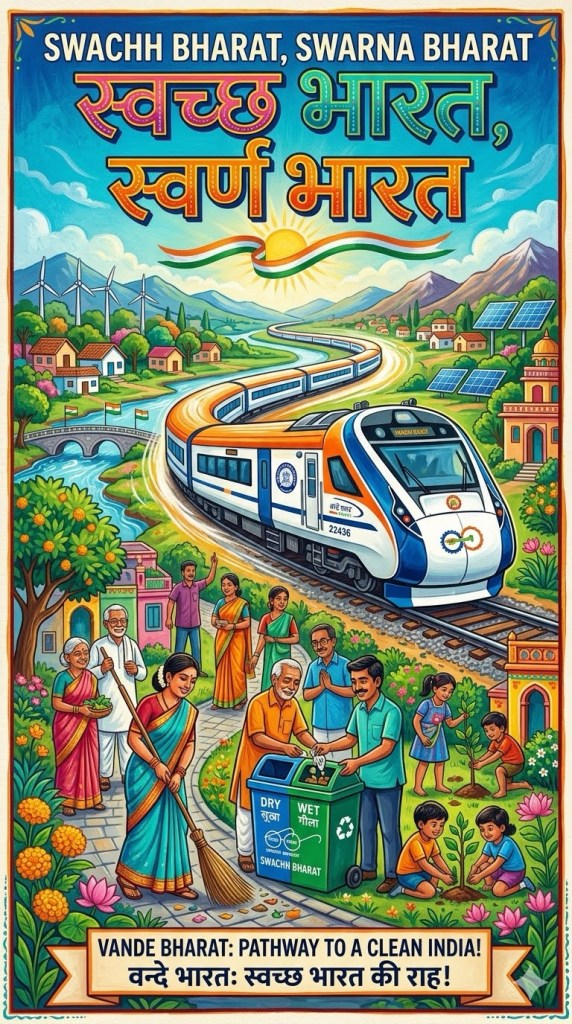
This is where the irony bites hardest. Today, India boasts Vande Bharat Express trains—semi-high-speed, air-conditioned, app-enabled coaches with modern toilets. These trains represent India’s technological ambition, its desire to be seen as a 21st-century power.
But passengers boarding these trains often come from villages and towns where open defecation remains normal. They travel on platforms that may be cleaner due to Swachh Bharat funding, but the behavioral transformation is incomplete. The contrast between the gleaming Vande Bharat train and the reality of its passengers’ lives is stark: we have the technology, but not the cultural mindset to match it.
The trains may at times still seem a bit “Gandhā Bharat”—where Gandhi’s dream of cleanliness remains unfulfilled despite the infrastructure.
What Would It Take?
Research shows what actually works:
- Information + Subsidies: Studies show that awareness campaigns combined with subsidies reduce open defecation from 98% to 4%. Education about health risks, paired with financial support, works far better than infrastructure alone.
- Community-Led Total Sanitation: When communities collectively decide to stop open defecation and shame becomes social pressure rather than individual defiance, behavior changes.
- Caste Reform: The culture of purity, pollution, and untouchability must be addressed. Open defecation is not just a sanitation problem—it’s a caste problem.
- Civic Education: Tolerance for disorder must be replaced with civic responsibility.
The Road Ahead: From 2026 to Someday
In 2026, we stand at a crossroads. The Swachh Bharat Mission built the toilets. The Vande Bharat trains demonstrate technological capability. But the cultural transformation—the road from Gandhā Bharat to Vande Bharat—remains untraveled.
Mahatma Gandhi’s vision was not just about clean streets or functioning toilets. It was about self-reliance, dignity, and civic conscious.
Sudarshan Madabushi
(The author is a writer and researcher interested in Indian cultural history, contemporary politics, philosophy, religion. This piece highlights the gap between infrastructure and behaviour and is a reflection on the persistence of cultural norms despite technological and policy interventions).
Thanks a lot. Well said. Very true. The claims about the success of Swachh Bharat appear to be highly exaggerated. Barring very few public places, many places are still dirty . Unless there is a change in the mindset, cleanliness and hygiene everywhere will only be a dream.