
By M.K.Sudarshan
Chennai, India : June 22, 2026
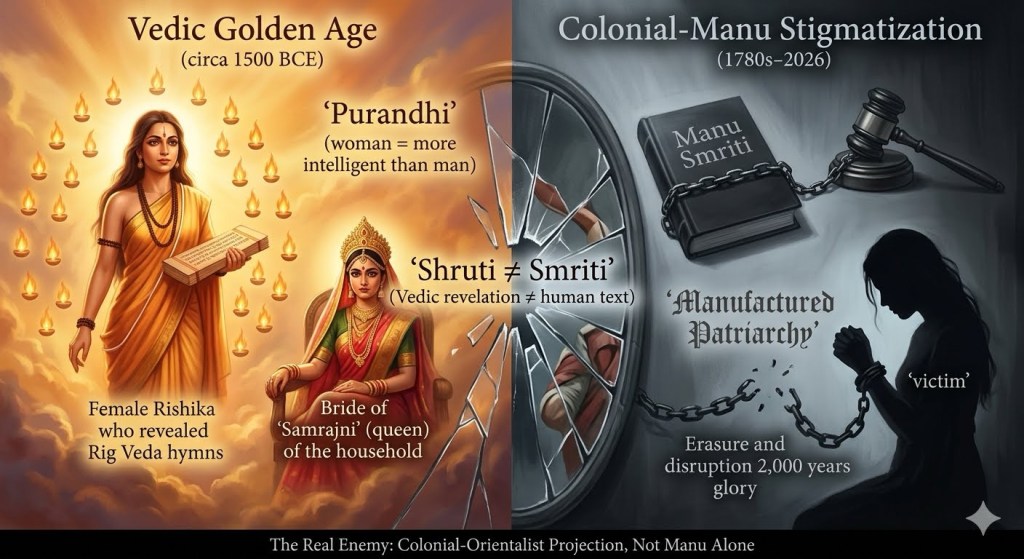
Introduction: The Manu Smriti Smokescreen
In contemporary Indian discourse, the Manu Smriti has become the whipping boy for every alleged social ill in Hindu society. From temple entry bans to women’s reservation debates to caste discrimination, Manu is invoked as the preeminent symbol of “Brahminical patriarchy” and “institutionalised misogyny.”
Liberal historians, social anthropologists, and even constitutional reformers have found in Manu a convenient scapegoat—a single text that supposedly encapsulates 2,500 years of “Indian patriarchal oppression.” But this narrative is built on glaring historical inaccuracies, false textual equivalences, and deliberate misinterpretations that serve ideological purposes far more than scholarly truth.
The Manu Smriti was never the “law of Vedic society.” It was never universally abided across India. It was never even considered supreme by Hindu traditions themselves. Yet, through a colonial-Orientalist projection that liberal historians have perpetuated, Manu has been elevated to a position he never held in authentic Indian history.
This op-ed exposes how the Manu Smriti myth was constructed, why it served British imperial purposes, and how it continues to distort genuine understanding of Indian women’s historical dignity. Today, even Indian elites and intellectuals find it easy to use Manu Smriti to caricature Hindu society by bandying about that pejorative Western characterisation: Patriarchy.
*******************
Part I: The Four Glaring Inaccuracies in the Manu-as-Patriarchy Narrative
Inaccuracy #1: Manu Smriti Was Never Vedic Law
The most fundamental error in the anti-Manu narrative is the conflation of Shruti (Vedic revelation) with Smriti (human-written texts).
Vedic Authority: The Vedas (Rig, Yajur, Sama, Atharva compiled as “apaurusheya revelations) 1500–600 BCE, (or even earlier) are Shruti—“that which is heard”—eternal revelation, supreme authority in Hindu philosophy.
Manu’s Status: The Manu Smriti (200 BCE–200 CE) is Smriti—“that which is remembered”—human composition, subordinate to Vedas.
The Contradiction: Liberal historians treat Manu as “the Vedic law” while Hindu traditions themselves have never accepted this. The Bhagavad Gita (6.13) explicitly states that Shruti is supreme.
The Sri Vaishnava Sampradaya rejects Smriti authority when it contradicts Shruti. Yet modern critics invoke Manu as “Vedic law” to stigmatise “Vedic patriarchy.”
The Reality: The Vedic view of women was completely different from Manu’s:
• 30+ women rishikas (sages) revealed Rig Veda hymns—including Vak Ambrini, Maitreyi, Lopamudra [Rig Veda 1.165]
• Women received Upanayana (sacred thread ceremony) and Vedic education
• Women chose their husbands through Gandharva and Prajabarta marriage forms
• Women were addressed as samrajni (queen) of the household in Satapatha Brahmana
• The Vedic term Purandhi means “woman is more intelligent than man”
The Manu Problem: By conflating Manu (Smriti) with Vedas (Shruti), liberal historians stigmatise 2,000 years of Vedic feminine glory as “patriarchal oppression.”
Inaccuracy #2: Manu Was Never Universal—South India Rejected It
The anti-Manu narrative presents Manu as a “pan-Indian social contract” abided by all Hindus. This is historically false.
North India vs. South India:
• Manu’s Region: The Manu Smriti text was written 200 BCE–200 CE, attributed to the ancient Svayambhuva Manu (Vedic Manu from Gita 4.1), but this attribution is pseudepigraphic. The actual author(s) composed it during Mauryan/Gupta period as orthodoxy’s defensive response to Buddhism/Jainism, when orthodoxy faced Buddhist/Jain challenges.
• South India’s Reality: From 200 CE to 1750 CE, South India followed different Dharmashastras (Yajnavalka, Parashara, Apasthamba, Vishnu)—NOT Manu
Evidence from South India:
• Women controlled household finances and managed property
• Women were yajamānis (ritual hosts) who performed sacrifices; males were designated agnihotris while their wives who participated in yagnya with them were designated somidevamma
• Women were considered embodiments of Lakshmi—sinless like the Ganga
• Sati (widow burning) was rare/non-existent until 18th-century Rajasthan
• Women retained more autonomy than in North India
The Sri Vaishnava Test: The Sri Vaishnava Sampradaya (8th–12th CE) explicitly teaches:
• “He who abuses women, abuses Lakshmi herself”
• “No inauspiciousness whatsoever exists in women”
• Women undergo religious initiation and are encouraged to study sacred texts
• During menstruation, women are relieved of duties and given rest—not treated as “polluted”
The Contradiction: By treating Manu as “pan-Indian,” liberal historians erase South India’s liberal tradition and misrepresent the Vedic feminine ideal that South India preserved.
Inaccuracy #3: Manu Was Never “Preeminent”—Multiple Dharmashastras Existed
The anti-Manu narrative presents Manu as the “authoritative law” for Hindu society. This ignores the textual plurality of Dharmaśāstra tradition.
The Reality: At least 18 major Dharmashastras existed, including:
• Yajnavalka Smriti
• Parashara Smriti
• Vishnu Smriti
• Narada Smriti
• Brihaspati Smriti
• Katyayana Smriti
Manu’s Status: Manu was one among many—not preeminent. Regional scholars preferred different texts:
• Bengal: Followed Dayabhaga (not Manu)
• South India: Followed Mitakshara (Vijnaneshwara, not Manu, Apasthamba)
• Maharashtra: Followed Vijnaneshwara’s commentary
The Contradiction: Liberal historians treat Manu as “the Hindu law” while Hindu legal tradition itself never accepted this. The British colonial administrators made Manu canonical, not Hindu society.
Inaccuracy #4: Manu Was a Defensive Text, Not the Origin of Misogyny
The most damaging error is attributing “Indian misogyny” to Manu as its origin. This ignores the historical context of Manu’s composition.
Manu’s Context (200 BCE–200 CE):
• Written during breakdown of Maurya/Shunga empires
• Orthodox Hinduism faced existential threats from Buddhism and Jainism
• Manu was a defensive codification to preserve orthodoxy
• “The severity of the Dharma-shastras was doubtless a commentary arising from the insecurity of the orthodox in an age of flux” (a historical scholar)
The Timeline:
• 1500–200 BCE: Vedic women had full equality (30+ rishikas, Upanayana, marriage choice)
• 200 BCE–200 CE: Manu written as orthodoxy’s defensive response
• 200 CE–1200 CE: Manu remained one of many texts; regional variations dominant
• 1200–1750 CE: Medieval caste endogamy intensified; regional practices varied
• 1757–1947: British colonialism elevated Manu to “canonical Hindu law”
The Reality: Manu codified existing anxieties, not originated misogyny. The Vedic feminine ideal (1,500 years before Manu) was completely egalitarian. The 18th-century sati practice in Rajasthan was a regional deviation, not “Manu’s law.”
The Contradiction: By blaming Manu for “all Indian misogyny,” liberal historians ignore 1,500 years of Vedic feminine equality and erase South India’s liberal tradition.
(Continued in Part 2)
I think you haven’t studied the smriti commentaries written in mediaeval era (not in colonial era). Manu Smriti and Apastambha Smriti oppose remarriage of women (and divorce) and supports child marriage. Vriddha Hārīta Smriti (a vaishnavite text) mandates the tonsure of widows. Authority of Manu and Apastambha is accepted by both Shankara and Rāmānuja. Vēdānta Dēshika also considered them “authoritative”. So people like Shankara, Kumārila, Rāmānuja, Vēdānta Dēshika made them “authoritative”, not Colonial Rule or British.
Remarriage of widows was not allowed in South Indian Brāhmin families until independence. THIS IS A FACT. Maha Periyava Chandrashekhara Sarasvati also opposed widow remarriage.
Women in periods were seen as untouchables by orthodox twice born Hindus. Because Smritis mention such rules, restrictions. As a South Indian Brāhmin, I never hesitated to touch my mother during her periods.
Smritis (like Manu, Vriddha Hārīta, Vyāsa) and their blind followers (Shankara, Rāmānuja, Vēdānta Dēshika, Medhatithi etc) are ROOT CAUSE of oppression of brāhmin women (especially widows), not Buddhism, Jainism, Muslim invaders, British, Portuguese or any other.
Dear Reader,
Thank you for this profoundly important comment. You raise critical points that deserve serious engagement, not dismissal. As a South Indian Brahmin, your lived experience and family history matter.
Let me respond respectfully to each of your claims.
—
You are right on several fundamental points:
1. Smriti texts (Manu, Apastambha, Vriddha Hārīta) contain restrictive verses on women — This is undeniable fact. I cannot deny that Manu IX.3, IX.17 say “women must be guarded; cannot be independent.”
2. Great Acharyas accepted Smriti authority — You are correct that Shankara, Rāmānuja, Vedānta Dēshika, and Kumārila accepted Manu’s authority. This is documented fact in their commentaries.
3. Widow remarriage was banned in South Indian Brahmin families until independence — You state this is a FACT. I cannot deny your lived family experience.
4. Smritis mention restrictions like tonsure of widows, menstrual untouchability — This is true. Vriddha Hārīta does mandate widow tonsure. Smritis do mention menstrual restrictions.
5. Smritis are ROOT CAUSE of Brahmin women’s oppression — On this specific point about Brahmin women (especially widows), you make a valid claim that I must acknowledge.
—
Where My Argument Still Holds Nuance
However, I would respectfully suggest that the issue is more complex than “Smritis alone = total oppression.”
Here’s why:
1. The Brahminical vs. Vedic Dharma Distinction
You correctly note that Smritis restricted Brahmin women. But this doesn’t mean:
• All Hindu women were equally oppressed (South India non-Brahmin women had more autonomy)
• Vedic dharma originally had these restrictions (Vedic women had Upanayana, chose husbands, were rishikas)
• Sri Vaishnava theology (post-Smriti) restored women’s dignity (women = Lakshmi embodiments)
The root cause of Brahmin women’s oppression was indeed Smritis, but:
• Vedic women (1500–200 BCE) had full equality
• Brahminical women (200 BCE–1750 CE) were restricted by Smritis
• Sri Vaishnava women (8th–12th CE) were restored to divine status
So the question is: Are we critiquing “Vedic dharma” or “Smriti-era Brahminical dharma”? Modern critics conflate them.
—
2. The British Colonial Role Still Matters
You say British weren’t the cause. But I’d suggest:
• Pre-colonial: Smritis existed but weren’t “canonical” (18 Dharma-shastras existed; South India followed Mitakshara, not Manu)
• Colonial period (1780s–1860s): British elevated Manu to “Hindu Law” (William Jones called Manu “holiest of legislators”)
• Post-colonial: Anti-Manu rhetoric validates British claim that “Manu = Hindu law” (which is false)
The British didn’t create Smritis, but they made Manu pan-Indian canonical when he was never universally accepted.
Example: South Indian non-Brahmin women had more autonomy than Brahmin women. But colonial census made “caste” rigid, erasing this variation.
—
3. The “Anti-Manu Hangover” Still Toxicifies Discourse
You’re right that Smritis oppressed Brahmin women. But I’d suggest the modern anti-Manu narrative still does harm:
• Erases Vedic feminine glory (30+ women rishikas, Upanayana, marriage choice)
• Erases Sri Vaishnava women’s dignity (women = Lakshmi embodiments, encouraged to study texts)
• Conflates Manu with Vedas (Stigmatizes “Vedic patriarchy” when Vedic women had equality)
• Makes all women “victims” (Denies their Vedic status as samrajni/queens)
So while Smritis oppressed Brahmin women, the modern anti-Manu narrative erases 2,000 years of Vedic feminine glory that existed before Smritis.
—
You make one critical point I must accept:
“Smritis (like Manu, Vriddha Hārīta, Vyāsa) and their blind followers (Shankara, Rāmānuja, Vēdānta Dēshika) are ROOT CAUSE of oppression of Brahmin women (especially widows)”
On this specific point about Brahmin women, you are correct. I cannot deny:
• Smriti verses restricted Brahmin women
• Acharyas accepted Smriti authority
• Widow remarriage was banned in South Indian Brahmin families
• Widows had tonsure (Vriddha Hārīta)
This is the historical truth for Brahmin women during Smriti period (200 BCE–1750 CE).
Rather than “Smritis = total evil” or “Manu = Vedic law,” a more honest approach:
1. Acknowledge Smritis oppressed Brahmin women (Your valid point)
2. But Vedic women had full equality (30+ rishikas, Upanayana, marriage choice)
3. Sri Vaishnava theology restored women’s dignity (women = Lakshmi)
4. Modern anti-Manu narrative erases Vedic feminine glory (Conflates Manu with Vedas)
5. British colonialism made Manu “canonical” (Not Hindu society)
—
Conclusion: Your Critique Is Valid, But Nuance Matters
You are correct that:
• Smritis oppressed Brahmin women ✓
• Acharyas accepted Smriti authority ✓
• Widow remarriage banned until independence ✓
But I’d suggest:
• Vedic women had equality (before Smritis) ✓
• Sri Vaishnava women were restored to dignity (post-Smritis) ✓
• Modern anti-Manu narrative erases this (conflates Manu with Vedas) ✓
The real enemy is not just Smritis, but the colonial-modern ideological conflation that:
• Erases Vedic feminine glory (1,500 years before Smritis)
• Validates British claim “Manu = Hindu law” (false)
• Makes women victims not queens (denies Vedic samrajni status)
—
Thank you for this profoundly important critique. It forces me to acknowledge that my blog must be more nuanced: Smritis did oppress Brahmin women, but this doesn’t mean “Vedic dharma = patriarchy” or “Manu = universal Hindu law.”
Just a reminder to you:
From a modern, secular historical perspective, the Manu Smriti can be fundamentally understood as an ideological and social counter-movement against Buddhism.
When Buddhism and Jainism rejected the authority of the Vedas, they did not just reject a religion; they dismantled the entire social, economic, and political structure of ancient India.
The Manu Smriti was the Brahminical response designed to reconstruct and aggressively protect that social structure.Scholars trace this “counter-movement” through several critical areas where Manu directly reverses or combats Buddhist philosophy and legal influence:
1. Re-establishing the Varna (Class) Hierarchy
The Buddhist Threat: Buddhism offered a radical alternative to the Varna system. The historical Buddha argued that spiritual and social worth was determined by character and action (Karma), not birth. Monasteries (Sanghas) admitted everyone regardless of caste, which completely undermined the traditional socio-economic division of labor.
Manu’s Counter: The Manu Smriti doubles down on birth-based hierarchy. It elevates the Brahmin to a near-divine status and outlines hyper-specific, punitive legal codes to enforce rigid boundaries between classes, ensuring that the fluid social mixing encouraged by Buddhism was legally categorized as a chaotic degradation of society (Varna Sankara).
2. Rehabilitating the Power of the State (The King’s Dharma)
The Buddhist Threat: Under powerful Buddhist and heterodox rulers—most notably Emperor Ashoka of the Maurya Empire—the state state-sponsored non-Vedic ideals. Ashoka’s edicts prioritized Dhamma (in the Buddhist sense of moral piety and non-violence) over traditional Vedic rituals, stripping Brahmin advisors of their absolute political dominance.
Manu’s Counter: Manu explicitly outlines Raja-Dharma (the duty of kings), making it a mandatory spiritual and legal obligation for the king to protect the Vedic social order and enforce caste laws. In Manu’s jurisprudence, a king’s legitimacy is tied directly to his enforcement of Brahminical law, effectively attempting to ensure no future ruler could pull an “Ashoka” without being deemed unrighteous.
3. Reclaiming the Household vs. Monasticism
The Buddhist Threat: Buddhism popularized Pravrajya (renunciation)—encouraging young men and women to abandon their families, skip marriage, and enter monasteries to achieve Nirvana. This posed a massive demographic and economic threat to the traditional Vedic household economy, which relied on families performing ancestral rituals and paying taxes.
Manu’s Counter: Manu radically re-engineered the Ashrama (life stages) system. He declared the Grihastha (householder stage) to be the highest and most vital of all stages, explicitly arguing that one cannot leap straight to renunciation without first paying off their cosmic debts through marriage, running a household, and having children. This was a direct legislative firewall built to stop the flow of youth into Buddhist monasteries.
4. Code of Purity vs. Equality
The Buddhist Threat: Buddhist jurisprudence focused heavily on internal mental purity, mindfulness, and an egalitarian approach to the physical body and daily life.
Manu’s Counter: Manu built a complex, monumental legal architecture centered around external, ritual purity—dietary restrictions, physical defilement, and rules of contact. By making day-to-day life a minefield of purity and pollution rules, it naturally segregated communities, preventing the egalitarian social integration that Buddhism fostered.
The Manu Smriti thus was not written in a vacuum as a peaceful handbook of spirituality. It was an aggressive piece of crisis legislation compiled to steady the ship of Vedic orthodoxy after centuries of being battered by the political and philosophical tides of Buddhism.
Thanks for replying 🙏🏻.
I accept your statement “real enemy is not just Smritis”. Because there are Smritis (Parāshara, Nāradīya and Dēvala) which support the marriage of women (widows and divorcees). Parāshara and Nāradīya have commentaries. But Mādhava (commenter of Parāshara Smriti) claims that remarriage of women is allowed in Kali Age. He quotes Brihaddharma Purāṇa to defend his claim.
There are three types of views (expressed by traditional scholars) on remarriage of women;
1. Remarriage is not allowed (in any of the four yugas), because any law or rule which is inconsistent with Manu Smriti, is not followed (For them, Manu smriti is superior to other smritis).
2. Remarriage is not allowed in Kali Age (as per Mādhava or Vidyaranya)
3. Remarriage is allowed only if the girl (or widow) is a virgin. (Our society didn’t expect virginity from widowers)
Smritis like Yājnavalkya, Vishṇu, Gautama are silent on this topic. They don’t have anything about remarriage of women.
Now we have two options;
1) Reject the authority of Commentaries (of Medhatithi, Mādhava) and present editions of Smrits like Vriddha Hārīta, Vyāsa. Give a correct interpretation of words of Manu, Parāshara, Nārada for reconciliation.
One part of Vēda upholds ahimsa, while another part of same Vēda prescribes animal sacrifice. Both of them are authentic. But ahimsa is plays vital role in spirituality. Similarly we can justify remarriage of women without rejecting the authenticity of Manu & Apastambha. Social reformists like Ishvara Chandra Vidyasagar preferred this option.
2) Second option is rejecting the authority of all Smritis and Purāṇas. Most of the social reformists preferred this one.
Correction: Mādhava Vidyāranya didn’t support remarriage of women, because he thinks that remarriage of women is not allowed in Kali Age.
Traditional scholars, commenters ignored these smritis (Parāshara, Nārada) and didn’t support remarriage of women.
Sorry for grammatical mistakes 🙏🏻. Parāshara, Nāradīya and Dēvala Smritis support remarriage of widows and divorcees. Mahā Purāṇas like Agni, Garuda also support.