
By M.K.Sudarshan
Chennai, India : June 22, 2026
Part II: How British Colonial Orientalism Made Manu “Canonical”
The British Imperial Purpose
The elevation of Manu Smriti to “preeminent Hindu law” was not accidental—it was a calculated imperial strategy serving three purposes:
Purpose #1: Simplify Governance
• British administrators needed a “single code” for Hindu law
• Manu provided a textual authority they could cite in courts
• William Jones (1780s) called Manu the “holiest of legislators”
• James Mill (1817) propagated Manu as “canonical Hindu law”
Purpose #2: Create Division
• By elevating Manu’s Brahmanical provisions, British reinforced upper-caste authority
• Appointed Brahmanical scholars as “Hindu Law advisors” in courts
• This entrenched caste hierarchy under colonial law
• Enabled “divide and rule” by creating fixed caste categories
Purpose #3: Justify Colonial Intervention
• By portraying Manu as “misogynistic Hindu law,” British justified “reform”
• Missionaries used Manu to argue Hinduism was “backward”
• Colonial “abolition of sati” (1829) was framed as “rescuing women from Manu”
• This created moral justification for colonial occupation
The Evidence:
• 1780s–1860s: British legal codification appointed Brahmanical scholars as advisors
• 1871: First decennial census attempted to enumerate entire population by caste
• 1901: Risley’s Census mapped social hierarchy; made caste rigid and formalized
• 1936: Scheduled Castes Order officially identified “untouchables”
The Paradox as it panned out:
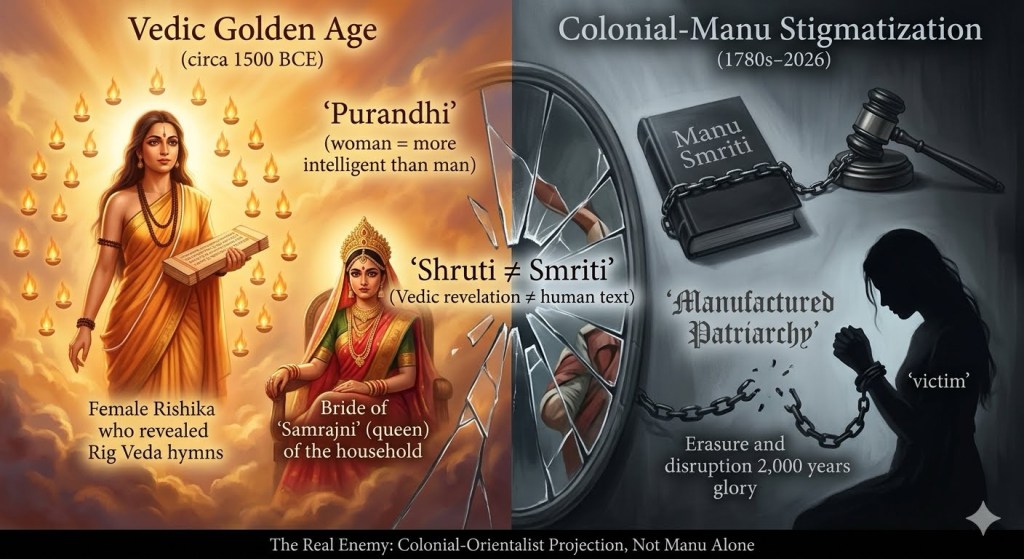
British made Manu “canonical” → Modern critics blame Manu for “Brahminical oppression” →
But Manu was never the original Vedic view →
Vedic women had full equality.
****************
The Orientalist Text Selection
British Orientalists selectively elevated Manu while ignoring:
What They Ignored:
• Vedic Shruti authority (supreme over Smriti)
• 30+ women rishikas in Rig Veda
• South India’s alternative
Dharmashastras (Yajnavalka, Vishnu)
• Sri Vaishnava theology (women = Lakshmi embodiments)
• Satapatha Brahmana (bride = samrajni/queen/somidevamma)
What They Elevated/Exaggerated:
• Manu’s IX.3 and IX.17 (“women must be guarded; cannot be independent”)
• Manu’s caste endogamy provisions
• Manu’s ritual purity/pollution codes
The Result: By cherry-picking Manu’s restrictive verses and ignoring Vedic feminine glory, Orientalists created the “Manu = Hindu patriarchy” myth that liberal historians perpetuate today.
(Continued in Part 3)