
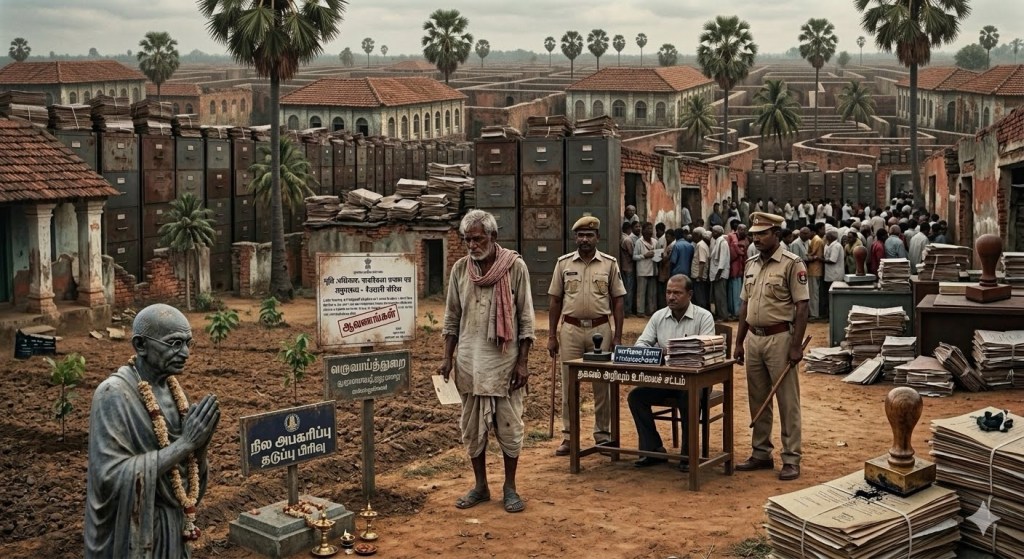
(A short-story inspired by Franz Kafka)
by M.K.Sudarshan
He owned one-tenth of an acre.
Not much, but enough to keep a man alive if the sky remained merciful. It was the only map he trusted. Its boundaries were not drawn in ink but in memory: a tamarind tree on one side, a broken stone on another, a ditch that swallowed rainwater for three days and then forgot it ever existed.
His father had stood on that land. His grandfather too. The soil remembered their feet more faithfully than any office ever would.
One morning, while the sun was still pale and the crows had not yet begun their arguments, the police came.
Three men.
One held a paper. One held a pen. One held nothing at all, which made him the most frightening of the three.
They stood at the edge of the field as if they had arrived not to visit a man, but to inspect a defect.
“This land is not yours,” said the first.
The farmer looked at him, then at the earth.
“Whose is it?” he asked.
“That is not for you to ask.”
The second policeman unfolded the paper with ceremony. It rustled like a legal bird.
“You are not a citizen of India.”
For a moment the world did not react. The millet stood still. The wind paused. Even the ox at the far end of the village stopped chewing. It was as if the sentence had not been spoken to him alone, but to the entire landscape.
He laughed once, quietly, because there are sentences so absurd that the body answers them before the mind does.
“My name is here,” he said. “My father’s name too. The patta is here.”
The paper was not impressed.
“Not enough.”
“My children were born here.”
“Not enough.”
“My wife is buried here.”
“Not enough.”
“My blood is in this soil.”
“Not enough.”
The third policeman, the one with nothing in his hands, looked at him with a face so blank it seemed to have been issued by the state.
“You must prove citizenship.”
“How?”
A sheet was produced, as though from a wound.
A checklist.
Birth certificate. Parents’ documents. School leaving certificate. Domicile proof. Voter roll entry. Affidavit. Certified copies. Attested copies. Supporting records. Additional records. Further records where necessary. Any other document as may be demanded.
It was not a list. It was a corridor.
He entered the city carrying that corridor under his arm.
The city received him with the indifference of a machine that had long ago stopped caring whether the pieces inside it were human.
At the first office, he was told the form was incomplete.
At the second, the seal was wrong.
At the third, the officer was absent.
At the fourth, the officer was present but not empowered.
At the fifth, the file was missing.
At the sixth, the file had been found but not opened.
At the seventh, the file had been opened but not seen.
At the eighth, it had been seen but not understood.
At the ninth, it had been understood but not accepted.
At the tenth, he was asked to return to the first office.
By then the first office had become the seventh.
He came to know the city by its queues.
He learned the shape of waiting. He learned that chairs in government corridors are designed not for rest but for surrender. He learned the particular smell of old paper heated by ceiling fans. He learned that every clerk speaks in a voice trained to survive without compassion. He learned that every stamp is a verdict, and every signature a temporary mercy.
He sold his goat.
He sold his wife’s bangles.
He pawned the little brass vessel from which his mother had once fed him rice.
He borrowed money from a cousin who no longer visited the village except in dreams and tax season.
Months passed.
The monsoon arrived and went away without asking him. The fields drank water he did not see. The village continued to exist without him, which felt less like life and more like betrayal.
In the city, the file moved.
It moved from table to table, drawer to drawer, officer to officer. Always moving, never arriving.
“Come next week.”
“Come after verification.”
“Come with a witness.”
“Come with the witness’s father’s certificate.”
“Come with the original of the copy.”
“Come with a fresh affidavit.”
“Come with the old one too.”
“Come after local inquiry.”
“Come after final scrutiny.”
The words multiplied until they no longer meant anything. They became a chant used to keep him alive just long enough to remain unfree.
At last, after all the stamps and counters and signatures, after all the forms and re-forms, after all the polite refusals wrapped in official language, the final clerk looked at him without looking at him and said:
“Application rejected.”
He stared. “Why?”
“Insufficient proof.”
“What proof?”
“Proof of citizenship.”
“But that is what I came to prove.”
“Then prove it.”
He stood there, holding a file that had become thinner than hope.
He returned to the village.
His field was still there, but it had changed.
On his tiny patch of land, the panchayat had erected a statue of Mahatma Gandhi. White stone. Quiet face. One hand raised. The other holding a staff. Very dignified. Very complete. Very final.
He stood before it, exhausted beyond speech.
The land beneath the statue was his land once. Or had been. Or perhaps had only ever been, in the eyes of those who remembered him, a space waiting for something more official.
Now the statue stood where his crop had once grown.
The millet was gone.
The groundnut was gone.
The soil had been measured, corrected, beautified, and made suitable for public reverence.
A small board stood beside the statue:
Under public development.
He laughed then, but it was not laughter. It was the sound a human being makes when the world has gone so far beyond cruelty that cruelty itself begins to sound inefficient.
He looked at the statue and knelt.
“Thank you for being the Father of my Nation,” he said in a voice so low even the dust could barely hear it. “But even if you are my father, I still must prove I am a citizen.”
The wind moved across the empty field.
The statue did not answer.
The panchayat office, a little distance away, had already sent another notice.
The land was being reassessed.
The assessment required proof of ownership.
Ownership required proof of citizenship.
Citizenship required proof of identity.
Identity required documents.
The documents required attestation.
The attestation required an appointment.
The appointment required an application.
The application required citizenship.
And so the circle closed.
That night, the village did not sleep.
The next morning, they found his file outside the panchayat gate. Neatly tied. Damp from dew. Stamped in red.
REJECTED.
Inside the file, on the last page, someone had added a note in careful official handwriting:
No further action possible.
And below it, in a different ink, as if written by a hand that had briefly remembered being human:
Status unresolved.
(Concluded)