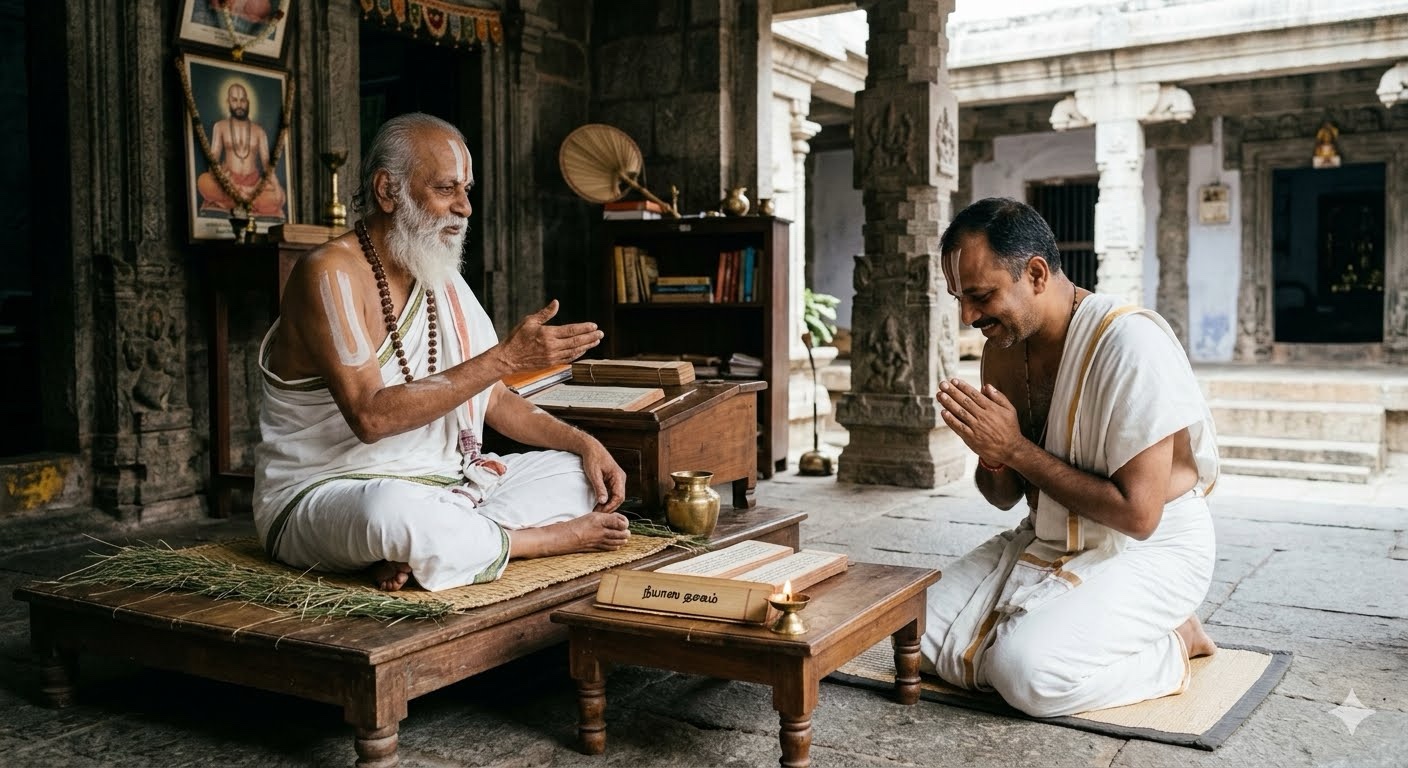
A sishya attending a series of lectures on Rahasya Traya Saaram (of Sri Vedanta Desika) humbly requested the Acharya to provide an explanation on the doctrine of Atma Samarpanam .
Dandasamarpanam to our KAALAPSHEPAM acharya swamin,
Today’s lecture on the doctrine of Atma Samarpanam was very enlightening indeed and gave me a good idea about why Atma Samarpanam has to be done when (a) Atma svarupa Gnyaanam is realised and (b) even when such Atma svarupa is not realised by a spiritual aspirant.
Swami, there is however only one doubt that arises in my mind and I will be grateful if it can be clarified. During the KAALAPSHEPAM itself, raising these kind of questions and doubts does not seem to be polite because it takes up time and other students may be inconvenienced. So, I ask now much later after the class.
The Artha Panchakam doctrine teaches us that Atma svarupa gynanam and Paramatma svarupa Gnyaanam , once realised give rise immediately to spiritual recognition of daasabhutatvam. Immediately then “ahamkaaram” and “mamakaaram” gets dissolved. After that dissolution, the jivatma has no agency at all … none.
Under such a condition, where is the need at all for jivatma to further do Atma Samarpanam?
When true svarupa gnyana is attained — of both Paramatma and jivatma —doesn’t that state by itself constitute realisation of parama purushaartham?
When it is posited that Atma Samarpanam is another act to be performed by the jivatma or prapannan— or even if it happens to be not an act of will but simply a attitudinal stance associated with daasabhutvam — it seems to suggest a Dvaita Siddhantham thought process or standpoint. Perhaps, I am wrong. So, I request Swami to please remove my confusion.
Daasoham
**********************
The KAALAPSHEPAM Acharya provided an illuminating clarification:
All of your doubts are valid ; there’s no disputing it. All the questions you have raised are pertinent and I will answer them and settle them now within the authority of the saadhyopaya and siddhopaaya test.
First, I address the first question asked regarding the jīva’s and Paramātmā’s sambandha-jnāna (knowledge of relation).
Now in this discourse we ask, ultimately, what is this ātma-samarpaṇa (self-surrender)?
Until now, regarding the ātma topic, we had this notion that the ātman belonged to us; we had the thought “it is ours,” we had a mental weight of ātma-rakṣā (protective-ownership) on us — all that was present.
Now, putting that knowledge aside, seeing that this is the Lord’s property — since it is His property, its rakṣā-bhāra (burden of protection) is also His — a certain mental stance has arisen that reflects this is bhaara-samarpaṇa. I will state what that bhaara-samarpaṇa says.
Now, whether sambandha-jnāna alone is sufficient or not, whether the anukūlya-saṅkalpa etc. elements and the other Prappati angas (limbs) are also included — why should one perform Atma -samarpaṇa? That is the doubt here.
If you ask how I settle that doubt, using reason alone and by invoking scripture or sastra, examinable propositions and objections will be raised. But that is not enough. That is the first point.
In the scriptures two upāyas (means) are said for attaining the Lord: bhakti and prapatti. Now, scripture-nivṛtti — by following scripture — for one who has no capacity to do bhakti-yoga, one must perform saranāgati (prapatti). Scripture says one should perform saranāgati with anukūlya-saṅkalpa and with five angas. Whether one practices bhakti-yoga or does saranāgati, both require svarupa-jnāna (knowledge of one’s essential nature). When that svarupa -jnāna comes — when one knows what our ātman is like — then sambandha-jnāna will naturally arise.
So that svarupa-jnāna is an essential feature for doing bhakti and prapatti. There is nothing else essentially needed; svarupa -jnāna alone is necessary. But one cannot say sārūpa-jnāna alone is sufficient by itself.
Another point: if one claims that sambandha-jnāna alone is the cause for ātma-rakṣaṇa (self-protection), and therefore for protection, even where there is no sambandha-jnāna, the Lord’s protection we see is already present — yes, it does exist.
Consider inert substances (aseṭhana dravya) — because they are aseṭhana or insentient and devoid of chaitanya (consciousness), they have no sambandha-jnāna. Even so, for those aseṭhana dravyas there is Iśvara as their protector. Cows, animals, birds, and so on — similarly, infant creatures that are as helpless as a little child feeding on its mother’s milk — they too have protection; but they do not like you or I ask “What is there to be protected?” or make any such inquiries.
Likewise, in those beings there is no sambandha-jnāna. Yet, even where there is no sambandha-jnāna, protection exists. So you cannot say that the sole function of sambandha-jnāna is the only thing vital for protection.
Fine. Let’s leave it there.
Now, empirically we see the fact that even where there is no sambandha-jnāna, Iśvara is the protector — we have seen that reality. Now the scripture says that one attains mokṣa through bhakti and prapatti; because of that scripture-sayings, one might argue that in this context only sambandha-jnāna is necessary and thus sambandha-jnāna is declared sufficient. If one accepts the scriptural statements that way, one must also accept the special jñāna-vishesha (distinctive knowledge).
By jñāna-vishesha I mean the prapatti-form of special knowledge — one must adopt that as well. Therefore scripture cannot say that only sambandha-jnāna is enough. In the anukūlya-saṅkalpa etc. doctrine and its distinct great beliefs, prapatti only discloses that sambandha-jnāna — but what consummated it is ātma-samarpaṇa.
Sambandha-jnāna can even come to an nastikan (non-believer). It can come; by doing kalākṣepa (discourse) — we ask questions and get answers — so sambandha-jnāna can be produced in a person. If someone says “sambandha-jnāna alone is enough, you say, yes, of course, but you also further add ātma-samarpaṇa whereby we not merely modify the doctrine a little or tweak it; we refine it, and again ensure that that sambandha-jnāna remains etched in the mind at all times, such that there is no disturbance in it.
That state is what we call the jñāna-vishesha in ātma-samarpaṇa. Accepting that jñāna-vishesha is what matters. Therefore the objection that “sambandha-jnāna alone is sufficient” arises among some people; I address those objections from the authority of saadhyopaya and siddhopaaya. This response I give now immediately because it might otherwise again come up after many days in our ongoing kalākṣepa, and so better to answer your question right away.
Now, one more thing I will say: is ātma-samarpaṇa the jīva’s action, or is it something dependent on the state of the mind (dāsa-bhūta manobhāva)?
In the Bhagavad-gītā there are various tyāgas (renunciations) — the renunciation of the doer-ness (kartṛtva–tyāga), the renunciation of attachment (mamathā–tyāga), and several other renunciations. I classify all such renunciation as coming under saranāgati.
For the purushārthas (worldly pursuits), one surrenders to the Lord by surrendering the doer-ness and attachment — both of those remain. In that kartṛtva-tyāga (renunciation of doer-ness), one says “svasvaya suprīthīye svameva kārayadīn” (he causes things according to his own will?) . So, I state that even when today we perform saranāgati, we do not do it ourselves; Iśvara makes us perform it.
Suppose one says: we have not done it for so long, will He make us do saranāgati now? Perhaps He will make us do it; but there is a dasha (period) that grants the fruits of our punya and pāpa (merit, demerit) from actions we did. Just as a mango on the tree ripens and hangs; only when it hangs ripe one can pluck and eat it — there must be a period of ripening and a capacity to use it. Similarly, the Lord grants the fruit of our punya and gives us a great favour by causing us to have the inclination to perform ātma-samarpaṇa.
Thus even in performing ātma-samarpaṇa we did not do it ourselves; Iśvara makes it happen.
Now you also ask me, if ātmā Samarpanam will come under special-advaita (viśiṣṭādvaita) purview or dvaita (dualism)?
If it is dvaita — that the distinct-selves are different, the prēraka (one who urges) and the prēritha (one urged) — then the one who commands is another person; the subordinate being obeys commands. In that aspect we accept that doctrine. But the dvaitins do not accept the notion of sarira-sareeri sambhandham; the dvaitins do not accept that. To that extent, we do not accept the flow of dvaita philosophy. Why? Because the Lord gives us this initial apprehension (buddhi-pradhāna), and He acts so that we reach Him; that is the ultimate goal (paramārtha).
Thus I hope I have answered your doubt. Let us revisit this matter when we come to it later in our ongoing sessions on Rahasya Traya Saaram.
**********************
The Sishya then responded to the Acharya with another respectful follow-up query :
Swamin, extremely comprehensive and lucid explication you have given about a profound doctrine. I am extremely grateful to you Sir.. In fact, you have at least for me also shed fresh new light on Swami Desikan’s Nyaasa Dasakam shloka.
What I am able to clearly understand from your exposition on Atma Samarpanam is this: for a prapannan Atma- Paramatma svarupa Gnyaanam and the 5 angams of Prappati are essential pre-requisites for attaining moksha. But they are not sufficient conditions… i.e. Essentiality, yes, but Sufficiency, no.
Atma Samarpanam fulfills the sufficiency condition after what has been completed as the essentiality condition for Prappati.
Swamin, when I think more deeply about what has been now explained to me by you, an analogy (Drishtaantam) comes to my mind which I share ⬇️.
I hope the analogy is not found to be misplaced or inappropriate.
The tenant who occupies a house and lived there for long often develops, unwittingly, an attitude of self-ownership of the dwelling.
This mentality develops over time because Possession by itself gives rise to the illusion of Ownership.
The Jivatma is a merely a tenant in possession of impermanent spatio-temporal space. But that possession creates an illusion of Ownership and Agency of that very same ontological space.
This happens due to Avidya or Agnyaana. The Agnyaana disappears when the Jivatma realises that it is merely a tenant in possession and was never the owner from whom its very existence had been taken merely as temporary fixed term , karma-determined leasehold!
Once the tenant has realised his true status — his svarupa — that’s when the jivatma too realises that what had always been in his mere possession had never belonged to it. The real owner of what was in possession had always been and will always be Paramatma only and eternally.
That realisation changes everything about whatever was hitherto known about the Jivatma-Parmatma sambhandham. It’s a transformation. A paradigm change. The tenancy ends … it no longer exists as reality.
However, the tenancy does not get terminated merely by the expiry of the period of tenancy. The realisation of Svarupa Gnyaanam and Daasbhuttvam is essential but it is not sufficient. Sufficiency in the termination of the tenancy becomes effective only when the tenant formally hands over both the occupation and possession back to the Owner. And it is indeed such a formalised return of the jivatma’s own svarupa back into the hands of Perumal that constitutes and defines Atma Samarpanam.
Swamin, by means of the above analogy, would you say I have grasped and understood correctly what you have explained to me about the doctrine of Atma Samarpanam? Once again, I express my deep gratitude to you swami for taking such pains to enlighten me. Dhanyosmi
Daasoham
And the Acharya then responded to the sishya simply with a “👌”… as a sign of endorsement.
(Concluded)
Sudarshan Maadabushi