
by M.K.Sudarshan
June 30, 2026/Chennai, India
Introduction
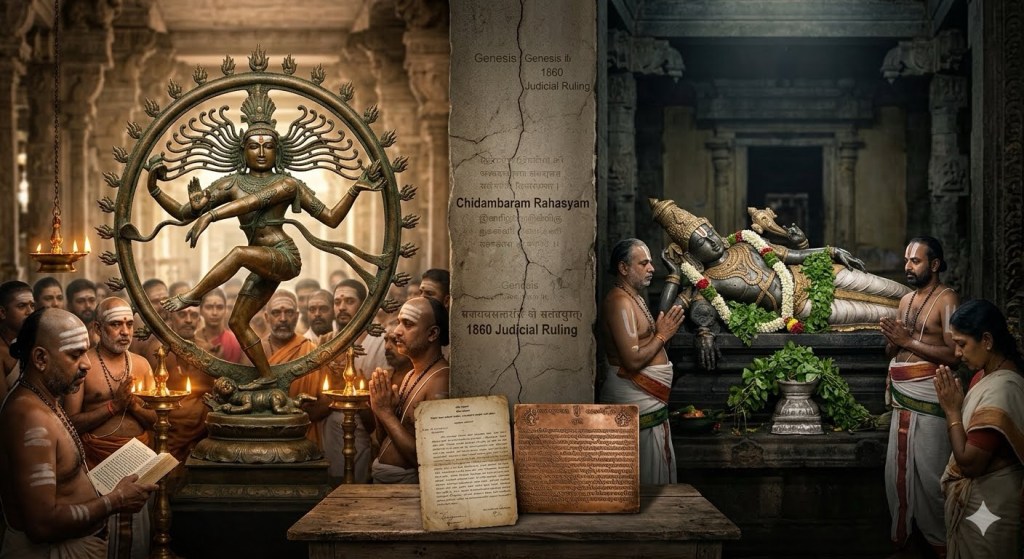
The Chidambaram Nataraja Temple is globally celebrated as the cosmic stage of Lord Shiva’s Ananda Tandavam. Yet, deep within its sacred geometry lies a quieter, parallel sanctuary: the Thillai Govindaraja Perumal shrine. For centuries, this physical coexistence of Shiva and Vishnu symbolized a rare, uneasy theological truce. Today, however, that truce has shattered.
This essay deconstructs the multi-layered crisis of Chidambaram, revealing how ancient agamic codes, colonial legal settlements, and modern state-sponsored administrative warfare have converged to lock the temple in an intractable stalemate. It is a story where genuine religiosity has been sidelined by political posturing, leaving a vulnerable religious minority caught in the crossfire.
The Shared Sacred Canon: Where Tevaram Meets Divya Prabandham
Long before British benches or secular departments arrived to arbitrate the boundaries of Thillai, the temple complex existed as an intertwined dual-capital of the Tamil Bhakti movement. For the Saivites, it is simply Kovil—the definitive temple—whose golden eaves and cosmic dance were gloriously captured in the emotional Tevaram verses of the Nayanmar holy trinity (Appar, Sambandar, and Sundarar), and codified by Saint Manikkavasagar, who composed his sublime Thiruvasakam directly within these walls.
Concurrently, the Vaishnavite Alvars mapped this very precinct as Thiruchitrakoodam, one of the most uniquely situated of the 108 Holy Divya Desams. In the Perumal Tirumoli, the royal saint Kulasekhara Alvar ecstatically equated this shrine to the epic Chitrakoota of the Ramayana. Meanwhile, Tirumangai Alvar dedicated thirty-two sacred Pasurams to the reclining Vishnu, setting his opening decads to the Raga Shankarabharanam to mirror the majestic cadence of Lord Nataraja’s surrounding Tandavam… the Dance of the Cosmos conceived alternately in both Furious and Exuberant mood.
This overlapping hymnodic heritage stands as a historic reminder: the current administrative paralysis does not just split a physical courtyard, but splits a shared literary golden age where the highest expressions of Shiva and Vishnu bhakti once harmoniously echoed from the exact same pillars.
Part 1: The Genesis — From Chola Expulsion to Vijayanagara Consecration[12th Century: Chola Expulsion] ➔ [Ramanujacharya Saves Idol] ➔ [1539 CE: Vijayanagara Restoration]
The friction between the Saivite custodians (the Podhu Dikshitars) and the Vaishnavite lineage at Chidambaram is not a modern political invention; it is a centuries-old theological rivalry written in blood and stone.
The Medieval Rupture
During the 12th century, the Chola Empire reached the zenith of its power. King Kulothunga II, a fiercely orthodox Saivite, embarked on a massive renovation of the Chidambaram temple to exclusively glorify Lord Nataraja. Viewing the presence of the reclining Vishnu (Govindaraja) within the same precinct as an ideological blemish, the king ordered the Vaishnavite idol to be violently uprooted and cast into the Bay of Bengal.
Ramanujacharya’s Intervention
The great Vishishtadvaita philosopher, Sri Ramanujacharya, intercepted the fleeing Vaishnavite refugees. To preserve the sacred lineage of the deity, Ramanujacharya recovered the processional idols (Utsava Murtis) and traveled to Tirupati, consecrating a consecrated duplicate shrine at the foot of the Tirumala hills (the Govindaraja Temple in Tirupati) to ensure the continuity of worship.
The Vijayanagara Restoration
For nearly four centuries, the Chidambaram temple remained an exclusively Saivite space. The geopolitical landscape shifted drastically with the rise of the Vijayanagara Empire. In 1539 CE, King Achyuta Deva Raya—the successor to Emperor Krishnadevaraya—waged a campaign to reclaim and restore ancient Vaishnavite heritage across South India.
Backed by imperial military might, Achyuta Deva Raya forcefully re-installed the deity of Sri Govindaraja Perumal into the Chidambaram complex. He appointed hereditary Vadakalai Bhattacharyas to administer the shrine according to the strict protocols of the Vaikhanasa Agama.
This state-enforced re-consecration was met with absolute horror by the local Saivites. Historical records indicate that the resistance was so fierce that several Podhu Dikshitars committed ritual suicide by leaping from the temple’s high gateway towers (gopurams) in a desperate, failed bid to halt the pollution of their sacred space. The seeds of a permanent proxy war were sown.
Part 2: The 1860 Compact — A Century and a Half of Enforced Quietus[1860: Voluntary Truce] ➔ [1920: Madras High Court Decree] ➔ [140 Years of Predictable Peace]
By the onset of British colonial rule, both communities realized that executing two independent, full-scale religious calendars within the same narrow geographic boundaries was logistically impossible.
The Spatial Deadlock
A traditional Brahmotsavam (the primary annual festival) requires a multi-day sequence of high-volume public events. It demands a flag-hoisting ceremony (Dhvajarohanam), extensive internal processions within the narrow corridors (prakarams), and a grand chariot festival (Rathotsavam) traversing the four main outer car streets of the town.
Because both the Saivite rituals (governed by Sage Patanjali’s Chidambara Kshetra Sarvasvam) and the Vaishnavite rituals (governed by the Vaikhanasa Agama) are tethered to unalterable astronomical alignments, their calendars frequently overlapped. Two massive, ideologically distinct crowds trying to move through the exact same physical choke points at the same time caused immediate public danger.
The Great Relinquishment of 1860
In 1860, facing imminent administrative intervention by colonial authorities, the Perumal temple trustees made a landmark concession: they voluntarily relinquished their right to host a full-scale, multi-day public Brahmotsavam.
The 1920 Legal Seal
This spatial compromise was formally codified sixty years later. Following intense litigation regarding temple keys, gate access, and right-of-way, the Madras High Courtissued a definitive ruling in 1920. The court noted that no full Vaishnavite Brahmotsavam had been conducted in living memory. It restricted the Govindaraja Perumal shrine to:
- Smaller, localized internal festivals.
- Short, strictly scheduled processional windows.
- A complete ban on any activity that disrupted the late-night or early-morning agamic schedules of Lord Nataraja.
For the next 140 years, an uneasy but uninterrupted quietus prevailed. The Vaishnavas accepted a smaller, subordinate ritual footprint, and in return, the Saivites allowed the daily Vaikhanasa pujas to proceed without violence. The town of Chidambaram forgot what a Vaishnavite Brahmotsavam looked like, and peace reigned by keeping one side small.
Part 3: The Secular State Enters the Sanctum — The HR&CE vs. Dikshitar War[Hereditary Autonomy (Article 26)] ⚔️ [State Regulatory Takeover (HR&CE)]
The peace of the 20th century evaporated with the aggressive institutional expansion of the modern secular state via the Tamil Nadu Hindu Religious and Charitable Endowments (HR&CE) Department.+------------------------------------+------------------------------------+ | Podhu Dikshitars (Saivite) | HR&CE Department (State Bureaucracy| +------------------------------------+------------------------------------+ | • Claim autonomous control | • Alleges lack of financial audits | | • Protected under Article 26 | • Uses Govindaraja as legal wedge | | • Operates via Patanjali's manual | • Seeks complete state control | +------------------------------------+------------------------------------+
The Fight for Autonomy
The Podhu Dikshitars are a unique, closed clan of hereditary married Brahmins who collectively own and manage the Nataraja temple. Unlike almost every other major historic temple in Tamil Nadu, they do not answer to state bureaucrats. They operate as an independent religious denomination.
The Dravidian political movement, which has dominated Tamil Nadu’s governance for over half a century, views this hereditary control as an archaic, unaccountable monopoly. For decades, successive state governments have deployed financial audits, administrative circulars, and public allegations of mismanagement to bring Chidambaram under total state control.
The Supreme Court Defeat
In 2014, the state suffered a major legal defeat. The Supreme Court of India ruled in favor of the Podhu Dikshitars, affirming their status as a protected religious denomination under Article 26 of the Constitution. This ruling meant the state could not arbitrarily depose the Dikshitars or permanently take over the management of the Saivite temple properties.
The Government’s New Strategy
The HR&CE Department changed its tactics. While they could not legally touch the Natarajar administration, the Govindaraja Perumal shrine within the complex falls under HR&CE jurisdiction.
Recognizing this legal opening, the state began using the Vaishnavite shrine as an administrative wedge. By aggressively championing the rights of the Vaishnavite deity, the HR&CE found a legitimate way to insert state officials, police escorts, and regulatory mandates directly into the shared pathways of the temple, keeping the Dikshitars under constant pressure.
Part 4: The 2024 Flashpoint — The Anatomy of a Manufactured Stalemate[HR&CE Revives 10-Day Festival] ➔ [Dikshitars Protest Invasion] ➔ [High Court Mediation Freeze]
In May 2024, the administrative proxy war escalated into an open public crisis. Backed by the state, the Vaishnavite trustees announced a full, 10-day public Brahmotsavam—effectively attempting to overturn the 140-year-old status quo ante.
The Legal Leverage of a “Minor”
The HR&CE based its actions on a specific principle within Indian temple law: the deity is a perpetual minor. Under this doctrine, a human trustee’s decision to pause a festival in 1860 cannot strip the deity of its right to those rituals in perpetuity. Armed with this argument, the state moved to reassert a full Vaishnavite presence in the temple’s shared spaces.
The Podhu Dikshitars, legally advised by prominent temple activist T.R. Ramesh of the Temple Worshippers Society, resisted immediately. They argued that a 10-day Vaishnavite festival would shut down crowd management, violate their agamic timeline, and allow state officials to dictate terms in a denominational space.
The Judicial Avoidance
When the matter reached a special bench of the Madras High Court, the judiciary chose a cautious approach. Recognizing the explosive political and communal tensions, the court refrained from issuing a definitive, binding ruling. Instead, it referred the entire dispute to a judicial mediation process, instructing both sides to negotiate a mutually acceptable calendar.
The Zero-Sum Trap
This mediation process quickly stalled into a permanent freeze:
- Scriptural Inflexibility: You cannot mediate an astrological alignment. The Vaikhanasa Agama demands specific days; Patanjali’s manual demands those exact same days for Shiva. Neither side can compromise on their scriptural dates without violating their own agamic laws.
- Refusal of Standing: T.R. Ramesh and the Dikshitars refuse to negotiate with HR&CE bureaucrats, arguing that secular state officials have no legal standing to mediate agamic traditions.
The court’s decision effectively preserved a frozen conflict. No full Vaishnavite Brahmotsavam can be held without mutual consent, which means the 140-year suppression of the full Vaishnavite festival remains firmly in place.
Part 5: The Cynical Balance Sheet — Winners, Losers, and Silent Deities ┌───────────────────────────────┐ │ THE CHIDAMBARAM THEATER │ └───────────────┬───────────────┘ │ ┌────────────────┴────────────────┐ ▼ ▼ ┌───────────────────────┐ ┌───────────────────────┐ │ THE WINNERS │ │ THE LOSER │ ├───────────────────────┤ ├───────────────────────┤ │ • HR&CE (Political) │ │ • Vadakalai Vaishnavas│ │ • Saivites (Spatial) │ │ (Exploited & │ │ • T.R. Ramesh (Legal) │ │ Disenfranchised) │ └───────────────────────┘ └───────────────────────┘
The current standoff at Chidambaram reveals a cynical balance sheet where political and legal actors find utility in the stalemate, while a small religious community pays the price.
The Winners
- The Podhu Dikshitars & T.R. Ramesh: By locking the dispute in a slow-moving judicial mediation process, they have successfully maintained their spatial monopoly over the temple complex. The state’s push has been halted by procedural delays, keeping their denominational autonomy intact for now.
- The HR&CE Department: The state government has successfully politicized the issue. They can present themselves to their political base as champions of religious equity and defenders of a Vaishnavite minority against orthodox Brahminical hegemony, while using the unresolved dispute to justify ongoing regulatory pressure on the Dikshitars.
The Loser: The Vadakalai Sri Vaishnavas
The only clear losers in this conflict are the local Vadakalai Sri Vaishnavas. The hereditary Bhattacharyas and their small community of devotees are caught in an institutional crossfire:
- They lack the political influence of the state apparatus.
- They lack the constitutional autonomy enjoyed by the Dikshitars.
Their historic grievances and genuine religious aspirations have been used as leverage in a broader battle over state regulation. The judicial mediation process, framed as a path toward equitable access, has instead left their ancient right to a full Brahmotsavam suspended indefinitely.
Conclusion
As the litigation drags on through the courts, the true spiritual heritage of the shared complex remains obscured by administrative legal battles. In Chidambaram, the cosmic dance of Shiva and the deep sleep of Vishnu continue, undisturbed by the modern proxy wars fought in their names.
(Concluded)
One thought on “The Chidambaram Rahasyam: How a Sri Vaishnava Shrine became a Proxy War Pawn in Tamil Nadu politics”