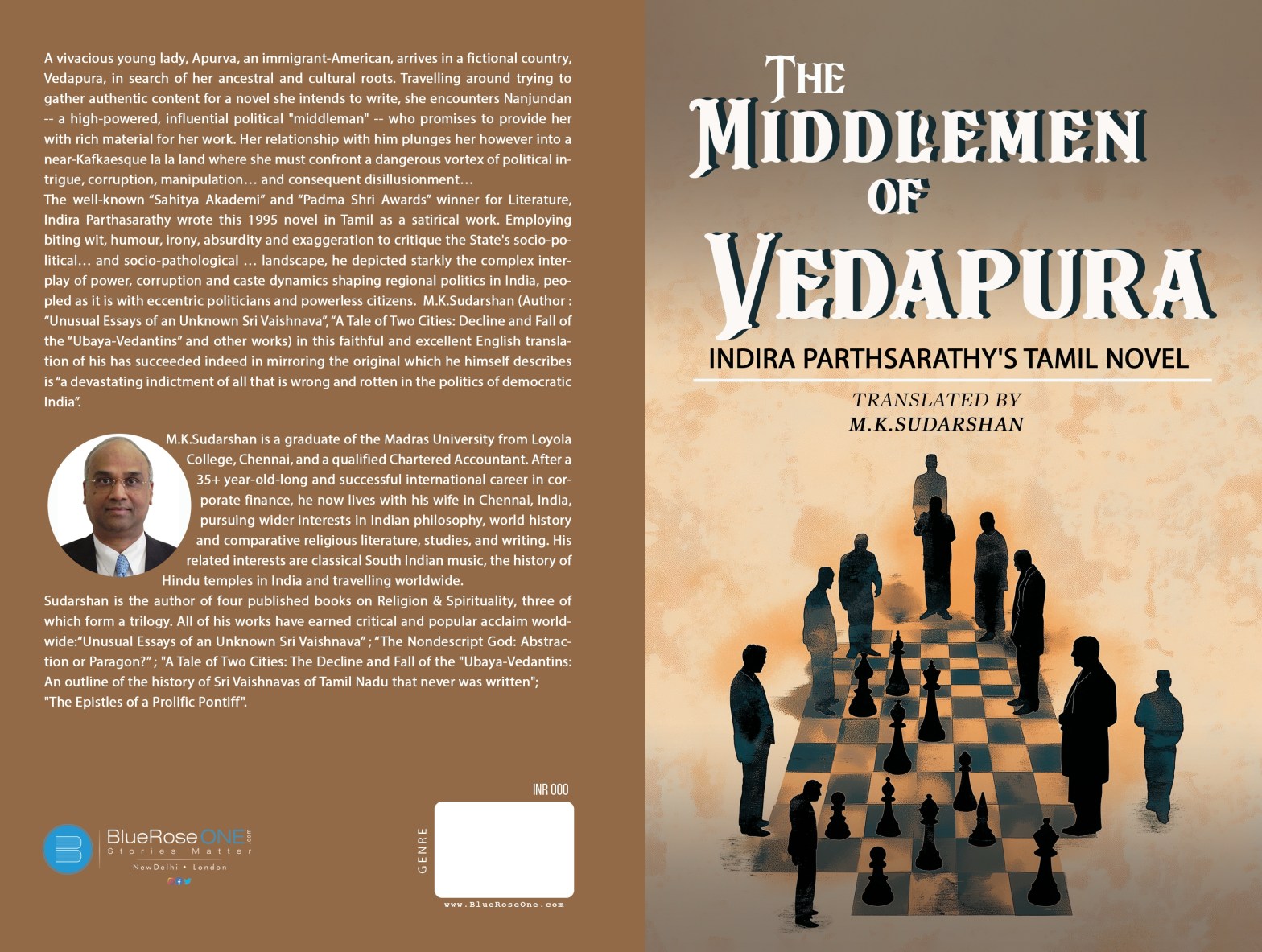
by M.K. Sudarshan
July 12, 2026: Chennai, India

What happens when you send birthday greetings to a doyen of Tamil literature? If the doyen is Indira Parthasarathy (affectionately known to generations as Eepa), you don’t just get a standard “thank you”—you get a masterclass in razor-sharp wit and historical cynicism.
The legendary playwright, Sahitya Akademi winner, and Padma Shri recipient recently celebrated his 96th birthday. Having sent him my warm wishes, my phone buzzed the next morning with a characteristically brilliant response. Eepa messaged back, dropping a famous quote by Winston Churchill:
“History will be kind to me because I intend to write it.”
It is a perfect quote for Eepa—a writer who has spent his entire career pulling back the curtain on elite power structures, political manipulation, and the narratives fed to the public. Throughout his career, Ee. Paa. has used his novels and plays (like Kuruthipunal or Ramanujar) to dissect power structures, religious politics, and how human narratives are manipulated by elite classes. He has always been a writer who looks beneath the official version of history. (His Tamil novel “Vedapuratthu Vyaabaarigal”, a political satire, was translated by me into English as “The Middlemen of Vedapura” in 2024, and which he wholeheartedly endorsed).
I couldn’t help but laugh, and I texted him back with a bit of financial and historical counter-punching:
“And Sir, in 1953, he wangled a Nobel Prize for turning History into Literature too! History gets written by victors. Economics is written by creditors. And historians are handed grand awards by the debt-collectors.”
There is a delicious historical irony hidden right there. Churchill actually coveted the Nobel Peace Prize, but the Swedish Academy couldn’t quite reconcile giving a peace award to a fiercely aggressive wartime prime minister. Instead, they compromised. They wangled a way to hand him the 1953 Nobel Prize in Literature for his massive, self-serving six-volume chronicle, The Second World War.
Because there is no Nobel Prize for “History,” the committee essentially codified the ultimate truth of power: if you win the war, your personal version of history is so absolute that it gets validated as literal high art. Churchill didn’t just document the war; he carefully sculpted a literary monument where he was the undisputed hero, conveniently editing out the massive sacrifices of over 2.5 million Indian colonial troops.
For anyone tracking markets or global macro trends, this remains the ultimate reality. The entity that holds the accounting ledger holds the narrative. The military winner controls the history books, while the lender dictates the economic rules of the game.
What I meant to tell Eepa was only this:
- History and Victors: Military or political winners control the archives, rewrite textbooks, and frame their conquests as “progress” or “liberation.”
- Economics and Creditors: Financial systems are designed by those who hold the capital. Terms like “fiscal responsibility,” “structural adjustment,” and “creditworthiness” are defined by lenders (nations, central banks, or institutions) to ensure they get paid back, often prioritizing debt repayment over human welfare.
- Historians and Debt-Collectors: Institutions that fund elite universities, think tanks, and prestigious foundations are often built on accumulated wealth and financial systems. Intellectuals who normalize or justify these power structures are frequently rewarded with grants, chairs, and prestigious awards.
Real-World Parallelisms
- The Global South: International lenders often dictate national economic policies, forcing developing nations to cut public spending to service foreign debt.
- The Imperial Narrative: Historically, colonial empires justified extraction by claiming they were bringing “economic development” and modern banking to the colonies.
A moment later, the master satirist himself fired back with his ultimate stamp of approval:
“Quite smart saying!”
Getting validated by a literary giant who has spent nearly a century mastering the art of the subtext — well, for me at least — feels like a profitable trade closing at the absolute highs of the day.
The Market Takeaway
For the traders and investors among us, (BTW, I’m a Chartered Accountant who sweated for 37 long years, both India and abroad, in the big, bad, bad, bad world of corporate/ project/investment finance), there is a profound truth hidden in this morning’s banter between Eepa and I:
- Watch the Creditors: In the markets, just like in history, the people who underwrite the debt are the ones who ultimately author the economic reality. Central banks, institutional lenders, and massive market-makers build the framework we have to trade within.
- Question the “Official” Narrative: When a trend looks universally accepted or a consensus seems completely unshakeable, remember that narratives are usually constructed by the entities holding the winning positions.
Happy 96th Birthday to Eepa ! —a legendary mind who proves that age is no barrier to keeping your intellectual edge sharper than a high-frequency trading algorithm.
