by M.K.Sudarshan
July 18, 2026: Chennai, India
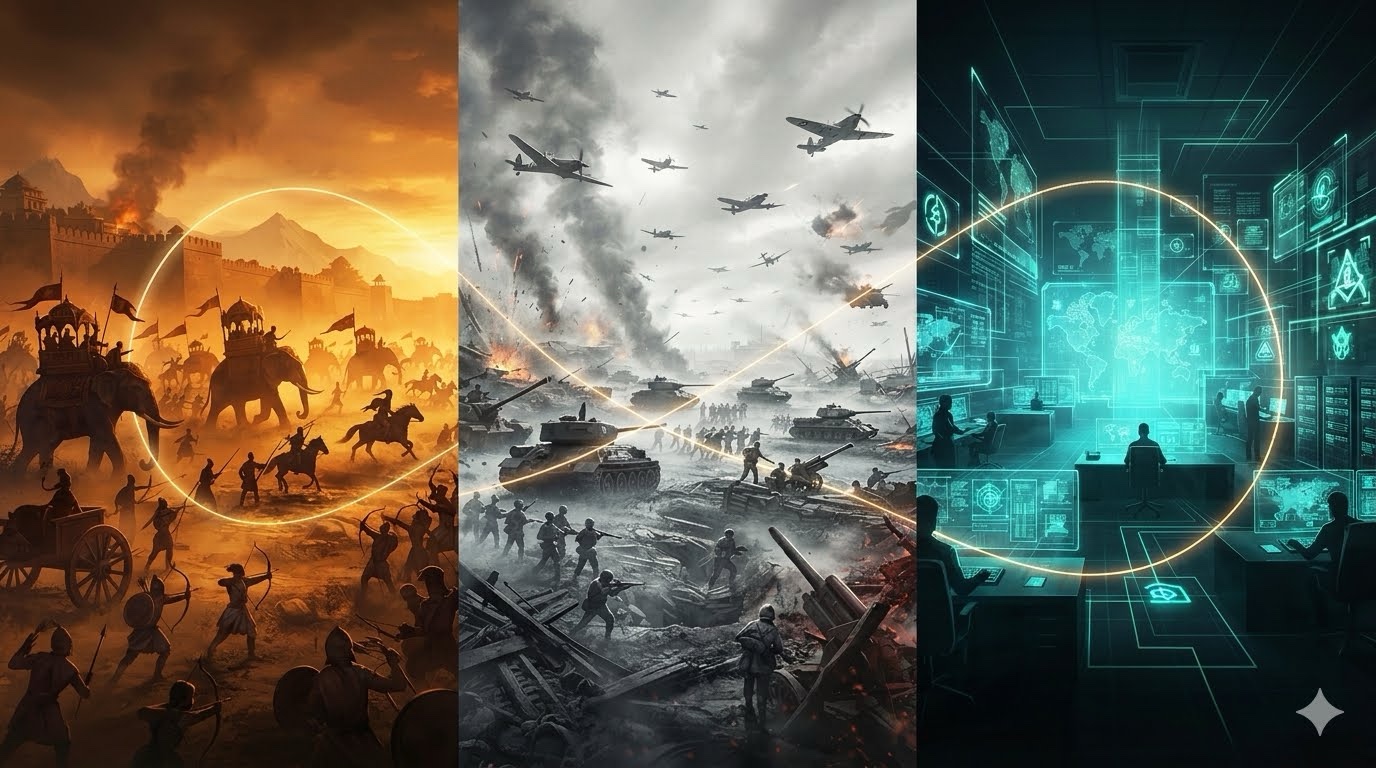
The Iron Principle of Temporal Limitation: “The Kurukshetra Limit”
The most profound failure of modern strategic ingenuity is not a lack of tactical imagination, but a complete blindness to the dimension of time.
In the framing of this “iron principle” what gets identified is what may be the ultimate axiom of sustainable conflict—what we can call the Kurukshetra Limit: When warfare is decoupled from a strict, compressed timeline, it ceases to be a tool of political resolution and instead mutates into an uncontainable, self-sustaining ecosystem of devastation.
The ancient Indian strategic tradition, while deeply familiar with the brutal realities of Danda (force), inherently understood that war is an unnatural, highly toxic disruption of the cosmic and social order (Dharma). Therefore, if a conflict must occur to restore systemic balance, it had to be intense, decisive, and strictly bounded by time.
The 18 days of the Kurukshetra War of the Mahabharata or the brief, climactic siege of Lanka in the Ramayana were not historical accidents; they were philosophical and operational boundaries. They recognized that the longer a war drags on, the more the original political or moral objectives are consumed by the sheer, irrational mechanics of survival and vengeance.
The Western vs. Eastern Dichotomy of Attrition
The tragedy of the post-Crusades and modern European, Central Asian, and West Asian strategic traditions is their comfort with temporal elasticity.
From the Hundred Years’ War (fought between England and France from 1337 to 1453) the Thirty Years’ War (1618–1648, fought primarily in Central Europe between two major coalitions: the Catholic forces, led by the Holy Roman Empire and Spain, and the Protestant alliance) to the trenches of World Wars I and II ( 1914-1919; 1939-45), Western strategic culture became accustomed to treating time as a cheap, infinitely expandable resource. They built industrial war machines specifically designed to sustain long-term attrition.
Modern high-tech innovations—whether cyber tools, economic sanctions, or protracted proxy operations—have only worsened this flaw. Because these modern tools allow nations to wage war below the threshold of open, bloody battle, and they remove the immediate domestic political pressure to bring the conflict to a swift end. They make war background noise, allowing it to drain a society’s wealth and focus indefinitely.
As this essay finally concludes, all modern history is a graveyard of empires that violated this Kurukshetra Limit:
- The United States entered Vietnam, Afghanistan, and Iraq with overwhelming technological superiority, only to be swallowed by decades of strategic drift because they could not force a temporal resolution.
- The Soviet Union marched into Afghanistan expecting a brief intervention, only to face a ten-year hemorrhage that cracked the very foundations of its empire.
- The Contemporary Mirror: In the current Russo-Ukraine war, the initial failure of a swift resolution has trapped both sides in a grinding, multi-year war of attrition that mirrors the ruinous Western front of 1916 far more than it does any quick, decisive campaign.
India’s Modern Strategic Fidelity
It is a remarkable and underappreciated fact of modern history that post-independence India, consciously or unconsciously, maintained a strict adherence to this short-timeline Kurukshetra principle.
Faced with existential regional rivalries, Indian military planners consistently engineered operations designed to hit a definitive temporal hard-stop:
- The 1962 Sino-Indian War: Even in a conflict where India was tactically overwhelmed, the active fighting was entirely compressed into a single month before China declared a unilateral ceasefire and withdrew, preventing a prolonged Himalayan quagmire.
- The 1965 Indo-Pakistani War: A intense, high-octane conventional clash that lasted just 22 days before international pressure and logistical exhaustion forced a ceasefire, leading to the Tashkent Declaration.
- The 1971 Liberation War (Bangladesh): Perhaps this is the finest modern textbook example of the Kurukshetra Limit. Facing a massive geopolitical crisis, the Indian Armed Forces executed a lightning, multi-axis blitzkrieg that forced the unconditional surrender of Pakistani forces in the Eastern theater in just 13 days, completely redefining the map of South Asia before global superpowers could intervene to freeze the conflict.
- The 1999 Kargil War: High-altitude warfare fought under intense international scrutiny, wrapped up in just over two months, strictly bounded to the localized peaks to avoid triggering a total, multi-theater nuclear escalation.
Epilogue:
The 21st-Century Proof of Temporal Containment
The definitive 21st-century proof of this strategic fidelity to the Kurukshetra Limit came during the 2025 India–Pakistan Border Conflict (Operation Sindoor).
Launched to avenge the brutal Pahalgam terrorist massacre that claimed the lives of 26 innocent tourists, India unleashed an intense, multi-axis precision air and missile strike targeting terror operational bases.
Despite the extreme friction—which saw extensive dogfights, drone swarms, and multiple aircraft downed—India held a firm, unyielding line against letting the confrontation spiral out of control. Within a tight window of just four days (May 7–10, 2025), India accomplished its targeted kinetic objectives and enforced a hard stop to hostilities.
The absolute genius of this operation lay in its temporal boundary, refusing to slide into a protracted regional entanglement. This containment stood firm even when US President Donald Trump later made highly exaggerated claims that his third-party mediation stepped in to halt an imminent nuclear exchange “that would have wiped out 30 to 50 million lives”.
Regardless of such theatrical international narratives, India’s operational clarity proved that a modern nuclear-shadow conflict can be strictly bounded, decisively delivered, and shut down before it transforms into an open-ended catastrophe.
It remains a striking validation of the Kurukshetra Limit. While global superpowers watch their own open-ended military investments dissolve into endless attrition, the strategic baseline preserved by the Indian nation continues to prove that the ultimate victory over chaos is knowing exactly when to draw down the curtain.
(Concluded)
