by M.K. Sudarshan
July 20, 2026: Chennai, India
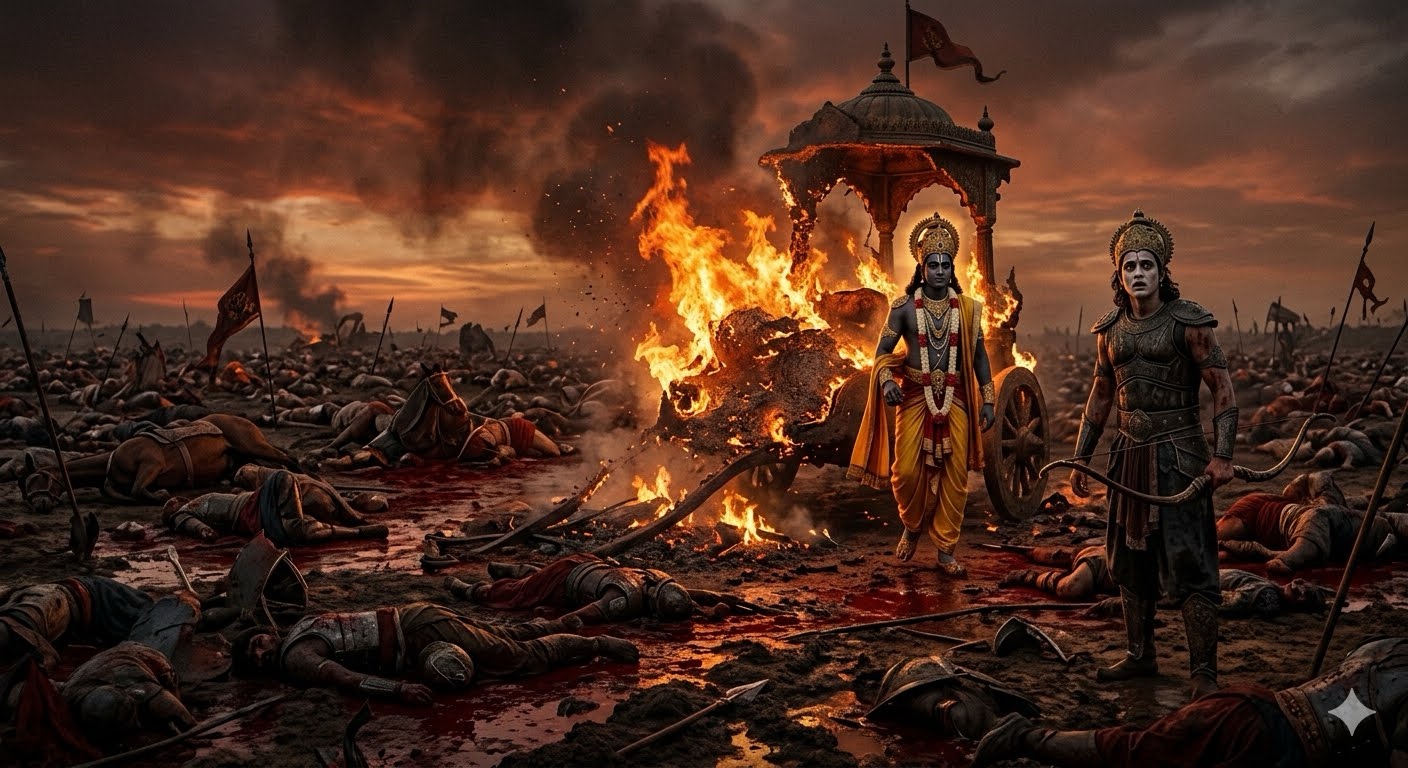
An Imaginary Retelling from the Mahabharata.
An impossible, suffocating shadow falls over the United Nations General Assembly, freezing the mechanisms of global power in a terrifying, absolute stasis.
Before an audience of stunned world leaders, a spectral entity suddenly materializes to deliver a devastating, four-part chronicle of an ancient apocalypse.
It is not an appeal for peace, but a final, shattering cosmic warning: having bartered their honor for tactical gain and crossed the threshold of divine patience, modern empires are actively engineering their own erasure—unaware that when the machinery of human hubris takes over, the heavens simply step back to let the fire consume it all.
Part 1: The Ladder of Escalation
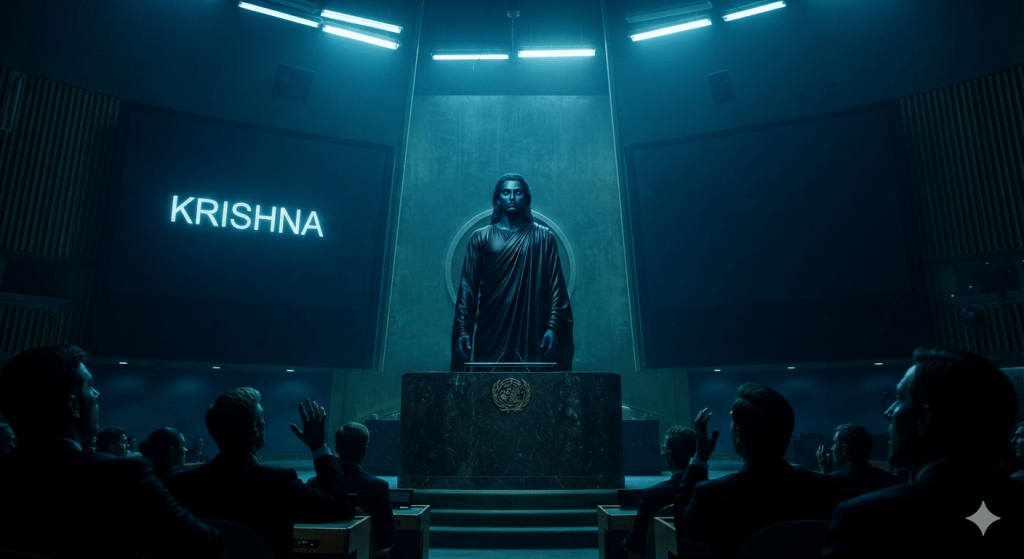
The air in the grand hall grows suddenly, inexplicably heavy. The hum of simultaneous translation headsets dies out as a profound silence grips the room. The harsh fluorescent lights flicker, dimming into a deep, oceanic blue.
Behind the marble podium, where presidents and prime ministers usually stand, a figure materializes. He wears a dark, silk robe that seems to absorb the shadows around him. His skin is the color of a storm cloud, and his eyes hold the terrifying weight of infinite galaxies. He does not introduce himself. He does not need to. The digital screens behind him flash with a single name: KRISHNA.
“You sit in this august chamber and speak of ‘measured response,’ ‘red lines,’ and ‘tactical thresholds,’ as if war is a beast you can keep on a leash,” Krishna’s voice echoes, bypassing the headsets and speaking directly into the consciousness of every delegate. “Let me show you the leash snapping. Let me tell you of Kurukshetra.”
“We began exactly where you stand today. We began with rules. We called it Dharma Yuddha.
For nine long days, our armies fought with absolute symmetry. Chariot against chariot. Infantry against infantry. When the sun dipped below the horizon, the trumpets sounded, the killing stopped, and enemies shared water by the same campfires. We believed we were civilized. We believed our codes would save us.”
“Then came the tenth day. The Pandavas could not break the Kaurava line. Desperate, they put forward a human shield—Shikhandi—knowing the patriarch Bhishma would not strike him. Hidden behind that shield, Arjuna loosed his arrows. The rules were breached. A tactical compromise, they called it. A necessary deviation to break a stalemate.”
“By the thirteenth day, the deviation became a freefall. The Kauravas trapped a lone boy, young Abhimanyu, inside the Chakravyuha formation. Six veteran generals—men who had sworn sacred codes of chivalry—encircled a single, unarmed teenager and butchered him. Honor died that afternoon. Revenge became the only currency.”
“The fourteenth day brought your modern nightmare: nocturnal warfare. The battle bled past sunset into the pitch black. Panic set in. When the illusionary terrors of Ghatotkacha threatened to wipe out the Kauravas, Karna panicked. He unleashed the Vasavi Shakti—a divine, heat-seeking, un-interceptable missile. A strategic weapon deployed solely to solve a tactical emergency.”
“From there, the descent was absolute. On the fifteenth day, we weaponized psychological warfare and deep-fake truths to decapitate the enemy command, tricking Drona into dropping his weapons before he was beheaded. By the seventeenth day, human empathy was entirely extinguished; Bhima ripped open his cousin’s chest to drink his warm blood, and Arjuna assassinated Karna while he was unarmed, trying to lift his chariot wheel from the mud.”
“The final day ended in the dirt. A mace duel fought below the belt. And then, the midnight strike—Ashwatthama infiltrating a sleeping camp, slaughtering children in their beds, and opening the Brahmashira Astra, a thermonuclear curse aimed directly at the womb of the future.
When the dust settled, four million men were gone. Eleven survivors stood on a continent of widows. Indraprastha and Hastinapur were not trophies; they were radioactive graveyards. We climbed the ladder of escalation, rung by bloody rung, believing we could stop at any time. You cannot.”
Part 2: The Impotence of the Lesson
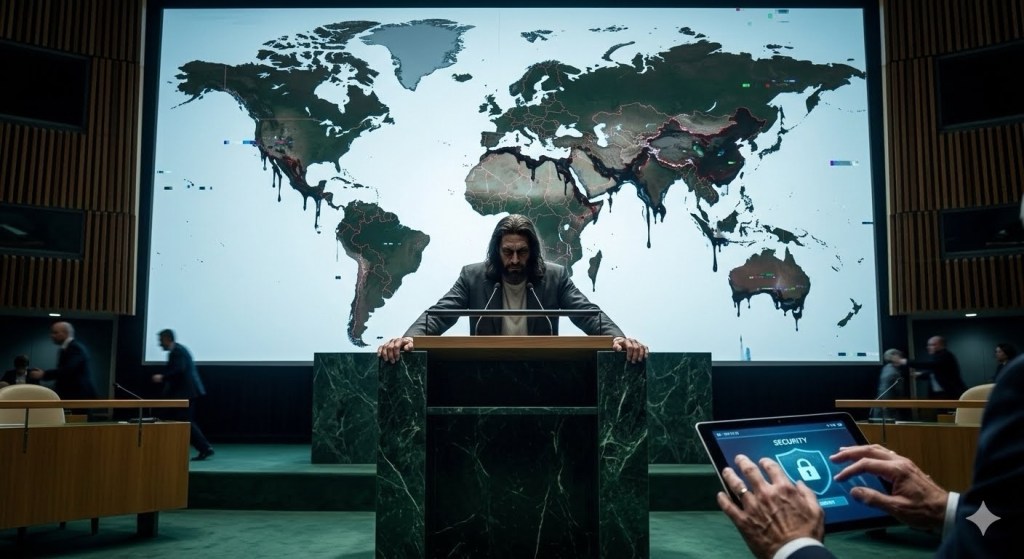
The divine figure leans over the marble podium. The holographic map of the world usually projected behind the speaker begins to distort, the borders of nations dissolving into bleeding pools of ink.
“I see the fear in your eyes,” Krishna murmurs, a bitter, melancholy smile touching his lips. “I see the delegations of the great powers writing down my words, preparing to archive them as a profound moral lesson. But I know your hearts. And I know that this story, despite the apocalyptic truth it holds, will change absolutely nothing in this room.”
“It will lack the power to drive sense into you because you do not see a tragedy; you see a case study. Your defense ministries look at the Brahmashira Astra and do not see a sin; they see a deterrent capability that must be modernized to maintain strategic parity.”
“You are paralyzed by your alliances. Like Duryodhana, your leaders are surrounded by counselors who feed their pride and weaponize their insecurities. You have built automated webs of treaties—your own version of the Chakravyuha—where the moment a single border is crossed, the machine of war activates automatically, bypassing your moral conscience.”
“Furthermore, you operate under the supreme delusion of the modern era: the myth of the ‘Rational Actor.’ You believe that because you have computers, satellites, and economic analysts, you can calibrate escalation. You believe you can bomb a city just enough to force a capitulation, but not enough to trigger a holocaust. You believe your opponent shares your definition of ruin.”
“But war is a fire that consumes the rationality of the one who starts it. When your survival is threatened, when your domestic political pride is on the line, your moral vocabulary will vanish just as ours did. A lesson cannot stop a man who believes he is the exception to the rule.”
Part 3: The Washing of the Hands
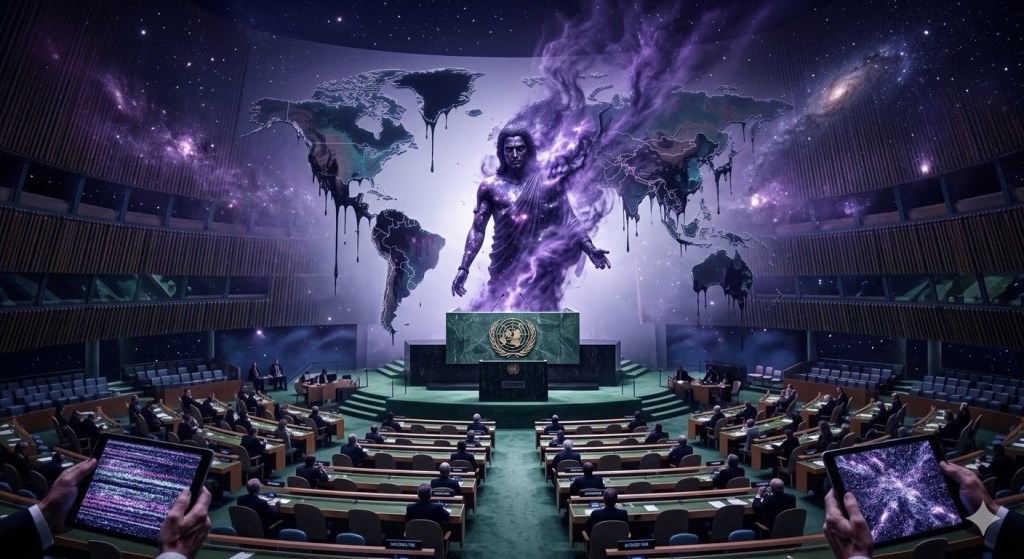
The violet light in the chamber deepens into an ominous, suffocating twilight. The marble walls of the United Nations building seem to turn translucent, revealing the vast, indifferent emptiness of the cosmos outside.
“You pray to the divine to save you from yourselves,” Krishna says, his voice carrying the weight of a dying star. “You cry out to God in your cathedrals, your mosques, and your temples, begging for peace talks to succeed, begging for a miracle to put the brakes on your Wars of Choice.”
“Hear this truth: Divine grace is not a safety net for human arrogance.”
“Before our war, I walked into the Kaurava court as a peace envoy. I did not ask for the world. I asked for a mere five villages to avert a global slaughter.
Duryodhana laughed. He tried to bind me in chains. I showed him my cosmic form, the Vishwaroopam, the terrible reality of the doom he was courting. He looked directly into the jaws of the apocalypse and chose it anyway. At that moment, I washed my hands of them.”
“There comes a point in time where the divine shifts from counselor to catalyst. When humanity repeatedly, willfully smashes the guardrails of reason, the universe ceases to protect you from the consequences of your own actions. The divine steps off the chariot, and lets the laws of cause and effect burn it to ash.”

“Look around your world today. The rot has gone deep. The strategic pride is absolute. The suffering of the innocent is dismissed as collateral damage. You have built a civilization on a foundation of systemic cruelty and nuclear hubris.”
“If you persist, a point will be reached where the cosmic clock must be reset. If you refuse to bend, the universe will let you break. It will let you fashion your own doom, because after a certain threshold of madness, the existing scheme of things becomes beyond repair.”
“It becomes ineluctable to shatter this sorry scheme of things entire, to let you grind your civilizations to bits and turn your great cities into the debris of Indraprastha. Only when you have completely erased your pride in the fire of your own making, will the canvas be clean enough for the divine to remould it all over again—nearer to His heart’s desire.”
Part 4: The Aftermath of Silence
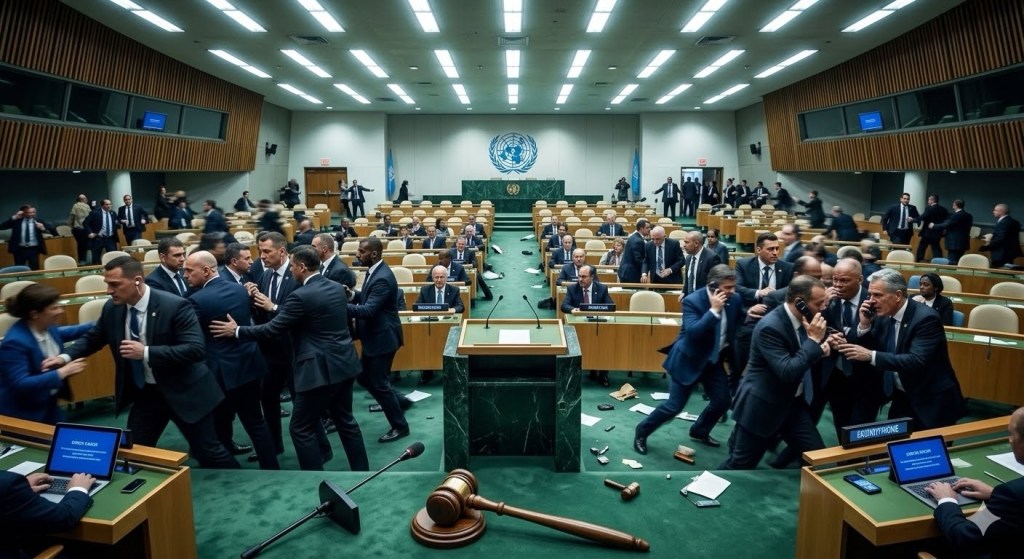
The figure behind the podium fades into the violet shadows. The oceanic light snaps back into the harsh, buzzing white of the General Assembly. The digital screens blink back to their standard layout, displaying the mundane agenda of the day. The microphones turn back on, capturing only the sound of hundreds of global leaders, frozen in their seats, staring at the empty podium, terrified to breathe.
For exactly ninety seconds, the silence is absolute.
Then, the illusion of unity shatters into frantic, chaotic self-preservation.
At the United States delegation box, the Secretary of State doesn’t look at his colleagues. He grabs the arm of his Chief of Security. Within seconds, Secret Service and UN Security details move into high alert, forming a physical wall around the American delegation to get the transport ready.
In the control booths overlooking the floor, technicians franticly run diagnostics. The digital recording systems, which usually archive every second of the assembly, show nothing but uniform white noise for the duration of Krishna’s presence. There is no electronic footprint of the voice that spoke inside everyone’s heads.
Instead of a collective awakening, the immediate reaction of the great powers is deep, defensive suspicion.
The Russian envoy, shaking off his initial paralysis, leans over to his military attaché, demanding to know if the West has developed a new type of low-frequency psychotropic weapon or a classified holographic projection system capable of bypassing their secure communications.
Across the room, the delegates from Israel and Iran, separated by just a few rows of seats, briefly lock eyes. The momentary shared horror evaporates. Hands instinctively reach for encrypted satellite phones. The immediate impulse is not to sue for peace, but to call their respective capitals to ensure their defense systems haven’t been compromised during the electronic blackout.
The President of the General Assembly tries to restore order. She reaches for the gavel, but her hand is trembling so violently it slips from her fingers, clattering loudly against the wood. She doesn’t try to pick it up. Instead, she leans into her microphone, her voice shaky and stripped of all diplomatic formality: “This plenary session… is adjourned. All delegations are requested to return to their secure compounds.”
As the hall erupts into a sea of moving bodies, hurried whispers, and rushing security details, a delegate from a small, low-lying island nation in the Pacific sits entirely still. He looks at the rushing, shouting leaders of the nuclear powers. He realizes that even faced with the architect of the universe, the machine of human pride cannot stop itself. They are already rationalizing away the miracle to protect their strategic positions.
He quietly closes his leather folder, steps out into the corridor, and watches the world’s most powerful men and women run toward their armored vehicles—unaware that they are running precisely down the rungs of the ladder Krishna had just mapped out for them.
(The End)