by M. K. Sudarshan
August 13, 2026: Chennai, India
The sun rose over Washington on Wednesday, August 12, 2026, casting a pale, sickly amber light through the windows of the Oval Office. President Trump sat behind the Resolute Desk, his television screens muted but flashing a chaotic montage of fire and steel.
Seventy-five days of a relentless U.S. naval blockade had finally broken Tehran’s endurance. Crippled by a suffocating economic stranglehold and facing imminent internal collapse, Iran had launched its promised asymmetric breakout campaign the night before. Thousands of fast-attack swarm boats, loitering drone munitions, and precision anti-ship ballistic missiles had rained down upon the Persian Gulf, successfully disabling two Western oil tankers and striking a U.S. guided-missile destroyer.
The response from the White House had been instant, unilateral, and total.
Bypassing the War Powers Resolution, ignoring a furious, late-night emergency session of Congress, and tearing up the traditional legal framework of executive authority, the President ordered a massive, multi-theater campaign.
By 2:00 AM, American B-2 stealth bombers and Tomahawk cruise missiles had begun obliterating Iranian air defense networks, command structures, and coastal missile sites.
Simultaneously, amphibious assault vehicles carried the first waves of U.S. Marines onto the beaches of Iran’s southern coast, while airborne divisions dropped into Khuzestan to seize vital oil infrastructure.
The legal checks designed by the Framers of the Constitution lay shattered.
The protests of European and Asian allies had been flatly ignored.
The red-line warnings whispered by Beijing and Moscow over secure hotlines had been bypassed with a single doctrine:
America First, America Alone.
The Morning After: Global Fallout
By 6:00 AM, the immediate geopolitical and economic shocks of the unilateral invasion began to paralyze the globe.
1. The Financial Meat Grinder
In New York, Tokyo, and London, trading floors descended into unprecedented panic.
- The Energy Shock: Brent crude oil futures did not merely rise; they shattered all historical metrics, violently gapping upward to $215 per barrel within minutes of the opening bell.
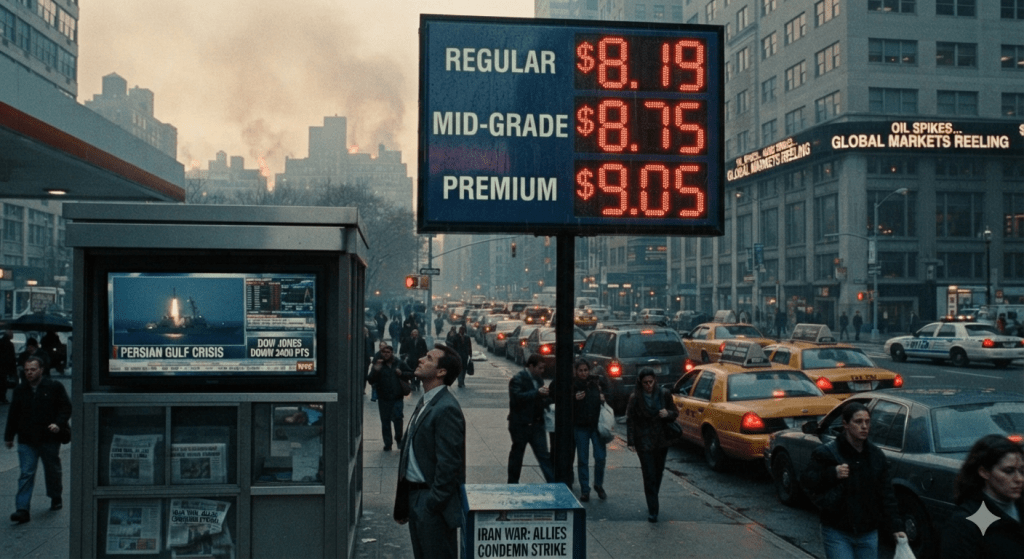
- The Gasoline Panic: Across the United States, automated systems at gas stations adjusted overnight. Digital signs across the country flashed terrifying numbers: $6.80, $7.50, and $8.20 per gallon. Long, anxious lines of vehicles began snaking down suburban avenues, reminiscent of the 1973 oil crisis.
- The Market Meltdown: The Dow Jones Industrial Average opened down a staggering 2,400 points. Automated circuit breakers tripped repeatedly, freezing trade, but failing to stop a global wipeout of trillions of dollars in equity value.
2. The Great Allied Schism
In Brussels, Tokyo, and New Delhi, the mood among traditional U.S. allies shifted from deep anxiety to outright hostility.
- Airspace Closed: The French, German, and Italian governments issued a joint emergency declaration: all U.S. military transports involved in the unilateral invasion of Iran were strictly banned from entering European airspace.
- The Gulf Dilemma: In Riyadh and Abu Dhabi, local authorities ordered their militaries to high alert—not to assist the Americans, but to seal their borders. Having been denied a say in a war launched from their doorstep, Gulf leadership quietly informed Washington that U.S. forces could no longer launch offensive sorties from regional bases.
3. The Eastern Counter-Move
The most dangerous developments, however, were unfolding in the capitals of the world’s nuclear-armed revisionist powers.
- Beijing’s Economic Weapon: China, seeing its primary source of energy unilaterally cut off by American warships, retaliated without firing a shot. The People’s Bank of China announced a massive, coordinated dumping of U.S. Treasury bonds and a total halt to the export of critical rare-earth minerals to the West.
- Moscow’s Proxy Delivery: In Russia, military cargo planes took off from southern airbases, loaded with advanced S-400 air defense components, intelligence officers, and electronic warfare jamming equipment. Their destination: Tehran’s domestic airfields, flying through a hastily secured Russian-Caspian corridor.
A Grim Foreboding: What Comes Next
As the morning progressed, the initial euphoria of a successful American military strike evaporated, replaced by the grim realization of a protracted, global nightmare. The world now stood on the precipice of a systemic, multi-front collapse:
- The Insurgency of the Mountains: While American armor easily secured Iran’s coastal flatlands, a massive, highly motivated military force of over one million regular and irregular Iranian troops withdrew into the rugged, impenetrable Zagros Mountains. Strategists knew what lay ahead: a brutal, asymmetric guerrilla war that would dwarf the casualties of Iraq and Afghanistan combined, with no exit strategy in sight.
- The Global Dark Age: With the Strait of Hormuz completely littered with smart sea mines and sunken hulls, 20% of the world’s energy supply was effectively locked away. Within weeks, manufacturing sectors across Europe and Asia would face mandatory rolling blackouts. Food supply chains, heavily reliant on diesel and oil-based fertilizers, would begin to break down, triggering acute shortages and hyperinflation across developing nations.
- The Collapse of the Dollar: De-dollarization, once a slow and theoretical concept, was suddenly forced into overdrive. Driven by pure survival, a newly formed economic bloc consisting of China, India, Russia, and major global suppliers announced the creation of an alternative, emergency financial system completely detached from the U.S. banking network.
- The Flashpoint of World War III: Most terrifyingly, the guardrails of the international order were gone. With American troops actively fighting on the Eurasian landmass against Chinese and Russian warnings, the likelihood of a miscalculation—a U.S. strike hitting a Russian advisor, or a Chinese naval escort clashing with an American destroyer in the Indian Ocean—rose exponentially.
The morning after the invasion did not mark the swift end of a rogue regime. Instead, it marked the first day of an unscripted, highly volatile era where the global economy lay broken, traditional alliances were dead, and the threat of an uncontainable global conflict loomed larger than it had in a generations.
That was the morning that Donald Trump took the whole world with him right over the precipice.
(Concluded)