by M.K.Sudarshan
August 18, 2026: Chennai, India
Characters:
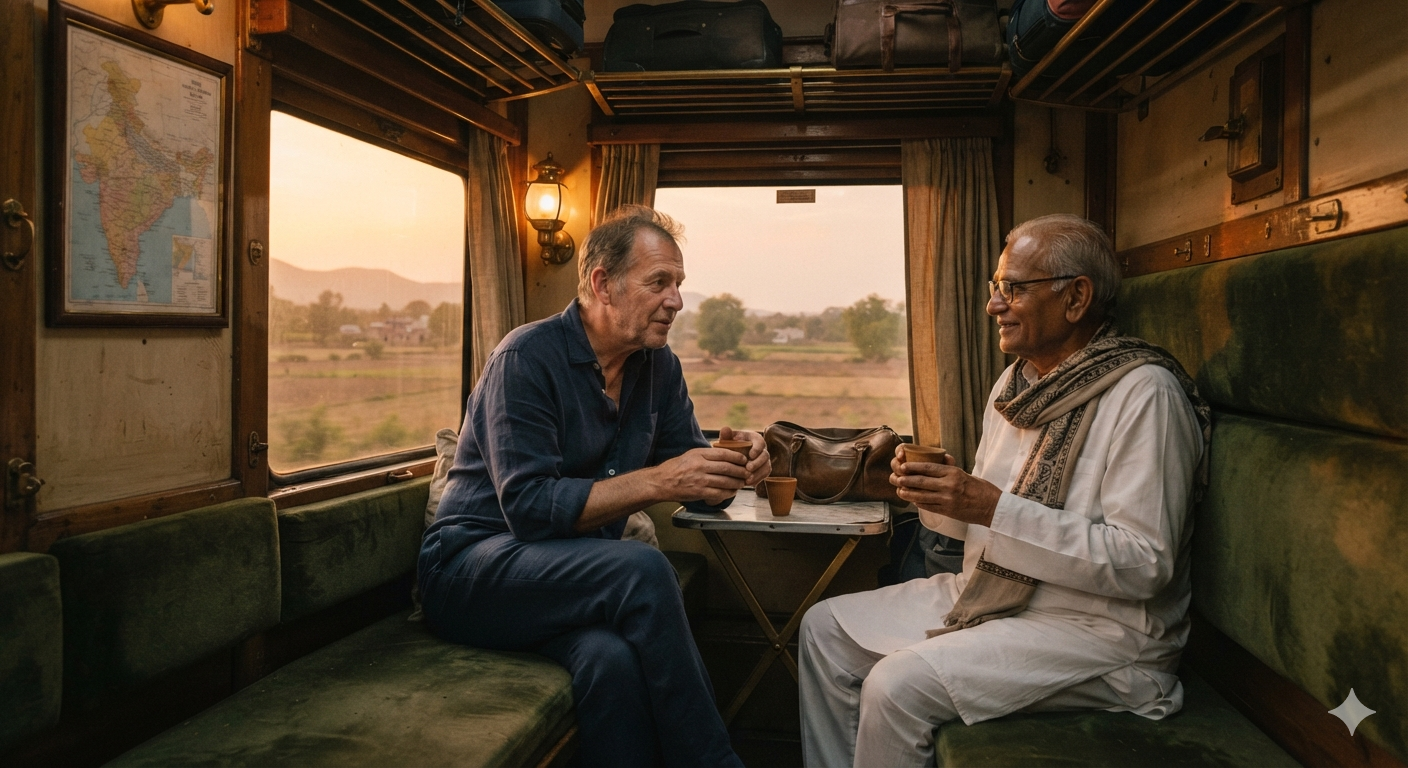
• DAVID — A middle-aged American student of Philosophy, on a year-long sabbatical in India visiting temples, gurus, and university professors.
• THE UNKNOWN SRI VAISHNAVA — A 70-year-old seeker of Vedantic truth, initiated into formal Vedaadhyaya but not a complete scholar, traveling incognito.

Setting:
A long train journey from Chennai to Tirupati. Late afternoon. The two men, strangers until an hour ago, sit across from each other in a non-AC sleeper compartment. David has been reading a copy of the Brahma Sūtras in translation. The Unknown Sri Vaishnava watches the passing landscape with quiet attention.
I. The Question That Will Not Rest
DAVID:
Excuse me—I couldn’t help but notice you’ve been observing me struggle with this text. I’m David, by the way. An American student of Philosophy. I’m on sabbatical, traveling through India to understand its philosophical traditions firsthand.
THE UNKNOWN SRI VAISHNAVA:
(with a gentle smile)
I am no scholar, sir. Just an old traveler on the same road as you. But if two passengers share a long journey, they may as well share a few thoughts. What troubles you in that book?
DAVID:
It’s not the book alone—it’s something deeper. I’ve been listening to Vedic chants in temples, at discourses, even in recordings. Some people are visibly moved—tears, stillness, a kind of awe. Others, including me, hear… sounds. Beautiful, perhaps, but not transformative.
Here is my question, and I ask it timidly because I’ve never received a candid answer: If the Veda is śabda-pramāṇam—cosmic sound, universal, apauruṣeya—shouldn’t it affect all human hearts the same way? Why does it resonate deeply for some and leave others untouched? Does that mean those who are unmoved are spiritually out of tune with Reality itself?
THE UNKNOWN SRI VAISHNAVA:
(nodding slowly):
You ask the question that has troubled many a sincere heart. And you are right to be troubled—it means you are not satisfied with easy answers. Let me tell you a story from my own life
II. The Story of Two Listeners
THE UNKNOWN SRI VAISHNAVA:
When I was a boy of ten, my father took me to a yāga in Kanchipuram. The ṛtviks chanted the Puruṣa Sūkta. I stood beside a elderly woman, a temple flower-seller, her hands rough from work, her sari simple cotton. As the chants rose, she began to weep silently. Her whole body trembled.
Beside her stood a learned pandit from the Sanskrit college, flawless in his own recitation, his mind clearly elsewhere—calculating his dakṣiṇā, perhaps, or thinking of his next meal.
The same sound entered both ears. One soul dissolved; the other remained dry.
Was the sound different? No. Were the ears different? Yes. But not in the way you think.
DAVID:
So you’re saying the problem is with the listener, not the Veda?
THE UNKNOWN SRI VAISHNAVA:
I am saying the Veda is like the sun. It shines on the open field, on the closed room, on the man who loves the light and the one who hides from it. The sun does not cease to be universal because a blind man does not see it.
The Veda’s universality is ontological—it is a feature of Reality itself. Its effect is phenomenological—it depends on the inner instrument, the antaḥkaraṇa, of the hearer.
III. Adhikāritva: The Question of Eligibility
DAVID:
But isn’t that elitist? To say only some are “eligible” to receive it?
THE UNKNOWN SRI VAISHNAVA:
(chuckles softly)
Eligibility is not a social club, my friend. It is a medical fact. If I give the finest medicine to a man who refuses to swallow it, or whose digestive fire is too weak to assimilate it, is the medicine at fault?
In our tradition, we speak of adhikāritva—spiritual eligibility. It is not birth alone, though birth may help. It is viveka (discrimination), vairāgya (dispassion), and mumukṣutva (desire for liberation). Without these, the Vedic sound may be heard but not received.
DAVID:
But what of the flower-seller in your story? Did she have these qualifications?
THE UNKNOWN SRI VAISHNAVA:
Ah! You catch me. She had no Sanskrit, no philosophical training. But she had something else: a heart purified by bhakti, by selfless service, by a lifetime of offering flowers to the Lord without expectation. Her saṃskāras—her past impressions—were aligned. The pandit’s were cluttered.
The Veda does not discriminate. But the vessel matters.
IV. Saṃskāra and the Tuning of the Soul
DAVID:
This brings me to another worry. I am a foreigner. My cultural conditioning is different. When I hear Vedic chants, they sound… alien. Sometimes even repugnant. Does that mean I am spiritually inferior? Or that the Veda is merely cultural noise for someone like me?
THE UNKNOWN SRI VAISHNAVA:
(leaning forward, eyes kind but sharp)
Let me ask you: when you hear Gregorian chant, or the Qur’ān recited, or Tibetan Buddhist bells, do you feel the same awe as a devotee of those traditions?
DAVID:
(pauses)
…No. I feel respect, perhaps curiosity. But not the same… homecoming.
THE UNKNOWN SRI VAISHNAVA:
Then you see. It is not that those sounds lack power. It is that your saṃskāras—your past impressions, your cultural and karmic conditioning—have not tuned your inner instrument to that frequency.
A Tamilian may find the Tevāram hymns of the Nayanmars deeply moving. A Bengali may feel the same about Rāmprasādī songs. A Punjabi about the Gurbāṇī. The sound is universal; the resonance is particular.
DAVID:
So you’re saying my lack of response is not a judgment on my spiritual capacity?
THE UNKNOWN SRI VAISHNAVA:
It is a diagnosis, not a condemnation. It tells you where your antaḥkaraṇa is now. It does not tell you where it may be after years of sādhana, of japa, of upāsanā.
The tradition is optimistic: saṃskāras are mutable. Adhikāritva can be cultivated. You are not fixed. You are a work in progress.
V. The Two Levels of Truth
DAVID:
But here is my philosophical worry. If the Veda is apauruṣeya—authorless, eternal, cosmic—shouldn’t its effect be immediate and universal? Why the need for all these conditions?
THE UNKNOWN SRI VAISHNAVA:
Ah! Now you touch the heart of Vedānta. We must distinguish two levels of truth:
• Vyāvahārika—the empirical, everyday level. Here, differences are real. People respond differently. Culture, psychology, saṃskāra—all matter.
• Pāramārthika—the absolute level. Here, śabda is identical with Brahman. Its universality is not empirically testable but metaphysically asserted.
At the absolute level, the Veda is the very breath of the Lord, inseparable from Him. At the empirical level, it is heard by ears, processed by minds, filtered by vāsanās.
To confuse the two is to fall into either dogmatism (“If you don’t feel it, you’re inferior”) or dismissal (“If many don’t feel it, it’s cultural noise”).
DAVID:
So the Veda’s universality is like… gravity? It exists whether or not I feel its pull?
THE UNKNOWN SRI VAISHNAVA:
(smiling)
Yes! Or like radio waves. They fill the room now. But without a receiver tuned to the right frequency, they are silence. The Veda is the cosmic broadcast. Your sādhana is the tuning of the receiver.
VI. The Role of Practice: Japa and Svādhyāya
DAVID:
But why, then, the emphasis on correct pronunciation, on japa, on svādhyāya? If the sound is cosmic, shouldn’t even a faulty recitation work?
THE UNKNOWN SRI VAISHNAVA:
Because the effect depends on the quality of the vibration you generate. A violin played out of tune still produces sound, but not music.
The tradition insists on ucchiṣṭa (correct pronunciation), nyāsa (ritual placement), and bhāva (intentional attitude) because these align your subtle body with the cosmic frequency. The same mantra, differently intoned or mentally approached, yields different effects.
This is why japa and svādhyāya are prescribed: the mind must be trained to attend to the subtle dimensions of śabda. The first exposure may be noise. The thousandth may be revelation.
DAVID:
So it’s not magic. It’s… discipline.
THE UNKNOWN SRI VAISHNAVA:
(nodding)
Discipline purified by bhakti. Without bhakti, it is mechanical. Without discipline, it is sentimental. Both are needed.
VII. A Candid Admission
DAVID:
May I be blunt?
THE UNKNOWN SRI VAISHNAVA:
Please. Bluntness is a virtue between travelers.
DAVID:
The tradition’s weakest point, it seems to me, is its pastoral communication. It asserts the Veda’s universality without preparing people for the fact that most will not feel it immediately. This leads to either dogmatism or dismissal.
THE UNKNOWN SRI VAISHNAVA:
(laughs softly, a sound of genuine appreciation)
You have pierced the heart of the matter with a single arrow. Yes. We have been poor teachers. We have said “The Veda is universal” without adding “But its salvific effect is conditionally manifest.”
We have created either spiritual pride in those who feel something, or spiritual shame in those who do not. Neither is helpful.
A more honest formulation would be: The Vedic śabda is universally present as a cosmic principle, but its effect is conditionally manifest, requiring adhikāritva, saṃskāra, and upāsanā. Non-responsiveness is a diagnostic, not a condemnation.
DAVID:
That… is the most candid answer I have ever received.
VIII. The Journey’s End
(The train slows as it approaches Tirupati station. The two men gather their belongings. The light outside is golden, the air thick with the scent of jasmine and dust.)
DAVID:
I must thank you. I came to India seeking answers. I leave this compartment with something better: a better perspective. I no longer see the Veda as a test I am failing, but as a call I am learning to hear.
THE UNKNOWN SRI VAISHNAVA:
(standing, adjusting his simple white dhoti and angavastram)
The Veda is not a club, my friend. It is a call. The call is universal. The hearing is cultivated. You are not outside the call. You are in the process of tuning your ear.
DAVID:
Will I ever hear it as the flower-seller did?
THE UNKNOWN SRI VAISHNAVA:
(pauses at the door, his eyes gentle but unflinching)
That is not for you to decide. Your task is to purify the vessel. The Lord will fill it in His time.
(He steps onto the platform, then turns back.)
One last thing: do not seek to feel the Veda. Seek to be the Veda. Let your life become the chant. Then the question of who hears what will dissolve.
DAVID:
(bowing slightly, a gesture he has learned in these months)
Thank you, swami.
THE UNKNOWN SRI VAISHNAVA:
(with a small, indulgent smile—never patronizing, always acknowledging)
I am no swami. Just an old traveler. Safe journeys, David. May your path be clear.
(He disappears into the crowd. David stands for a moment on the platform, the noise of the station around him, but his mind quiet. He looks down at the Brahma Sūtras in his hand, then closes the book gently. He does not open it again on the taxi ride to the temple. He simply watches the road, listening.)
[End of Dialogue]