by M. K. Sudarshan
September 2, 2026: Chennai, India
Are we using machines to become more human—or are we slowly becoming the kind of humans machines find easiest to use?
The question sounds theatrical, even alarmist. Yet it lies at the heart of our modern existence. The machine is no longer merely in the factory, on the road, or in the field. It is in the hand, on the desk, in the home, in the school, in the hospital, in the marketplace, and increasingly in the mind’s daily traffic of reading, remembering, choosing, and judging.
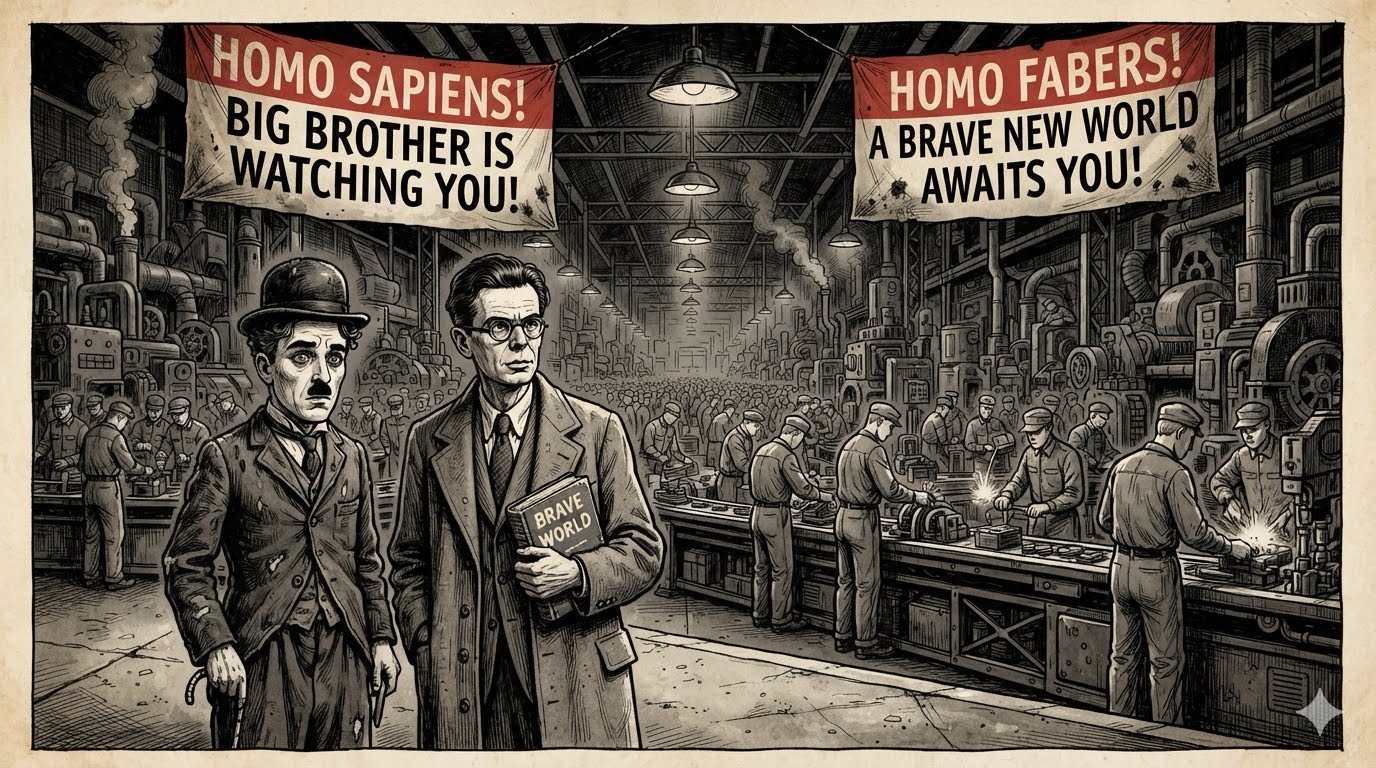
We have always been makers. Man is born Homo sapiens—the knowing, discerning being—and becomes Homo faber—the making, tool-fashioning being. The first asks, “What is true? What is good? What is worth doing?” The second asks, “How can this be made? How can it be done faster, larger, more efficiently?” Human civilisation depends upon both. But our crisis begins when the second question silences the first.
The two men within us
There is no human civilisation without tools. The first stone sharpened into a blade, fire brought under control, the wheel, the plough, the loom, writing, printing, the steam engine, electricity, the computer—each enlarged the range of human possibility. Humanity did not cease to be human when it made tools; rather, it became distinctively human through its capacity to make, preserve, transmit, and improve them.
In this sense, Homo faber is not the enemy of Homo sapiens. The maker is one expression of the wise being. The hand obeys the mind; the instrument serves a human purpose; technical power is directed by moral judgment. Philosophers of technology have argued that human life and technical invention have always evolved together: tools are not external ornaments but extensions of memory, capacity, and imagination.
But an extension can become an encroachment. When the machine grows in power, speed, complexity, and authority, a dangerous reversal becomes possible. The maker begins to serve what he has made. The tool acquires the dignity; the tool-user loses it.
Chaplin’s terrible comedy

Charlie Chaplin saw this reversal with unmatched comic force in Modern Times (1936). His Tramp works on an assembly line, tightening bolts at a relentless pace. The machinery accelerates; the worker’s body struggles to keep rhythm; his hands continue their mechanical movement even after he has left the line. Comedy becomes anguish.
The scene is memorable not because Chaplin hated machines. It is memorable because he understood that a factory can turn a man into an attachment of the machine. The worker is no longer a person with a body that tires, a mind that wanders, a life that needs time, and a dignity that deserves regard. He becomes a replaceable motion in an industrial sequence.
That is Human Abasement by the Machine: not merely hard work, but work stripped of agency, proportion, recognition, and meaning.
The same film also contains the grotesque feeding machine—an invention intended to eliminate the worker’s lunch break and increase output. Its absurdity discloses a permanent temptation of technological society: if an activity cannot be measured as productive, it is treated as waste. Rest becomes waste. Conversation becomes waste. Leisure becomes waste. Reflection becomes waste. Eventually, the human being himself becomes waste whenever he cannot keep pace.
Huxley’s more subtle nightmare
Aldous Huxley’s Brave New World presents a more polished and more frightening possibility. Chaplin’s worker suffers visibly; Huxley’s citizens are trained not to notice their servitude. The World State does not rely principally on terror. It manufactures contentment through biological engineering, conditioning, distraction, consumption, and pleasure. Individuality is inconvenient because it interferes with social stability; depth is inconvenient because it brings conflict; memory is inconvenient because it makes comparison possible.
Huxley’s warning is not against science in itself. It is against scientific and technical power when it becomes detached from a serious idea of what a human being is. A society may become astonishingly efficient, healthy, entertained, and orderly—and yet grow incapable of freedom, grief, love, moral courage, artistic seriousness, or independent thought.
The most complete enslavement may not be enforced with chains. It may arrive as convenience.
The dignity of the tool
Yet it would be foolish, and unjust, to speak of machines only as oppressors. A machine can give dignity as surely as it can take it away.
Put a lawn mower into the hands of a gardener, and the person does not merely cut grass faster. Bodily exhaustion is reduced; a larger field of work becomes manageable; the worker may gain skill, income, and a professional sense of command. Give a domestic worker a vacuum cleaner, and a task long associated with physical drudgery becomes less punishing and more efficient. Give the clerk a computer, the rickshaw puller an auto-rickshaw, the farmer a pump, the surgeon a precise instrument, the researcher access to digital archives—and each may acquire new powers over time, distance, labour, knowledge, and circumstance.
This is Human Dignity through the Machine. The machine does not replace the person; it enlarges the person’s effective freedom. It saves strength without extinguishing skill. It makes work safer without making the worker invisible. It offers competence without stripping away judgment.
The moral distinction is simple but profound: a humane machine gives a person more mastery over life; an inhumane system gives the machine more mastery over the person.
When progress turns against wisdom
The danger comes when Homo faber evolves brilliantly but not wisely. We become ever more competent at making, measuring, predicting, connecting, automating, and optimising. But we may become less competent at asking whether the thing made deserves to be made; whether the efficiency gained is worth the freedom lost; whether the convenience offered is quietly training us to surrender attention, privacy, judgment, and responsibility.
This is the real question posed by artificial intelligence. AI may help the doctor notice patterns, the scholar organise material, the disabled person communicate, the translator bridge languages, the farmer forecast conditions, and the writer overcome routine obstacles. Its potential for assistance is real.
But AI may also encourage a different social order: one in which workers are continuously measured; students cease to learn how to think; readers cease to distinguish truth from plausible imitation; citizens allow opaque systems to make decisions that demand human accountability. A human being then risks being reduced to a data profile—predictable, marketable, manageable, and increasingly disposable.
Pope Francis expressed the point with great clarity: human dignity depends on preserving proper human control over decisions made by artificial-intelligence systems. To surrender decisions about one’s own life to machines is to surrender something fundamental in human agency.
The quiet danger
Machine enslavement need not look like Chaplin being dragged through the gears. It may look much gentler.
It may be the person who cannot endure a moment without a screen. It may be the student who submits generated answers without undergoing the difficult inward labour of thought. It may be the employee whose workday is governed by invisible metrics. It may be the driver whose livelihood is controlled by an app, the reader whose tastes are moulded by recommendations, or the citizen whose fears and prejudices are quietly cultivated by algorithmic feeds.
None of these persons is necessarily forced. That is precisely why the danger is subtle. A chain that is comfortable is still a chain if it removes the power to choose, to refuse, to attend, to judge, and to act.
The question, therefore, is not simply whether machines make life easier. They often do. The deeper question is: What human capacities become weaker when life becomes too easy to examine?
Restoring the order
The proper order is not machine versus man. It is not a romantic return to the sickle, the handloom, the horse cart, or the pre-digital world. Such nostalgia ignores the dignity gained when arduous labour is relieved and knowledge becomes widely accessible.
The proper order is this:
Homo sapiens must remain sovereign over Homo faber.
Wisdom must guide ingenuity. Judgment must govern calculation. Human ends must determine technical means. Work must remain proportioned to human life, not human life to the demands of work. The machine must be answerable to the worker, the citizen, the patient, the child, the old person, and the community—not merely to the owner, the market, or the metric.
A society that remembers this will use machines to release time for thought, friendship, art, care, learning, and civic participation. A society that forgets it will use machines to extract more output, more data, more obedience, and more consumption from increasingly exhausted people.
The question for each of us
The final issue is personal as well as political. Each of us must ask, not with panic but with honesty:
Am I using this machine to deepen my life, or is it using me to thin it out?
Does it enlarge my attention, or fragment it? Does it assist my judgment, or relieve me of the need to judge? Does it strengthen fellowship, or replace living relationships with managed signals? Does it create time for self-respect, reflection, and meaningful work—or does it turn my hours into material for someone else’s system?
Man became Homo faber because he was Homo sapiens. He made tools because he could imagine ends beyond immediate necessity. He must not now become less wise because his tools have become more clever.
The machine can dignify humanity. The machine can abase it. The difference lies neither in iron nor in code, but in whether human beings remain awake—awake to their freedom, their responsibility, and the irreducible dignity that no machine can either create or rightly command.
(Concluded)
